
Vegetarian food is not always halal. Plants, eggs and dairy are permissible in Islam, so most vegetarian food is halal-friendly. But vegetarian labels still allow alcohol, wine-based ingredients and shared cooking equipment. Check for those three things, or look for halal certification, before you treat a vegetarian product as halal.
You're at a café or a work lunch where the meat isn't halal. The vegetarian wrap looks like the safe pick, and often it is. But the green "V" on the pack was never designed to check halal standards.
Can Muslims Eat Vegetarian Food?
Yes. Muslims can eat vegetarian food as long as it contains no haram (forbidden) ingredients. The Quran's main food prohibitions are carrion, blood, pork and meat offered to other than Allah, as set out in Surah Al-Baqarah 2:173.
Intoxicants are also forbidden. Surah Al-Ma'idah 5:90 names khamr (intoxicating drink) as something to avoid. A meat-free meal already leaves out most of this list.
The Islamic Foundation of Ireland sums it up in its guide to halal food and certification: vegetarian food is acceptable for Muslims if it is free from alcohol and other haram ingredients. That "if" is what you need to check.
Is Vegetarian Food Always Halal?
No, because vegetarian rules and halal rules check different things. UK law has no fixed legal definition of "vegetarian" or "vegan". Industry guidance fills the gap, as the Food and Drink Federation's labelling guidance (last reviewed August 2023) explains.
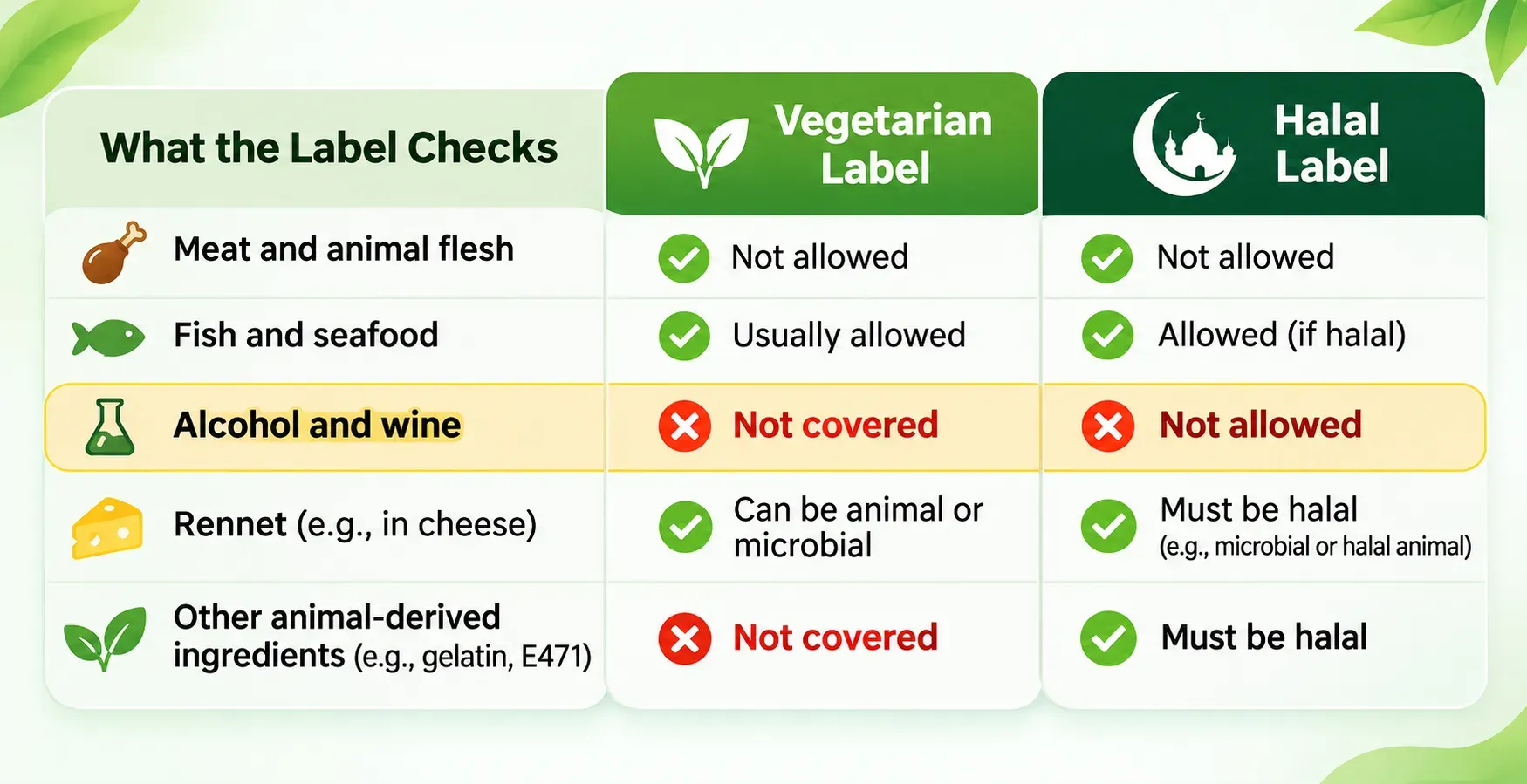
Even the strictest UK scheme leaves a gap. The Vegetarian Society Approved criteria ban animal rennet, gelatine, insects and shellac, but they don't mention alcohol. So a product with a vegetarian trademark can still contain wine or spirits.
Halal vs Vegetarian: What Each Label Checks
What's checked | Vegetarian Society Approved | Halal certification |
|---|---|---|
Pork, lard, pork gelatine | Not allowed | Not allowed |
Other meat and poultry | Not allowed | Allowed if slaughtered the halal way (zabiha) |
Animal rennet in cheese | Not allowed | Depends on the animal source |
Insects, e.g. carmine (E120) | Not allowed | Scholars differ |
Alcohol and wine | Not covered | Added alcohol not allowed; trace limits vary by fatwa body |
Eggs and dairy | Allowed (free-range eggs only) | Allowed |
Cross-contamination | "Reasonable and practicable" steps required | Separation from haram material required |
4 Things That Can Make Vegetarian Food Doubtful or Non-Halal
Most vegetarian products pass. These four issues cause most of the problems.
1. Added Alcohol
Wine in risotto and pasta sauce, beer in batter, rum in fruit cake and liqueur in desserts are all vegetarian. Halal certifiers and mainstream scholars treat alcohol added this way as non-halal.
Flavourings are a grey area. Many flavour extracts use ethanol (drinking alcohol) as a solvent. Singapore's MUIS Fatwa Committee allows ethanol that isn't made from khamr, but only for flavouring. The limits are 0.5% in the flavouring and 0.1% in the final product.
Malaysia's National Fatwa Council set a 0.5% limit for the final product at its July 2011 meeting, as the Federal Territory Mufti's office explains. Some scholars reject any added alcohol at all, so flavourings often fall into the Doubtful category. For more detail, read our guide to ethyl alcohol in halal food.
2. Wine Vinegar and Wine-Based Ingredients
Red wine vinegar, balsamic vinegar and some mustards and dressings are made from wine. Scholars agree that wine which turns into vinegar on its own is permissible. They disagree when the wine is deliberately turned into vinegar, as IslamQA's answer on wine vinegar sets out.
Some specialty vinegars also have wine or grape must added back after fermentation. That brings the alcohol question back, so read the full ingredients list.
3. Cheese, Whey and Enzymes
Rennet is the enzyme that curdles milk into cheese. Vegetarian cheese uses microbial or plant rennet, which avoids the slaughter question. The Vegetarian Society accepts vegetarian rennet and excludes animal rennet.
The risk is cheese, whey or enzymes in products that carry no vegetarian or halal mark. In those products the rennet may come from an animal that wasn't slaughtered the halal way. If the source isn't stated, treat the product as Doubtful until you confirm it.
4. Cross-Contamination
Vegetarian rules allow small accidental traces. A 2021 joint statement from FoodDrinkEurope and the European Vegetarian Union, quoted in the FDF guidance, says unintended traces should not stop a product being labelled vegetarian or vegan, as long as production follows best practice.
Restaurants are the bigger worry. A veggie burger may share a grill with bacon, or chips may go in the same fryer as non-halal chicken. Ask the staff before you order.
Is Vegan Food Halal?
Vegan food is closer to halal than vegetarian food, but it isn't automatically halal. Vegan products contain no animal ingredients at all, so rennet, gelatine, carmine and shellac are ruled out.
Alcohol is still allowed. Vegan wine, beer and spirits are common, and a vegan sauce can be wine-based. The Vegan Society's trademark standards also allow up to 100ppm (parts per million) of accidental animal-based contamination.
So the same two checks apply: alcohol and cross-contamination.
How to Check Vegetarian Food With Halal Scanner
Start with three checks you can do without any app:
- Scan the label for alcohol words: wine, beer, rum, brandy, sherry, liqueur, mirin, "alcohol" or "ethanol".
- Look for a halal logo from a recognized certifier, such as HFA or HMC in the UK or IFANCA in the US.
- Ask in restaurants whether the fryer and grill are shared, and whether sauces contain wine.
Labels are long, and the same doubt comes up every week. Here's the quicker way:
- Download Halal Scanner. It's free on iOS and Android.
- Scan the barcode on the pack with your phone camera.
- Read the result. Every product comes back as Halal, Doubtful or Non-Halal.
- Look closer at Doubtful results. The product has an ingredient whose source or alcohol content isn't confirmed. Decide using your own scholar's view, or contact the manufacturer.
- No barcode? Use the text search to look up a single ingredient.
The scan takes less time than reading the label. Download on the App Store or get it on Google Play.
Why Shoppers Use Halal Scanner
- 1 million+ verified products in the database
- 100,000+ scans every day
- 500,000+ users
- 50+ countries covered
Halal Scanner checks ingredients against verified halal data sources. It's a research tool, not a halal certifier.
The Bottom Line
Vegetarian food is a good starting point for Muslims, but the vegetarian label only tells you that the food has no meat. It doesn't tell you whether there's alcohol or a shared fryer. Check for alcohol, wine vinegar, unmarked cheese and cross-contamination, and you'll avoid most problems.
When you don't have time to read every label, scan it. Halal Scanner is free to download on the App Store and Google Play. You can find more guides on the Halal Scanner blog.