
The best halal food in the USA is clustered in the New York City metro, New Jersey, metro Detroit, the Chicago area and the Washington, D.C. region. "Best" also has to mean verified. Look for a named certifier such as IFANCA, ISA, HFSAA or HMS, and check it against the standard you follow before you order.
Picture a family visiting a new city. The cart says "halal," the menu says "zabiha," and nobody on shift knows who certified the chicken. With about 3.45 million Muslims living in the US as of Pew Research Center's 2017 estimate, that moment happens every day.
This guide shows where the strongest halal food scenes are and how to check a halal claim yourself. It covers the certifiers behind the logos and the state laws that back you up.
Please note: This guide is for general information. Halal Scanner is a verification tool, not a halal certifying body and not a source of religious rulings. Confirm a restaurant's status with its certifier, and follow your own scholar on questions of standard.
If you also buy halal groceries, Halal Scanner checks packaged food by barcode in seconds. It is free to download on the App Store and Google Play.
Where Is the Best Halal Food in the USA?
The biggest halal dining scenes sit where US Muslim communities are largest and where halal claims are easiest to check. New York, New Jersey and Michigan stand out on both counts. Pew projects the US Muslim population will reach 8.1 million by 2050, so these scenes keep growing.
Area | Why it stands out | How to verify a claim there |
|---|---|---|
New York City metro | HMS lists 80 restaurants it currently certifies as hand-slaughtered zabiha, across NYC, Long Island and northern NJ | Search the New York State halal registry |
New Jersey | First state to pass a halal consumer protection law, in 2000 | Read the halal disclosure every seller must post on the premises |
Dearborn and metro Detroit, MI | 54.5% of Dearborn residents reported Middle Eastern or North African ancestry in the 2020 Census | Michigan law bans false halal claims and lets the state agriculture department investigate |
Chicago area, IL | Home base of IFANCA, one of the oldest US certifiers (Des Plaines, IL) | Illinois requires halal dealers to register and disclose their certifier |
Washington, D.C. and Virginia | Three of the 10 spots in The Halal Times' 2025 list are in Virginia | Virginia requires certain unwrapped halal food to name the authority behind the claim |
Popularity lists help you discover places. They do not tell you who certified the meat, and that is the question this guide answers next.
How Do You Know a US Restaurant Is Really Halal?
Ask who certified it and what standard that certifier uses. The USDA's food safety agency does not define religious standards such as halal, so the certifier is your main evidence. These four checks work without any app:
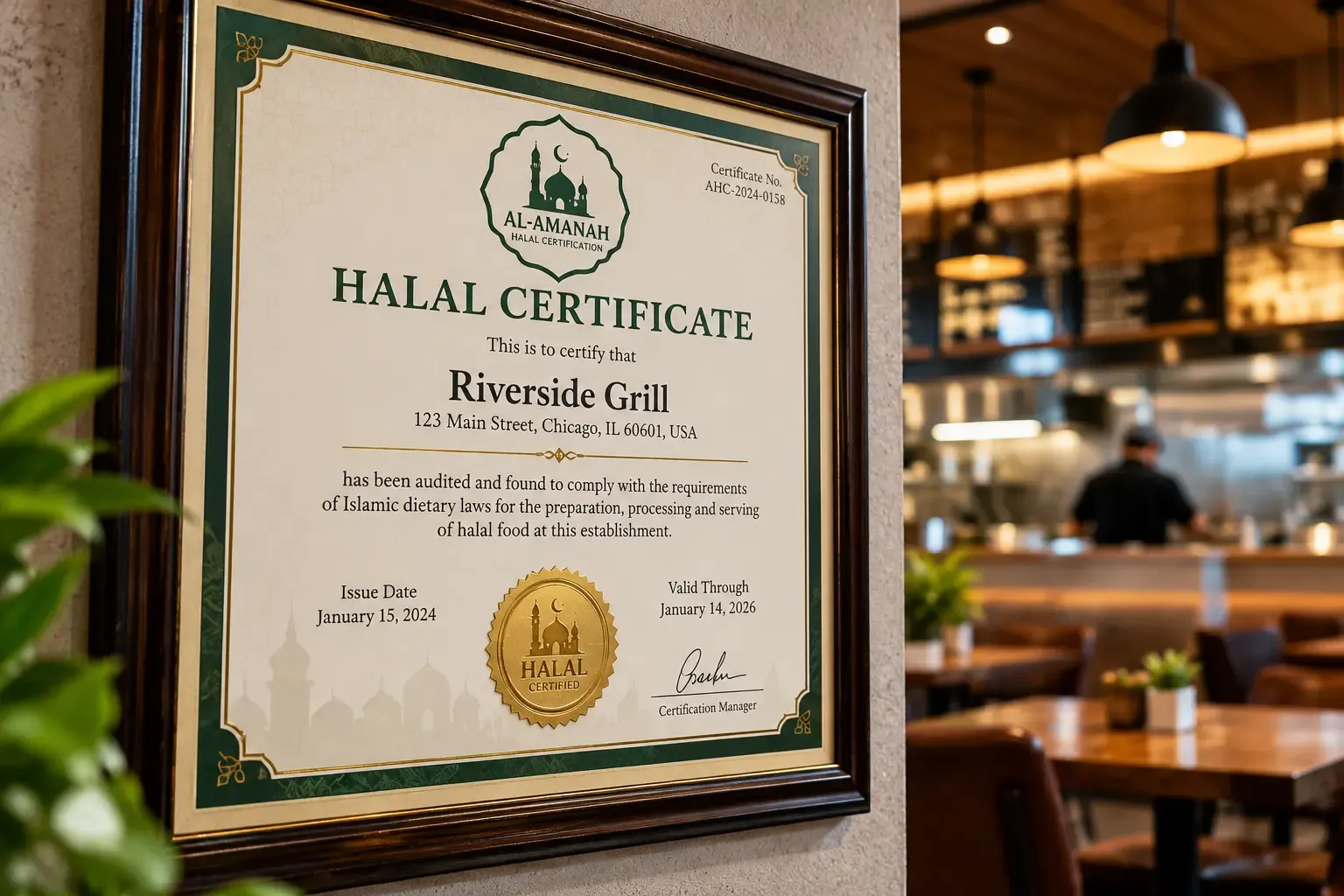
- Find the certificate. A real one names the certifier and shows an expiry date. A bare "halal" sign with no name is a marketing claim.
- Check the certifier's directory. HMS, for example, shows a "valid through" date for each restaurant it lists.
- Ask about the kitchen. Ask who supplies the meat, whether fryers are shared, and whether sauces use wine or other alcohol. Our guide to ethyl alcohol in food explains where scholars differ on this.
- Use the state's records. In New York, search the state registry. In New Jersey, read the posted disclosure.
Some restaurants make this easy. The Halal Guys, which started as a New York food cart in 1990, posts the halal certificates for its chicken and beef gyro on its website. That level of openness is worth asking for anywhere you eat.
What Is the Difference Between Halal and Zabiha?
Halal means permissible. Zabiha refers to the Islamic method of slaughter. In North America, "zabiha" has no legal definition that requires hand slaughter, according to Islamic Services of America.
Scholars and certifiers differ on two points: machine slaughter of poultry and stunning before slaughter. Some US certifiers accept one or both under conditions; others require hand slaughter for every animal. Neither view is imposed here. Choose the certifier whose standard matches the one you and your scholar follow.
Certifier | Founded / based | What its mark tells you |
|---|---|---|
1982, Des Plaines, IL | The Crescent M mark on packaged foods; standards published on its website | |
1975, Cedar Rapids, IA | The oldest halal certifier in North America; certifies meat, poultry and ingredients | |
United States | Focuses on hand-slaughtered, non-stunned meat, per HalalSpy's certifier comparison | |
Shariah Board of America | Certifies and monitors hand-slaughtered zabiha meat from slaughterhouse to restaurant |
The same logos appear on supermarket packaging. When you are in the aisle instead of a restaurant, Halal Scanner reads the barcode and shows the product as Halal, Doubtful or Non-Halal.
Which US States Protect Halal Food Buyers?
Eleven states have halal-specific laws, according to a state-by-state review by Halal Watch World dated August 27, 2026. These laws punish false halal claims and require disclosure. They do not decide which halal standard is correct.
State | What the law covers | Official source |
|---|---|---|
California | Fraud and false halal claims, including restaurant meals | |
Illinois | Dealer registration and certifier documentation | |
Maryland | Posted statements on halal handling practices | |
Michigan | False claims and signage where halal and non-halal food are both sold | |
Minnesota | False or deceptive halal representations | |
New Jersey | Posted disclosures, records and a halal fraud unit | |
New York | Registration of sellers and certifiers, public registry | |
Texas | Clear labeling where halal and non-halal meat are both sold | |
Utah | Filing rules for religious slaughter without stunning | |
Virginia | Naming the authority behind a halal designation | |
Washington | Penalties for knowingly false halal claims |
New York's registry is the largest public tool of its kind. The state reported in December 2024 that more than 1,300 halal and kosher establishments were registered. Laws change, so open the official source before you rely on a rule.
Are Fast Food Chains Halal in the USA?
No national fast-food chain is halal at every US location, according to HalalVouch's chain-by-chain check dated September 17, 2026. Some individual franchise stores serve certified meat, so treat each location on its own.
Meat-free items such as fries can still be doubtful. The ingredients may be fine, but a shared fryer or unknown preparation leaves the item uncertain. In Islamic terms, that is mashbooh, and many Muslims avoid it until they know more.
How to Check Halal Groceries With Halal Scanner
Halal Scanner checks packaged food, not restaurant kitchens. Use it for snacks, sauces and staples between meals out, and anywhere a label has codes you do not recognize.
- Download the app. Halal Scanner is free to download for iPhone and Android.
- Scan or search. Point your camera at the barcode, or type an ingredient such as "E471" or "gelatin."
- Read the result. Each product shows as Halal, Doubtful or Non-Halal.
- Handle Doubtful results. Check the ingredient source with the maker or the certifier, then decide with your own standard.
- Share a list. Save products to a shared halal list so one person plans the shop and another buys from it.
Traveling between cities? The app's Islamic tools include Mosque Finder, Prayer Times and Qibla direction.
The scan takes less time than reading the label. Download free on the App Store or Google Play.
Why Shoppers Use Halal Scanner
Halal Scanner's database covers more than 1 million verified products across 50+ countries. The app handles 100,000+ scans a day for over 500,000 users, according to Halal Scanner. Every result uses the three-state model, so you see when an answer is genuinely uncertain.
The Bottom Line
The best halal food in the USA is easy to find in New York, New Jersey, Dearborn, Chicago and the D.C. region. Trust comes from the certifier, not the sign. Check the certificate, match the standard to your own, and use state registries where they exist.
For everything you buy in a store, Halal Scanner gives you an answer in seconds. It is free to download on the App Store and Google Play.
Run a restaurant or food brand? Learn about partnering with Halal Scanner.