
A food truck is truly halal when its meat comes from a halal-certified supplier, nothing haram shares its grill or fryer, and its sauces and buns are free of doubtful ingredients. The word "Halal" painted on the side proves none of that. Check for a named certifier, ask two questions, and verify packaged extras yourself.
It's 12:40 on a weekday. The truck on the corner has a green HALAL banner, twenty people in line, and chicken over rice that smells exactly right. You have three minutes before you reach the window, and no idea who supplied that chicken.
That gap is normal, not rare. Zabihah's FAQ notes that only a small minority of halal restaurants seek formal certification. Most ask you to take their word for it.
What Does "Halal" Mean on a Food Truck?
On a food truck, "halal" is a claim, not a guarantee. The US has no federal halal standard, so the word can mean anything from certified hand-slaughtered meat to "we don't sell pork."
Demand keeps growing. Pew Research Center estimated 3.45 million Muslims lived in the US in 2017, about 1.1% of the population. More customers means more trucks using the word, and not all of them mean the same thing by it.
A certified truck has been checked by a third party, such as the Islamic Food and Nutrition Council of America (IFANCA) or the Halal Food Standards Alliance of America (HFSAA). A self-declared truck has not. Both can be honest, but only one can show you proof.
Process | Certified halal truck | Self-declared "halal" truck |
|---|---|---|
Who checked it | A named certifier audits the supplier and kitchen | The owner's own word |
What you can ask to see | Certificate with certifier name and expiry date | Supplier name, sometimes an invoice |
Slaughter method | Set by the certifier's published standard | Unknown until you ask |
Shared grill or fryer | Usually covered by the audit | Unknown |
Your next step | Confirm the certificate is current | Ask the two questions below |
Some states add legal backup. New Jersey passed the first Halal Food Consumer Protection Act in 2000. New York requires halal sellers and certifiers to register with the state. Michigan, Minnesota, California, Illinois, Texas and Washington have their own halal fraud laws.
How Can You Tell If a Halal Cart Is Really Halal?
Ask two questions at the window: who supplies your meat, and is the chicken hand-slaughtered or machine-slaughtered? Zabihah recommends exactly these two. A quick, specific answer is a good sign. A vague "it's all halal" means look closer.
Then take ten seconds to look around:
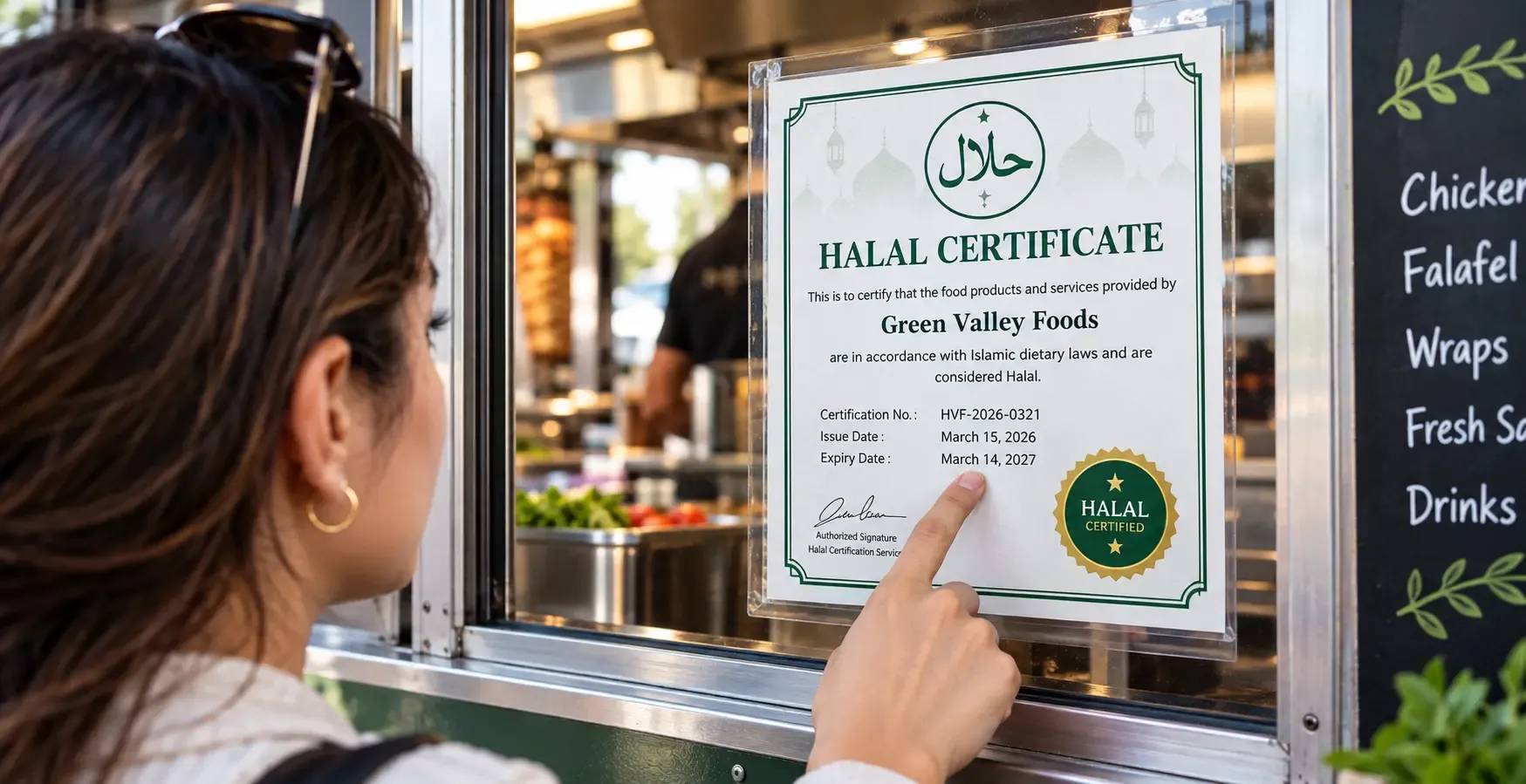
- The certificate. It should name the certifier and show a valid date. Certificates expire, and an old one taped to the window proves nothing about today.
- The rest of the menu. If the truck sells a cheesesteak, pepperoni or bacon, ask whether that meat is halal and whether it cooks on the same flat-top.
- The fryer. Halal fried chicken, broast and fries share oil. If non-halal items go in the same fryer, many Muslims treat everything in it as affected.
- Alcohol. Trucks at festivals sometimes sell beer from the same window.
Hand-Slaughtered vs. Machine-Slaughtered Chicken
This is a real scholarly difference, not a trick question. Some certifiers accept mechanical poultry slaughter under set conditions, while others require hand slaughter for every bird. IFANCA's published standard allows mechanical poultry slaughter with conditions. HFSAA focuses on hand-slaughtered zabiha.
Neither position is "the" Muslim view. Follow the standard you and your scholar hold, and choose trucks whose certifier matches it.
Are the Sauces and Buns Halal Too?
Not automatically. The meat gets the attention, but sauces, buns and desserts often contain ingredients with more than one possible source. Those land in the Doubtful (mashbooh) category until you know the source.
- White sauce. It's usually mayonnaise-based. Some flavorings use alcohol as a carrier, and scholars differ on trace amounts. Our ethyl alcohol guide covers both views.
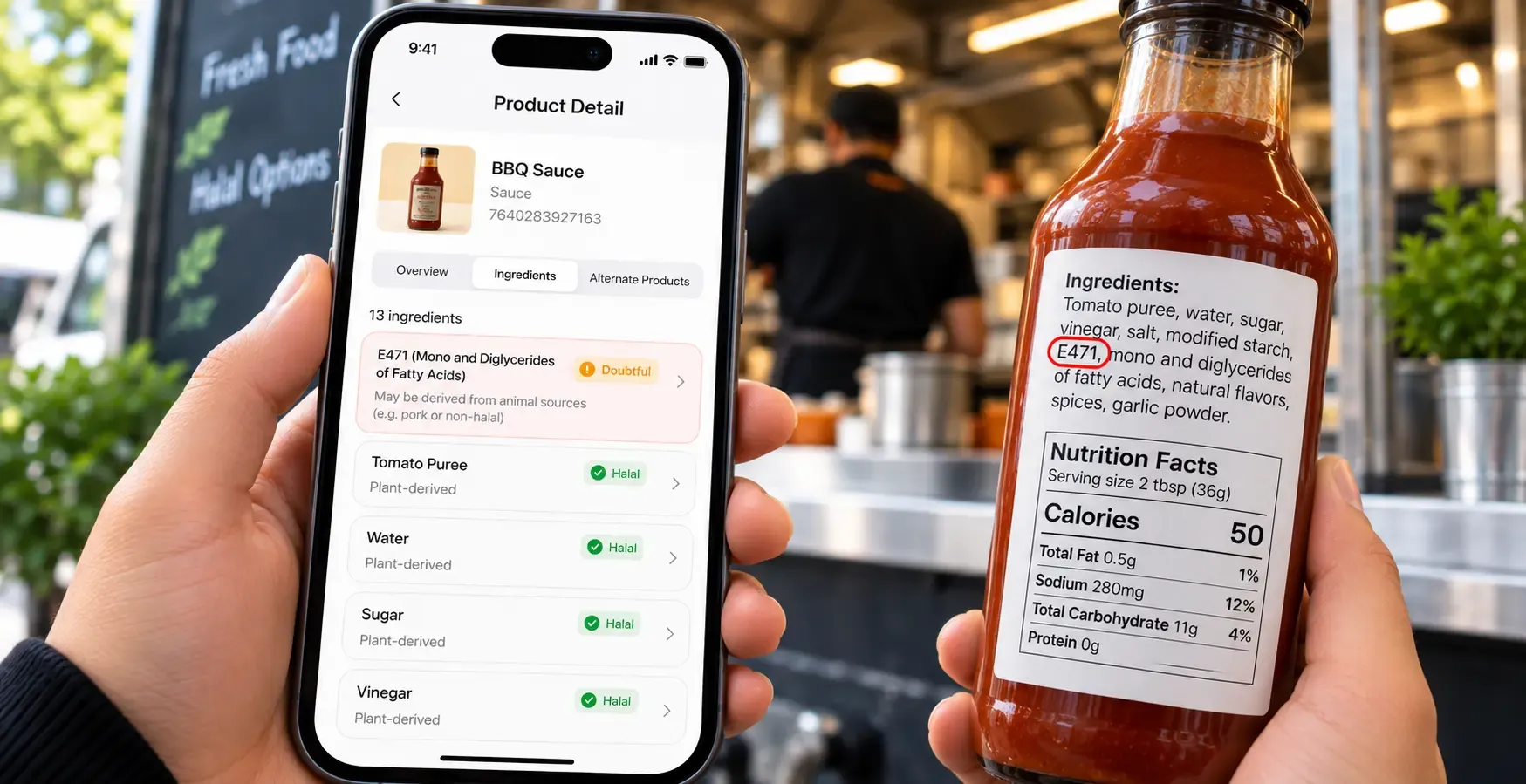
- Buns and pita. Mono- and diglycerides (E471) can come from plants or animal fat. The dough conditioner L-cysteine (E920) can come from poultry feathers or from fermentation. Labels rarely say which.
- Desserts. Gelatine in puddings or gummies may be pork, beef or fish. If the label doesn't specify, treat it as Doubtful.
The bottled hot sauce, chips and canned drinks at the window all have barcodes. Scan them in Halal Scanner and see Halal, Doubtful or Non-Halal for that exact product. The app is free to download.
How to Check This With Halal Scanner
Halal Scanner can't inspect a truck's kitchen or meat supplier. What it can do is check every packaged item you're unsure about, from the sauce on the counter to the groceries you buy to make chicken over rice at home.
- Download Halal Scanner. It's free to download, with premium features via subscription.
- Scan the barcode on any packaged item, or type an ingredient into the text search.
- Read the result: Halal, Doubtful or Non-Halal.
- Handle Doubtful results by your own standard. Look up the specific ingredient, then decide with your scholar or ask the truck which brand they use.
- Save trusted items to a shared halal list so your family shops from the same checked list.
The scan takes less time than reading the label. Download free on the App Store or Google Play.
Why Trust Halal Scanner's Results?
Halal Scanner cross-references ingredients against verified halal data sources. According to Halal Scanner, its database holds 1 million+ verified products, handles 100,000+ daily scans, covers 50+ countries, and serves 500,000+ users.
It's a research tool, not a certifier. For a truck's cooked food, a current certificate from a recognized body is still your strongest proof. The app covers what the certificate doesn't: the packaged products around it.
Finding Halal Chicken Spots and Shawarma Near You
A "halal near me" search shows what's open, not what's certified. Whether you want a halal chicken sandwich, broast, shawarma or a late-night spot, cross-check results against a certifier's own directory before you go.
Halal Monitoring Services (HMS) certifies hand-slaughtered zabiha meat at restaurants and grocers in 26 US states, and lists them by city. Zabihah lets you filter for fully halal menus and hand-slaughtered meat. The two window questions still apply at a drive-thru.
The Bottom Line
A halal sign starts the conversation; it doesn't end it. Look for a named, current certificate, ask who supplies the meat and how the chicken is slaughtered, and watch the fryer. For everything with a barcode, download Halal Scanner, which is free to download, and check it in seconds.
Run a halal truck or restaurant? See how partnering with Halal Scanner can help Muslim customers find you.