
Plain chocolate made from cocoa, cocoa butter, sugar and soy lecithin is widely treated as halal. A bar turns doubtful or non-halal because of what gets added: whey from animal rennet cheese, animal-fat emulsifiers, alcohol-based flavors, liqueur fillings or gelatine. So check the label, or a named halal logo, before you buy.
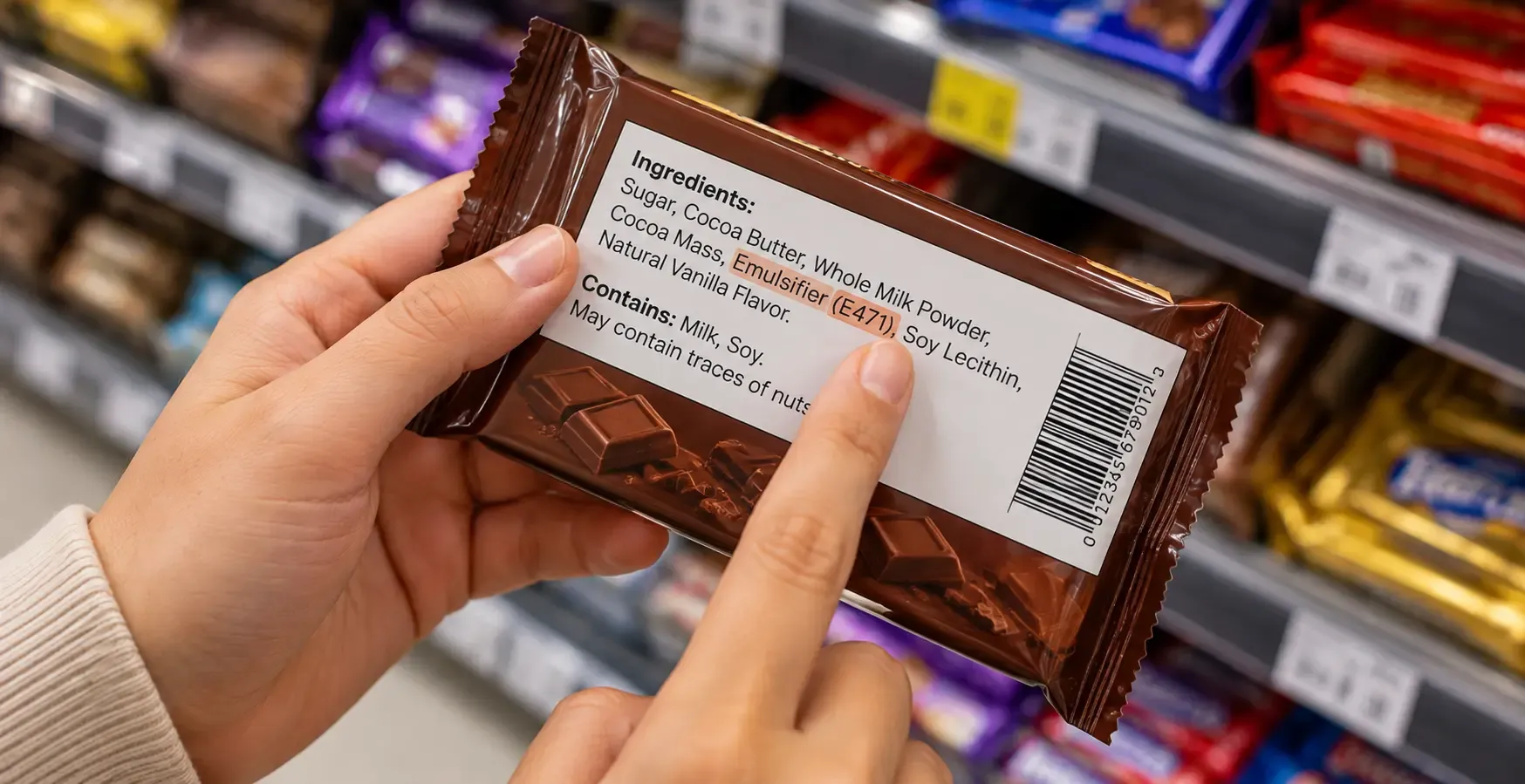
Picture yourself in a checkout line at a US pharmacy. Your child holds up a caramel bar. There’s no halal logo, and the label lists “whey,” “mono- and diglycerides” and “natural flavor.”
None of those words tell you where the ingredient came from. US labels don’t use E-numbers, and they rarely name a source. This guide shows what to check, how to find certified brands, and what to do when the label leaves you guessing. For logos and certifiers in general, start with our guide to halal certification in the US.
Short on time? Scan the barcode in Halal Scanner and get a Halal, Doubtful or Non-Halal result. It’s free to download, with premium features by subscription.
Is chocolate halal?
Chocolate starts out halal-friendly. Cocoa is a plant, and the basic recipe of cocoa mass, cocoa butter and sugar has no animal or alcohol inputs. The risk sits in the extras.
That risk isn’t only on paper. A 2021 study in the Asian Food Science Journal tested 42 imported confectionery samples in Bangladesh and found pork DNA in two of them. The authors suggested animal-based lubricants in packaging as one possible cause.
So a clean ingredient list isn’t the whole story. A logo from a named certifier covers sourcing and the factory, not just the recipe.
Which ingredients make chocolate doubtful or non-halal?
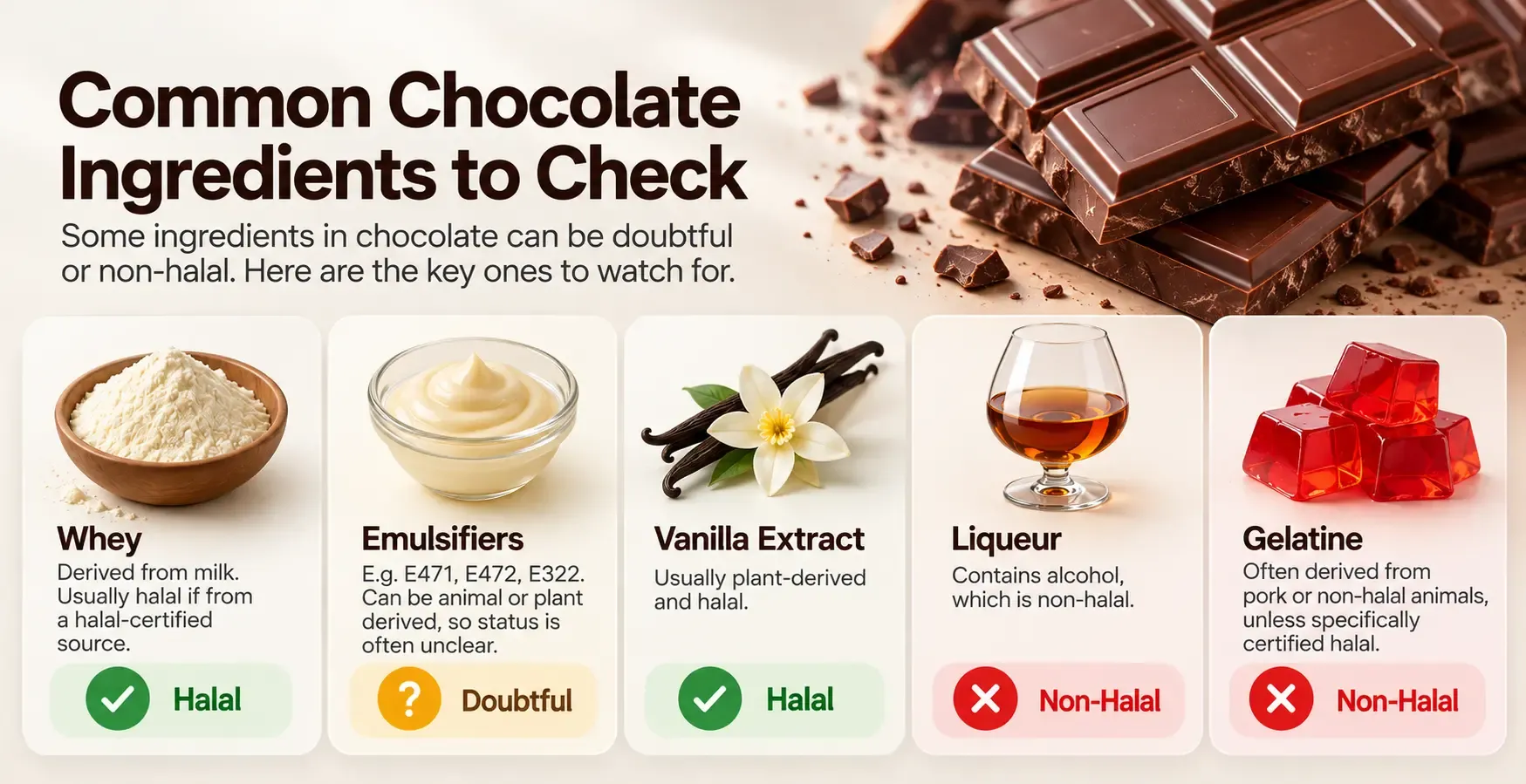
Five groups decide most halal chocolate results: dairy by-products, emulsifiers, flavors, fillings and colors. Here’s how each one shows up on a US label.
Ingredient | On US labels | Possible sources | Usual classification |
|---|---|---|---|
Whey | “whey,” “whey powder” | Cheese made with microbial, plant or animal rennet | Doubtful unless source is stated or certified |
Mono- and diglycerides (E471) | “mono- and diglycerides” | Plant oil or animal fat | Doubtful unless labeled vegetable |
Lecithin (E322) | “soy lecithin,” “sunflower lecithin” | Soy or sunflower | Usually halal |
PGPR (E476) | “PGPR,” “polyglycerol polyricinoleate” | Castor oil fatty acids plus glycerol | Often doubtful if glycerol source is unstated |
Vanilla extract, natural flavor | “vanilla extract,” “natural flavor” | Alcohol used as a solvent or carrier | Scholars differ |
Liqueur fillings | “rum,” “brandy,” “liqueur” | Alcoholic drinks | Non-Halal |
Carmine (E120) | “carmine,” “cochineal extract” | Insects | Scholars differ |
Gelatine | “gelatin” | Pork, beef or fish | Doubtful unless source is stated; Non-Halal if pork |
Is milk chocolate halal?
Milk chocolate is halal only when its dairy parts are. Milk powder is fine. Whey is the tricky one, because it’s left over from cheesemaking.
Some cheese is set with rennet from calves that weren’t slaughtered the halal way. Scholars differ on whether that affects the whey. Some accept it, following the view attributed to Imam Abu Hanifa on rennet, while others want microbial, plant or zabiha rennet only. Our post on whether cheese pizza is halal covers the rennet debate in more detail.
Are the emulsifiers in chocolate halal?
Emulsifiers keep cocoa butter and solids blended and help chocolate flow into molds. Soy and sunflower lecithin are plant-based, so they rarely cause concern. Mono- and diglycerides can come from plant oil or animal fat, and US labels usually don’t say which.
PGPR is made by joining glycerol with fatty acids from castor oil. The fatty acids are plant-based, but the glycerol isn’t always traced. That’s why some halal lists mark PGPR as doubtful when no source is given.
Does chocolate contain alcohol?
Some chocolate does. Under US federal rules, anything sold as vanilla extract must contain at least 35% ethyl alcohol by volume. Only a trace usually remains in a finished bar, and “natural flavor” can hide an alcohol carrier too.
Scholars differ on trace alcohol used as a solvent. Some permit it when it isn’t from wine and nothing intoxicating remains, while others avoid it completely. Our ethyl alcohol guide sets out both views.
Liqueur-filled chocolate is a different case. If the label lists rum, brandy or liqueur, treat it as non-halal.
Rather than decoding every flavor on the wrapper, you can scan the barcode. Halal Scanner flags the exact ingredient that made a bar Doubtful.
What about carmine and gelatine?
Red and pink coatings sometimes use carmine, a dye made from cochineal insects. US labels must name it as “carmine” or “cochineal extract.” Scholars differ on eating insects, so some Muslims accept it and others don’t.
Gelatine turns up in marshmallow fillings, mousse layers and chewy centers. Unless the label says beef, fish or halal-certified, treat it as doubtful.
Which chocolate needs the closest look?
Not every bar carries the same risk. The more layers a chocolate has, the more ingredients you need to check.
Chocolate type | Main ingredients to check | How closely to check |
|---|---|---|
Plain dark chocolate (70%+) | Vanilla extract, natural flavor | Lower |
Milk chocolate | Whey, emulsifiers, flavor | Medium |
White chocolate | Whey, vanilla extract | Medium |
Filled bars and truffles | Liqueur, gelatine, mono- and diglycerides | Higher |
Coated candies | Carmine, emulsifiers | Higher |
How to find halal chocolate brands in the USA
The surest way to find halal chocolate brands in the USA is to spot a named certifier’s logo, then confirm it with that certifier. Don’t rely on a brand list from a blog, including this one. Recipes change, and one brand can be certified in one country but not another.
These checks work without any app:
- Look for a named logo. IFANCA’s Crescent M is common on US packs, and IFANCA’s public product directory lets you search by product, company or country of sale.
- Search the maker’s site for “halal certificate.” Check the expiry date and confirm your exact bar is listed.
- Check where it was made. An imported bar may carry a Malaysian (JAKIM) or Indonesian (MUI) mark that covers that factory only.
Buying halal chocolate bars online? Ask the seller for the certificate, or scan the barcode when the box arrives.
How to Check Halal Status of Chocolates With Halal Scanner
Most chocolate in US stores has no halal logo at all. That’s where a scan saves time.
- Download Halal Scanner from the App Store or Google Play.
- Scan the barcode on the wrapper. No barcode? Type the product name into search.
- Read the result: Halal, Doubtful or Non-Halal, with the ingredients behind it.
- Handle a Doubtful result. See which ingredient caused it, then decide by your own standard or ask your scholar.
- Save approved bars to a shared list, so whoever shops next buys the same ones.
You can also browse chocolate the app has already checked, like Dark Chocolate 85% Cocoa. Halal Scanner isn’t a certifier and doesn’t replace one. It checks ingredients against verified halal data so you can decide faster.
The scan takes less time than reading the label. Tap the App Store or Google Play badge to download it free.
Why shoppers use Halal Scanner
- 1M+ product records
- 100K+ scans every day
- 500K+ users
- 50+ countries covered
Figures from Halal Scanner, October 2026.
The bottom line
Halal chocolate comes down to what’s added to the cocoa. Check the whey, emulsifiers, flavors and fillings, and trust a named certifier over a bare “halal” claim. When the label leaves you guessing, download Halal Scanner free and scan the bar before it goes in your cart.