

Yes, Muslims can eat beef. The Quran names cattle among the livestock Allah made lawful for food, and the Prophet Muhammad ﷺ sacrificed cows himself. Beef only becomes doubtful or non-halal when the cow is not slaughtered Islamically, the meat is cross-contaminated, or a beef-derived ingredient comes from an unverified source.
So the real question is rarely "is beef allowed?" It is "is this beef halal?" You are in a UK or US supermarket, holding a pack of mince. The label says British beef. It says nothing about how the animal was slaughtered.
This guide covers what the Quran and Sunnah say about cows, the exact points where beef stops being halal, the beef ingredients hiding in packaged food, and how to check a product in seconds.
Quick answer: is this beef halal?
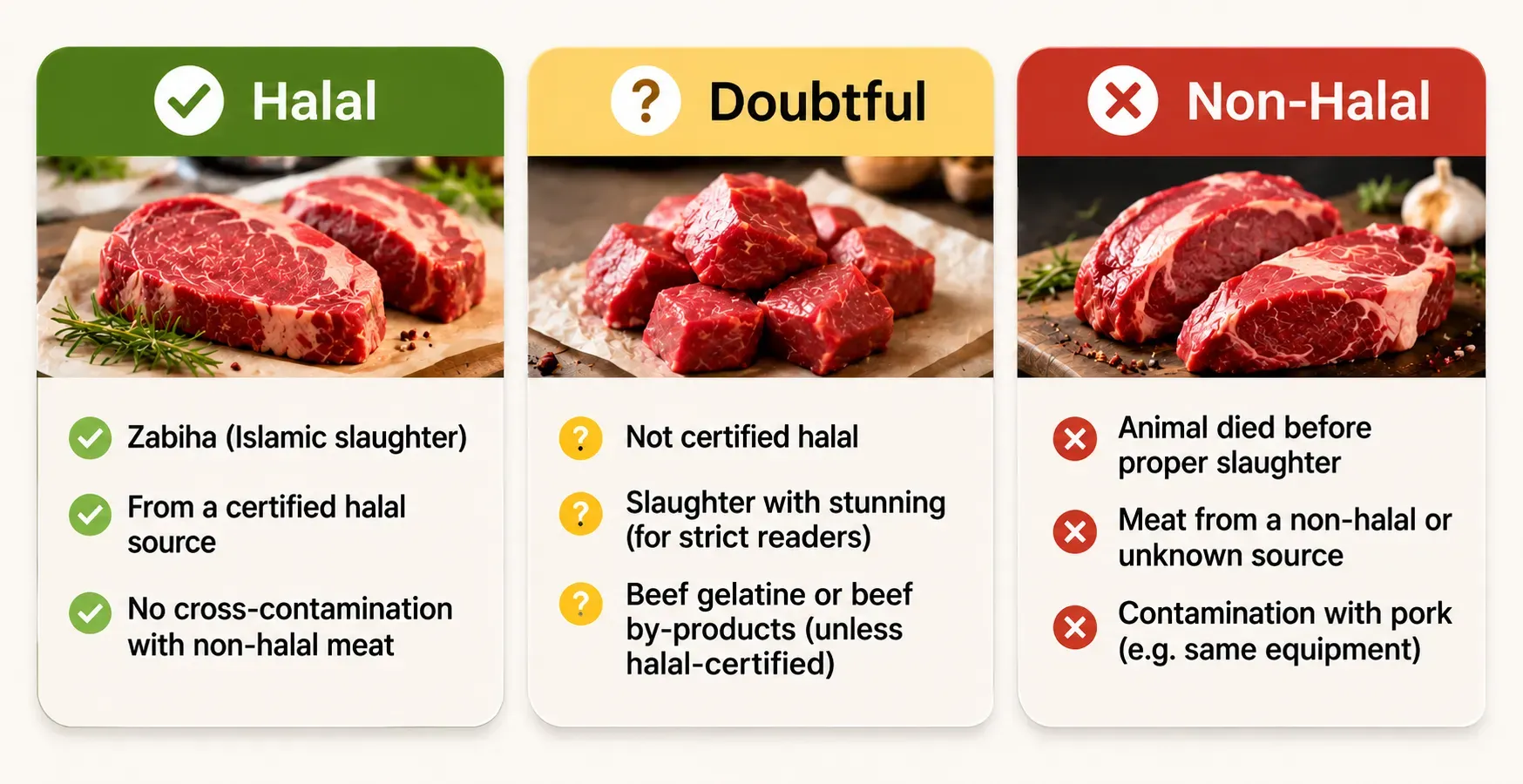
Situation | Status | Why |
|---|---|---|
Beef from cattle slaughtered by a Muslim with Allah's name, certified by a body you trust | Halal | Meets the zabiha conditions in the Quran and Sunnah |
Beef from cattle stunned, then slaughtered under a halal certifier that allows reversible stunning | Halal for many scholars, Doubtful for others | Scholars and certifiers differ on stunning |
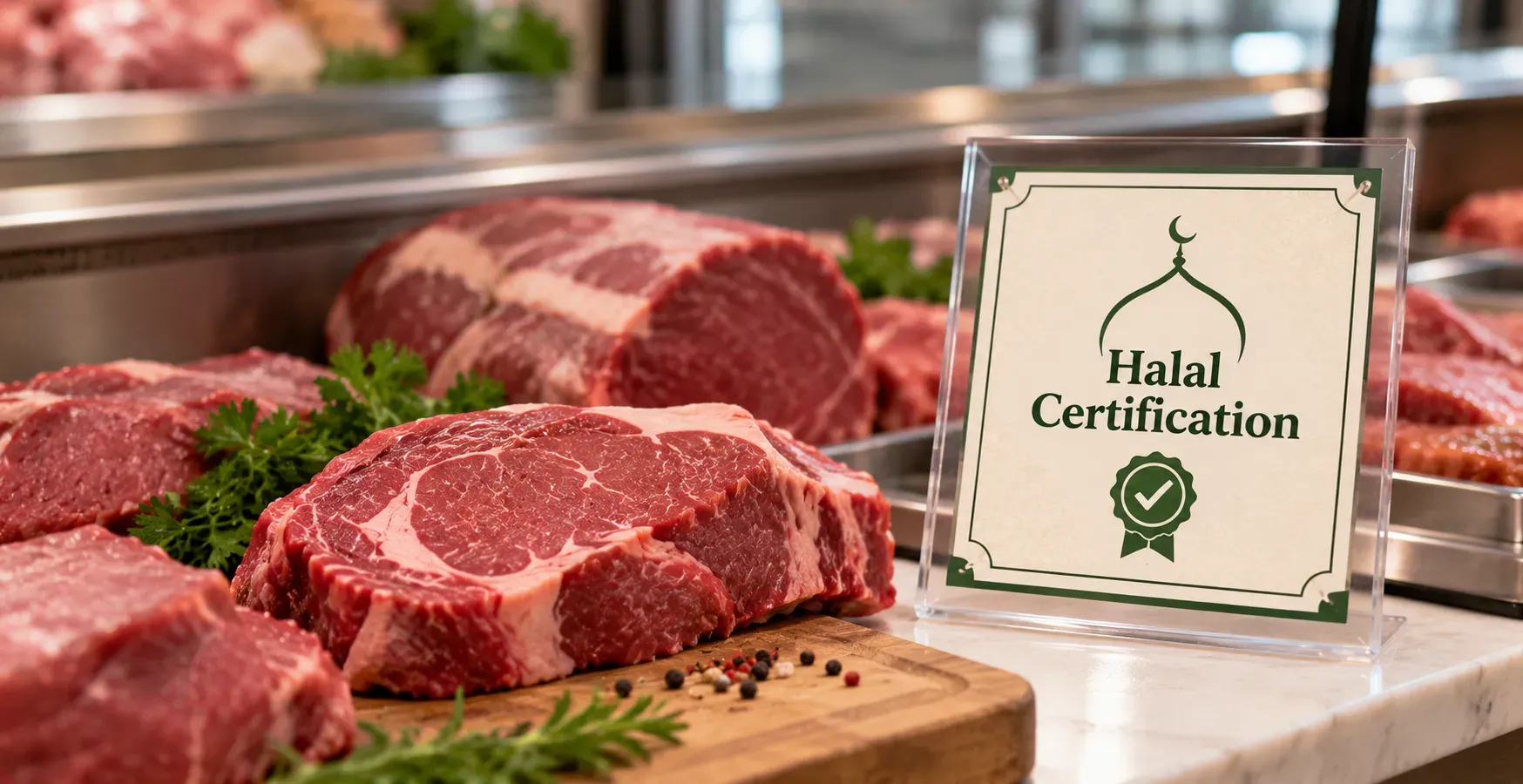
Ordinary supermarket beef with no halal certification | Doubtful (many scholars treat it as not halal) | Slaughter method and the name of Allah cannot be confirmed |
Meat from a cow that died before slaughter | Non-Halal | Dead animals (maytah) are forbidden in Quran 5:3 |
Beef cooked with wine, or processed on shared pork lines | Non-Halal or Doubtful | Haram additions or cross-contamination |
"Gelatine" or "beef gelatine" with no halal mark | Doubtful | The animal and its slaughter are not stated |
Religious guidance note: this article is educational and is not a fatwa. For a ruling on your own situation, ask a qualified scholar or your local halal certifier.
Is Beef Halal in Islam? What the Quran and Sunnah Say
Beef is halal in Islam by the agreement of all four Sunni schools and Shia scholars. No verse or authentic hadith forbids cow meat. The Quran mentions cattle as lawful livestock, and the Sunnah records the Prophet ﷺ slaughtering cows.
What the Quran says about cows
The Quran names cattle (baqar) among the eight kinds of livestock Allah provided. In Surah Al-An'am 6:144, cattle are listed beside camels, sheep and goats, in a passage that rejects people who made lawful animals forbidden without knowledge.
Surah Al-Hajj 22:36 speaks of the large sacrificial animals, which classical scholars explain as camels and cattle. It tells believers to mention Allah's name over them and then eat from them and feed the needy.
The second chapter of the Quran is even called Al-Baqarah, "The Cow." Its story of a cow that Musa's people were told to slaughter shows that cattle were never a forbidden animal.
What the Prophet ﷺ did with cows
The hadith record is clear. Jabir ibn Abdullah reported that at Hudaybiyyah the Companions sacrificed one camel for seven people and one cow for seven people (Sahih Muslim 1318a).
Jabir also reported that the Prophet ﷺ sacrificed a cow on behalf of his wife Aisha on the Day of Nahr, the 10th of Dhul-Hijjah (Sahih Muslim 1319a). This is why many families still share one cow among seven people for Eid al-Adha.
What is actually forbidden
The prohibition is about how the animal died, not the species. Quran 5:3 forbids carrion, blood, pork, meat dedicated to other than Allah, and animals killed by strangling, a blow, a fall, goring or a predator, unless they were properly slaughtered first.
So a cow is halal as a species. A piece of beef is halal only when that cow was slaughtered the right way.
When Is Beef Not Halal?
Beef stops being halal when the slaughter fails Islamic conditions, when the meat touches something haram, or when the source cannot be confirmed. Most of the real-life doubt sits in three places: the slaughter method, stunning, and meat from non-Muslim suppliers.
The zabiha conditions
Zabiha (or dhabiha) means Islamic slaughter. Scholars across the schools agree on the core conditions:
- The cow is alive at the moment of slaughter.
- The slaughterer is a Muslim (or, for many scholars, a Jew or Christian; see below).
- Allah's name (the tasmiyah, "Bismillah, Allahu Akbar") is said at the time of slaughter.
- A sharp blade cuts the throat, windpipe and main blood vessels so the blood drains out.
If the cow dies first, from a blow or any other cause, the meat counts as carrion under Quran 5:3. The UK's Halal Monitoring Committee (HMC) publishes a scholar's in-depth guide to zabiha that calls the tasmiyah the most important requirement.
Is stunned beef halal?
This is a genuine scholarly difference. Many abattoirs stun cattle before the cut. Some scholars accept it if the stun is reversible and the animal is still alive at slaughter. Others reject it because a stun can kill the animal first.
- A 2017 study in the journal Meat Science found over 95% of the Islamic scholars it surveyed accepted stunned meat as halal if the stun did not kill or injure the animal or block bleeding. Only 53% of the Muslim consumers surveyed agreed.
- The same paper cites a 2009 HMC survey in which 90% of 282 scholars rejected electrical stunning.
- HMC says it does not certify any stunned meat or poultry.
Standard | Position on stunning cattle | Where you will see it |
|---|---|---|
HMC (UK) | No stunning of any kind | UK butchers and restaurants with the HMC logo |
Halal Food Authority, HFA (UK) | Reversible stunning accepted | UK supermarkets and food brands |
JAKIM (Malaysia) | Reversible stunning accepted under conditions | Malaysian and export products |
Neither position is "the" Muslim view. Pick the standard your scholar follows, then check for that logo.
Can Muslims eat beef slaughtered by Christians or Jews?
Quran 5:5 says the food of the People of the Book is lawful for Muslims. Classical commentators such as Ibn Kathir explain "food" here as their slaughtered animals.
Scholars differ on how this applies to modern industrial meat. Some accept beef from Christian or Jewish slaughterers when Allah's name is not replaced by another and the animal is properly slaughtered. Others, including many Hanafi scholars, say today's supermarket beef does not meet those conditions. If your community follows a strict zabiha standard, treat uncertified beef as doubtful.
Cross-contamination
Halal beef can lose its status after slaughter. Shared mincers with pork, bacon fat on the grill, or wine in a marinade all cause problems. HMC, for example, says it does not work in plants where pork is handled. When eating out, ask what else is cooked on the same surfaces. If wine or spirits are in a sauce, our guide to ethyl alcohol in food explains which uses scholars allow.
Beef Ingredients in Packaged Food: Which Ones Need Checking?
Beef-derived ingredients follow the same rule as beef: they are halal only if the cattle were slaughtered Islamically and nothing haram was added. The catch is that labels rarely say where these ingredients came from.
Gelatine is the clearest example. Gelatine Manufacturers of Europe, whose members make about 68% of the world's gelatine, lists its raw materials as pigskin, bovine hides, bovine bones, pig bones and fish skin. A pack that just says "gelatine" or "E441" could hold any of these.
Ingredient on the label | Where it comes from | What to check |
|---|---|---|
Gelatine / E441 | Pigskin, pig bones, cattle hides or bones, or fish skin | Source animal plus a halal mark; "beef gelatine" alone is not enough |
Beef stock, broth or extract | Cattle bones and meat | Halal slaughter of the cattle; no wine or pork in the recipe |
Beef fat, tallow or dripping | Cattle fat | Halal slaughter of the cattle |
E471 (mono- and diglycerides of fatty acids) | Plant oils, or animal fats such as beef or pork | Ask the maker, or look for a vegetarian or halal mark |
Animal rennet (in cheese) | Enzymes from a calf's stomach | Microbial or vegetable rennet, or a halal mark |
Bovine collagen (supplements) | Cattle hides and bones | Halal certification on the tub |
Scholars differ on beef gelatine from cattle that were not slaughtered Islamically. One view says processing transforms it into a new substance (istihala), so it becomes permissible. Another view says the change is not complete, so it stays impermissible. Most halal certifiers only approve gelatine from zabiha cattle or fish.
Two checks work without any app:
- Look for a certifier logo you trust on the pack, such as HMC, HFA, IFANCA or JAKIM, and match it to the stunning standard you follow.
- Check the certifier's own list. HMC publishes its certified outlets online, so you can confirm a butcher or restaurant before you buy.
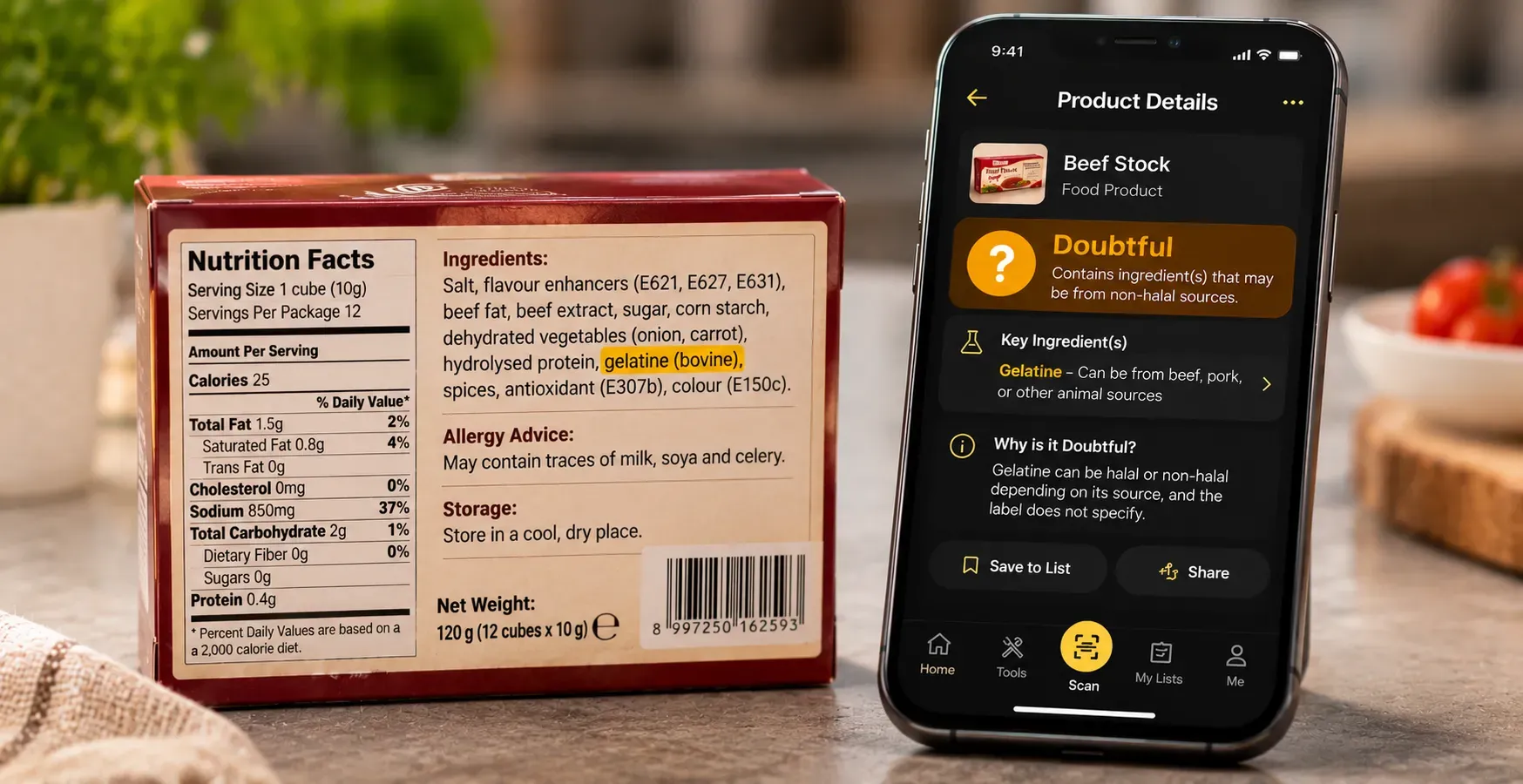
When a label is long and the E-numbers pile up, a scan saves the guesswork. Halal Scanner reads the barcode and flags beef-derived ingredients whose source is unclear.
Do Muslims Eat Cow Meat? Do They Have To?
Yes, many Muslims eat cow meat, but no Muslim is required to. Beef is permitted (halal), not obligatory. A Muslim who never eats beef, or never eats meat at all, breaks no religious rule.
Muslims are a large and varied group. Pew Research Center counts 2.0 billion Muslims as of 2020, with 1.2 billion living in the Asia-Pacific region. What ends up on the plate depends on local farming, prices and family habit as much as on religion. Chicken, goat, lamb and fish are everyday meats across much of the Muslim world.
Does every Muslim eat meat?
Muslims eat meat, but meat is not a duty. Islamic law allows a vegetarian diet. The only fixed meat rule is negative: pork, carrion, blood and improperly slaughtered animals are off the table. Eid al-Adha is the one time many families make a point of sacrificing an animal, and a cow shared by seven people is a common choice.
Why do people ask "can Muslims eat cow?"
The question often comes up in South Asia, where cows are sacred to many Hindus and some Indian states restrict cattle slaughter by law. Those laws are a legal and social matter, not a religious ruling on beef.
Muslim scholars have made the same point in public. In December 2024, Indian cleric Maulana Shahabuddin Rizvi Barelvi told Muslims in Assam that Islam does not require eating beef and that food is a personal choice. In short, beef is allowed in Islam, avoiding it is also allowed, and local law decides what you can legally buy.
How to Check Beef Products With Halal Scanner
Halal Scanner checks a packaged product's ingredients against its halal database and returns one of three results: Halal, Doubtful or Non-Halal. It is built for the moment you are standing in the aisle with a pack of burgers or a bag of sweets.
- Scan the barcode. Open Halal Scanner and point your camera at the barcode on the pack.
- Or search an ingredient. No barcode? Type "gelatine", "E471" or "beef extract" into the text search.
- Read the result. In seconds you will see Halal, Doubtful or Non-Halal for that exact product, not just for beef in general.
- Handle a Doubtful result. Doubtful (mashbooh) usually means a source is not stated, such as plain "gelatine". Check the pack for a certifier logo, contact the maker, or set the product aside if you follow a strict standard.
- Save it to a shared halal list. Add products you have checked to a list your family can open in-store, so no one has to re-check the same mince or stock cubes.
The scan takes less time than reading the label. Halal Scanner is free to download, with extra features available by subscription. Tap the App Store or Google Play badge below to get it.
Download on the App Store · Get it on Google Play
Halal Scanner is a research and verification tool. It does not replace certification from a recognised halal body or the advice of your scholar.
Why Shoppers Trust Halal Scanner
Halal Scanner reports these figures for its service:
Measure | Figure |
|---|---|
Verified products in the database | 1 million+ |
Scans per day | 100,000+ |
Users | 500,000+ |
Countries covered | 50+ |
The app also includes Qibla direction, prayer times, a mosque finder and other Islamic tools. See how it works or browse checked products.
The Bottom Line
Muslims can eat beef. The species is halal, and the Prophet ﷺ ate and sacrificed it. What matters is the individual product: how the cow was slaughtered, whether stunning fits your standard, and whether any beef-derived ingredient has a known halal source.
Check for a trusted certifier logo first. For everything else, scan it. Download Halal Scanner and get a Halal, Doubtful or Non-Halal result before the pack reaches your basket. You can find more ingredient guides on the Halal Scanner blog.