
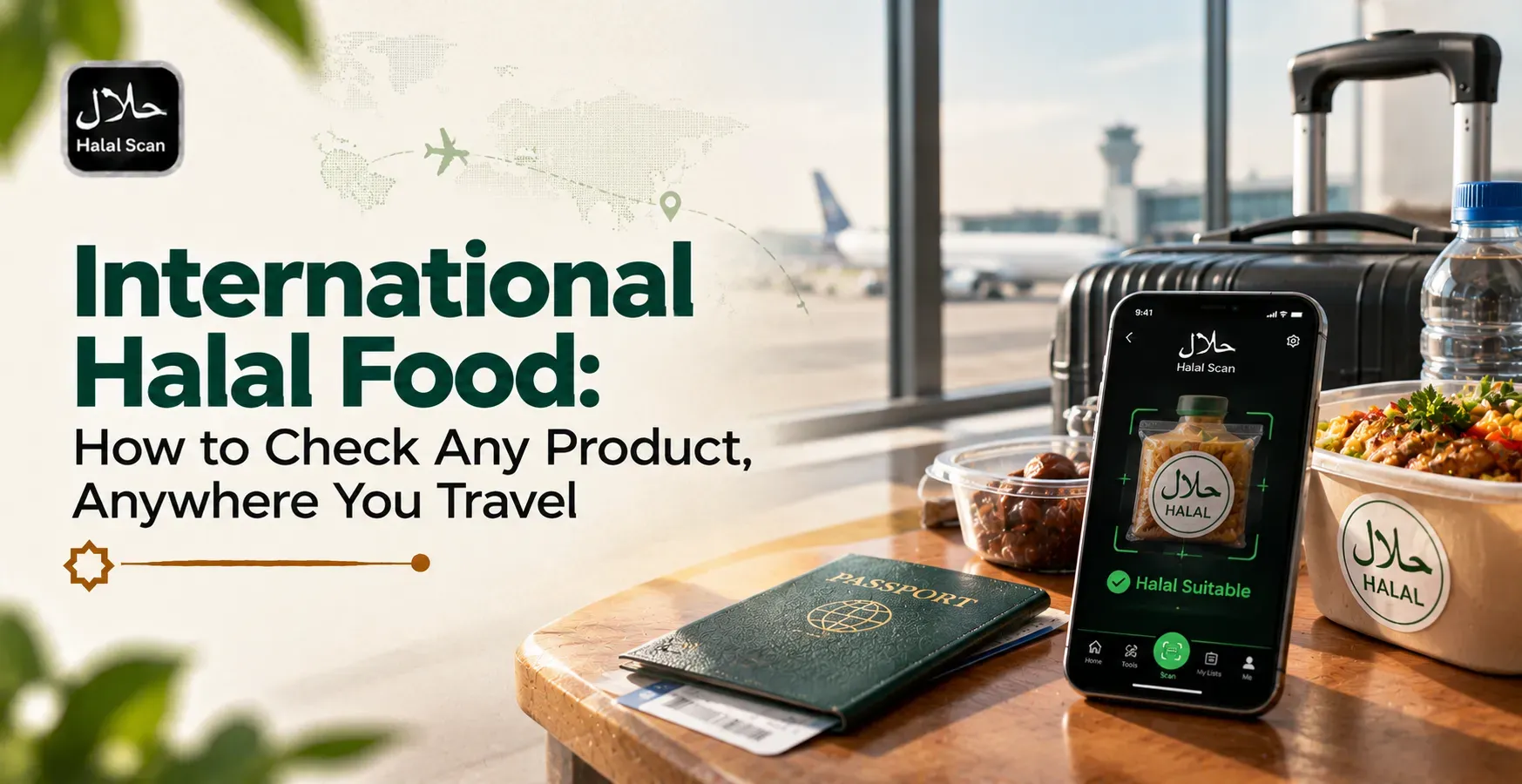
International halal food is food that meets Islamic dietary law wherever it's made or sold. There's no single global halal standard, so a halal claim abroad is only as reliable as the certifier behind it. To check a product overseas, look for a named, recognized certifier and read the ingredients for doubtful additives, or scan the barcode.
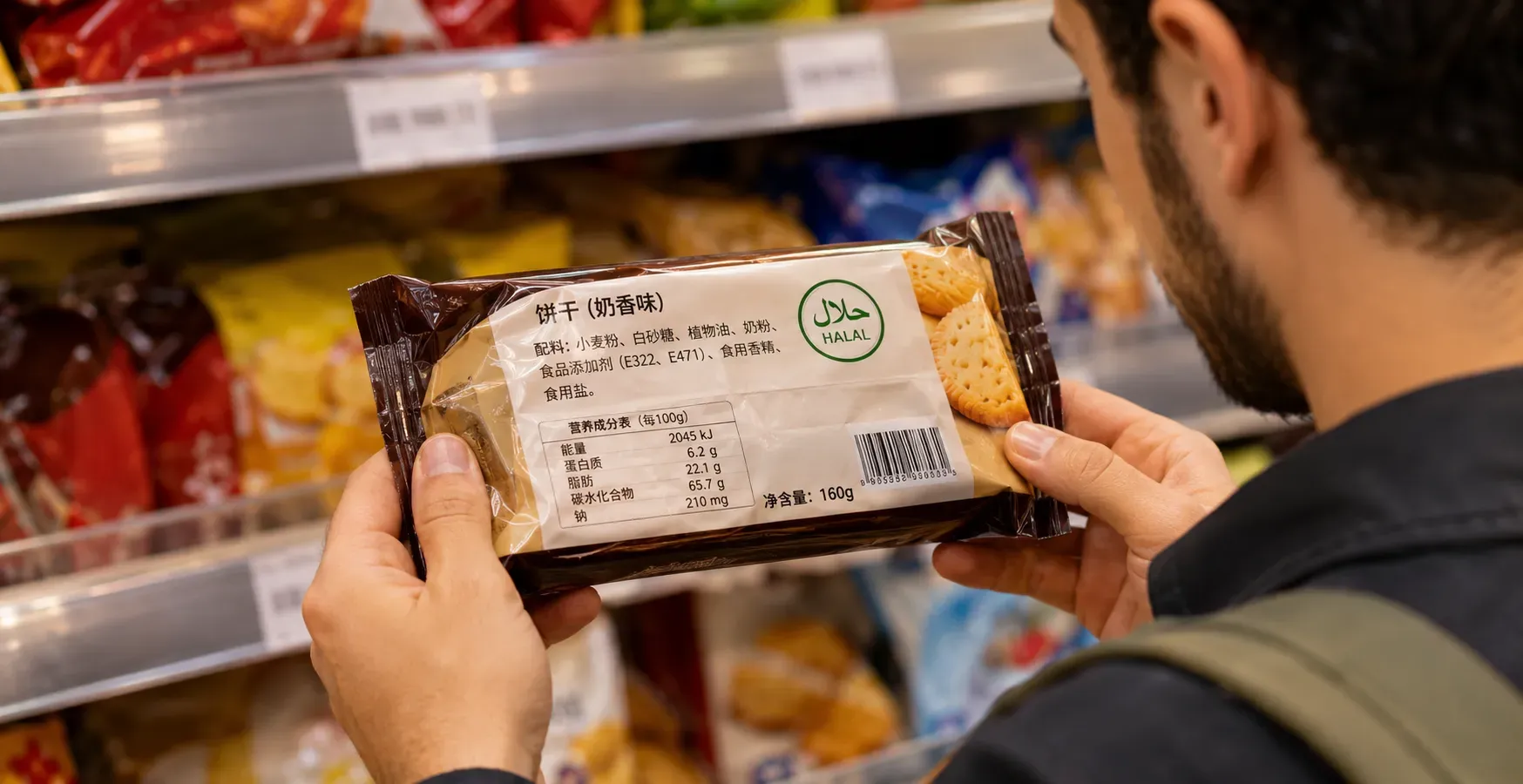
Picture this: you land in Seoul or Lisbon, walk into a convenience store and pick up a pack of biscuits. The label is in a language you can't read. The logo on the back is one you've never seen.
You're far from alone in that aisle. Pew Research Center counted 2.0 billion Muslims worldwide in 2020, up 347 million in ten years. DinarStandard's latest report puts Muslim spending on food and drink at US$1.53 trillion in 2024.
If the pack has a barcode, you can scan it in Halal Scanner and get a Halal, Doubtful or Non-Halal result in seconds. It's free to download on iOS and Android, with premium features available by subscription.
Why is there no single international halal standard?
Halal rules come from Islamic law, but each country and certifier writes its own standard. That's why the same product can be accepted as halal in one country and refused in another.
The closest thing to a global baseline is the Codex Alimentarius General Guidelines for Use of the Term "Halal" (CAC/GL 24-1997), adopted in 1997. The guidelines openly accept minor differences between Islamic schools of thought. They leave the final interpretation to each importing country's authorities.
The OIC's standards body, SMIIC, publishes OIC/SMIIC 1:2019, General Requirements for Halal Food. Some countries adopt it as their national standard. Others, such as Malaysia with MS 1500, keep their own.
The result is a crowded field. A 2026 review in the journal Foods estimates there are about 300 halal certification bodies worldwide. Only around 120 hold formal accreditation or mutual recognition agreements with governments.
Where scholars and certifiers differ
Many differences between certifiers reflect real scholarly disagreement, not carelessness:
- Stunning before slaughter. Some certifiers accept it if the animal is alive at the cut. Others reject it.
- Machine slaughter of poultry. Some accept a mechanical blade with the tasmiyah recited. Others require hand slaughter.
- Insect-derived colors such as carmine (E120). Scholars differ, so certifiers do too.
- Trace alcohol in flavorings. Views differ on ethanol used in small amounts as a carrier.
None of these positions is "the" Muslim view. Decide which standard you follow, ideally with your local scholar. Then choose certifiers that match it.
How do halal rules differ from country to country?
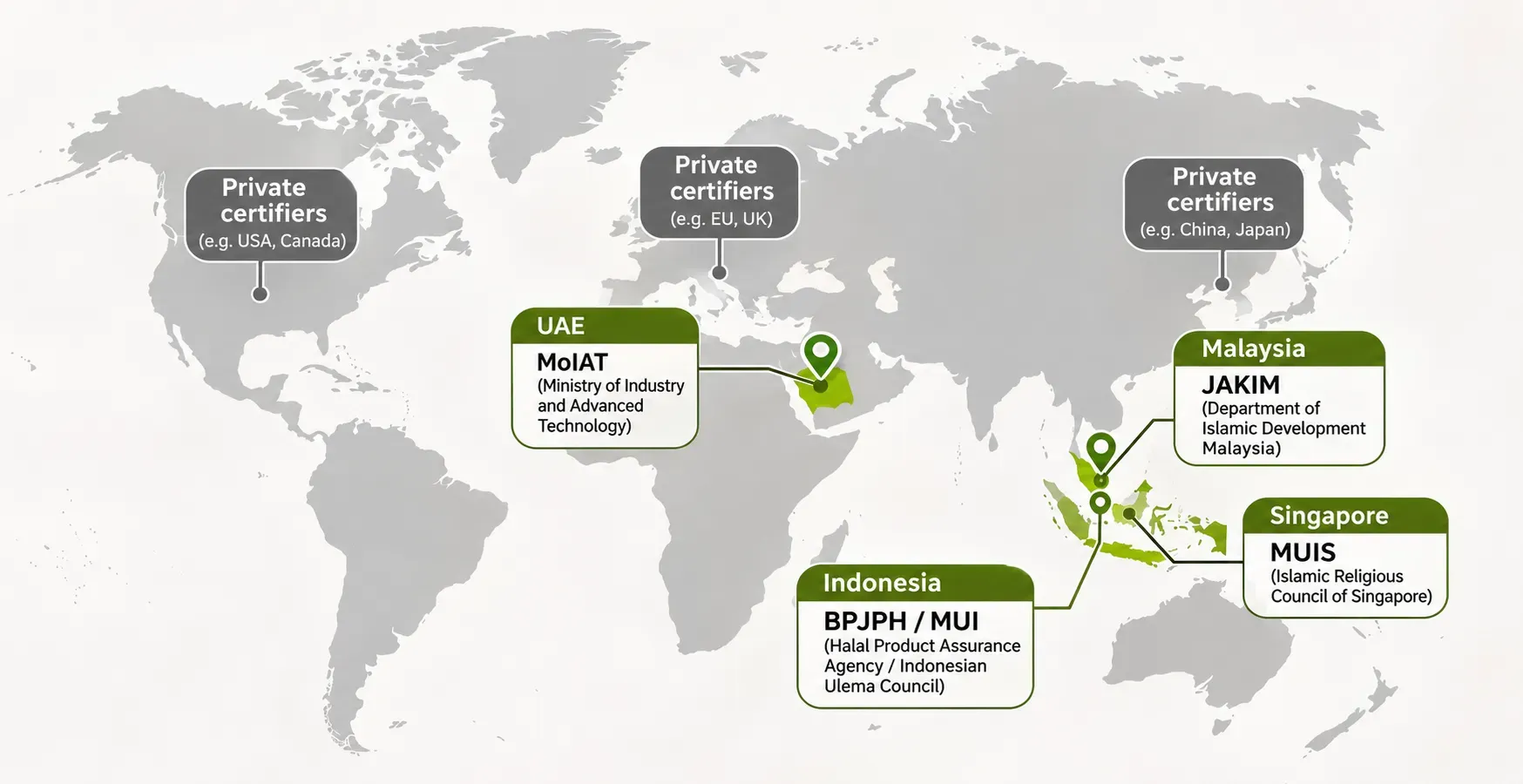
Each country decides who controls halal and whether certification is mandatory. Here's how common travel destinations handle it, as of November 3, 2026.
Country | Who controls halal | What it means for you |
|---|---|---|
Malaysia | JAKIM (Department of Islamic Development Malaysia) | Imported products sold as halal must be certified by a JAKIM-recognized foreign body. JAKIM recognized 96 bodies from 49 countries as of August 21, 2026. |
Indonesia | BPJPH, with MUI issuing the religious fatwa | Mandatory certification for most imported food and drinks now starts October 18, 2028. Until then, only imported meat and dairy must be certified. |
Singapore | MUIS (Islamic Religious Council of Singapore) | MUIS is the sole halal certification body under Singapore's Administration of Muslim Law Act. Look for the MUIS mark. |
UAE | MoIAT (Ministry of Industry and Advanced Technology) | MoIAT grants the UAE Halal National Mark after checking a product against UAE standards. |
UK, EU, US, Japan, South Korea | Private certifiers | No government body defines halal. The certifier's name and record carry all the weight. |
Rules change. Indonesia's import deadline has moved twice since 2024, most recently on October 16, 2026. Check the authority's latest notice before you rely on any date.
Wherever you shop, Halal Scanner checks products against data from 50+ countries and labels each one Halal, Doubtful or Non-Halal. Download it free before your next trip.
Shopping in the US? Our guide to halal certification in the US covers American certifiers and state halal laws in detail.
What should you look for on an imported food label?
Look for a named certifier, a certifier you can verify, and ingredients with a clear source. The word "halal" on its own proves very little.
- A certifier's name or logo, not just the word "halal." A bare claim with no named body is unverified.
- A certifier you can look up. Search the certifier's website for the product or company. JAKIM's list of recognized foreign bodies is a useful cross-check, since it spans 49 countries.
- A valid date and the right scope. Certificates expire, and some cover only one plant or one ingredient.
- Ingredients that could go either way. These are the ones that make a product Doubtful.
E-numbers are codes for approved food additives, listed by regulators such as the UK's Food Standards Agency. A code tells you what the additive is. It doesn't tell you whether it came from a plant, an animal or a lab.
Ingredient | Why it can be doubtful | What to check |
|---|---|---|
Gelatine | Made from the bones and skin of pigs, cattle or fish | It appears by name, not as an E-number, and rarely states its source. Look for "fish gelatine" or a halal certifier. |
Carmine / cochineal (E120) | Red color made from crushed insects | Scholars differ on insect-derived ingredients. Follow your own standard. |
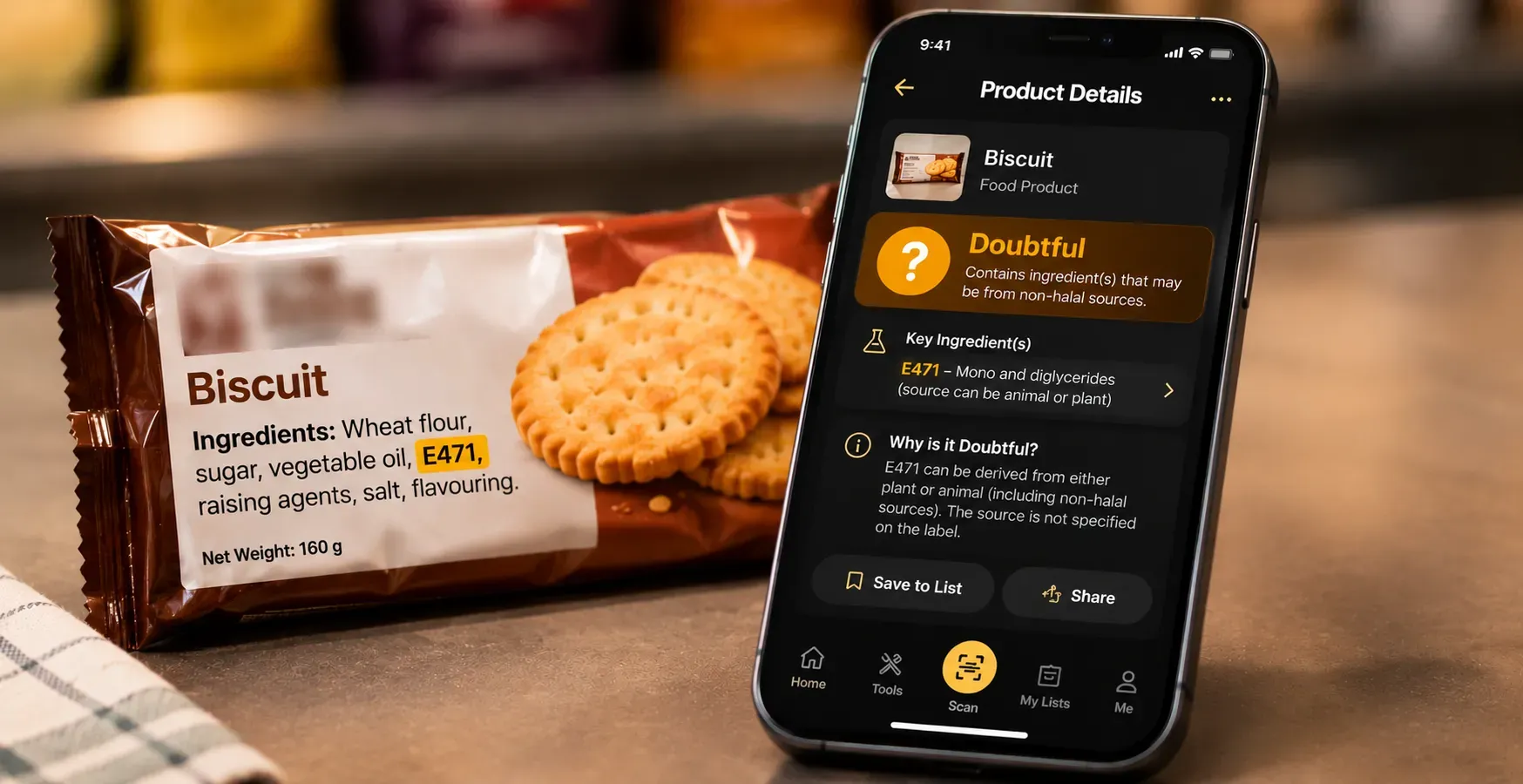
Mono- and diglycerides (E471) | Emulsifier made from plant or animal fat | Look for a "vegetable origin" note or ask the maker. |
Glycerol (E422) | Made from plant oils, animal fat or synthetic sources | The source is rarely printed. Ask the maker. |
L-cysteine (E920) | Dough conditioner that can come from feathers, hair or fermentation | Common in bread and baked goods. Ask the maker. |
Rennet and enzymes | Cheese enzymes from calves, microbes or plants | "Microbial" or "vegetable" rennet removes the animal question. |
Flavorings and "natural flavors" | May use alcohol as a carrier | Views differ on trace ethanol. Check with the maker or certifier. |
Rather than memorizing every code, you can scan the barcode. Halal Scanner shows which ingredient caused a Doubtful result, and it's free on iOS and Android.
For a worked example with whey and emulsifiers, see our halal chocolate guide.
How do you find halal food while traveling?
Plan before you fly, then verify on the ground. These tips work with or without an app.
- Learn the local halal logo before you go. Find the country's halal authority and save a picture of its mark. Indonesia's MUI also suggests checking halal logos and packing provisions for places with few halal options.
- Ask at the local mosque. The community usually knows which butchers, bakeries and restaurants it trusts.
- Pick seafood or vegetarian dishes with care. They avoid the slaughter question, but sauces can still contain wine, mirin or meat stock.
- Ask restaurants what the certificate covers. A certificate for the chicken doesn't cover a shared fryer or the sauces. Our food truck halal guide lists the questions to ask.
- Self-cater when you can. Fresh fruit, vegetables, eggs and plain grains are the easiest foods to check.
Halal Scanner also includes Islamic tools such as a Mosque Finder, Prayer Times and Qibla direction. They help when you're in a city you don't know.
How to check international halal food with Halal Scanner
A barcode reads the same in every language, so a scan works the same way in any country.
- Download Halal Scanner free from the App Store or Google Play.
- Scan the barcode with your phone camera. No barcode, or no match? Search by product name instead.
- Read the result: Halal, Doubtful or Non-Halal, with the ingredients that shaped it.
- Handle Doubtful results. Doubtful (mashbooh) means an ingredient can come from halal or non-halal sources. Look for a recognized certifier or contact the maker, then decide by your own standard.
- Save it to a shared list. Family at home or your travel group can shop from the same checked items.
Halal Scanner isn't a certifier and doesn't replace one. It checks ingredients against verified halal data, so you can decide faster.
The scan takes less time than reading the label. Tap the App Store or Google Play badge to download it free.
Why travelers use Halal Scanner
- 1M+ product records
- 100K+ scans every day
- 500K+ users
- 50+ countries covered
Figures from Halal Scanner, November 2026.
The bottom line
International halal food isn't one standard. It's many, and they don't always agree. Look for a named certifier, check that it's recognized, and know which ingredients make a product Doubtful. For everything else, download Halal Scanner free and scan before it goes in your basket.