
A halal menu is a restaurant, school or hospital menu where dishes are made with halal meat and no haram ingredients. In practice, many "halal" labels cover only the chicken or beef. Sauces, desserts, cheese and shared fryers need their own check before you order.
Picture a family dinner out. The grilled chicken has a small "H" beside it, but the pasta in vodka sauce and the panna cotta don't. The server isn't sure what's in either.
Halal menus are no longer rare in the US. Restaurant Business reports that Shah's Halal grew from one Queens food cart in 2005 to 130 US locations with a menu it calls 100% halal. More menus using the word means more ways it gets used loosely. For how certifiers audit kitchens, see our guide to halal certification in the US.
What does "halal" on a menu actually mean?
On a menu, "halal" can mean anything from a fully certified kitchen to one halal meat option. The label tells you what the venue claims. It doesn't tell you what was checked, or by whom.
The international benchmark is broader than meat. The Codex Alimentarius general guidelines for use of the term "halal", adopted in 1997, say halal food should be prepared, processed, packaged, transported and stored so it stays compliant. The same text accepts minor differences between Islamic schools of thought on lawful animals and slaughter.
Here's how common menu wording usually breaks down:
Menu wording | What it usually means | What to check |
|---|---|---|
"100% halal" or "fully halal menu" | Every dish is meant to be halal | Named certifier, current date, what the certificate covers |
"Halal certified" with a certifier's name | A third party audited the meat or kitchen | Look the venue up on that certifier's website |
"Halal meat" or "halal options" | Only some proteins are halal | Shared grill, fryer, sauces, desserts |
"Halal-friendly" | Ingredients believed halal; kitchen may be shared | How the kitchen prevents cross-contact |
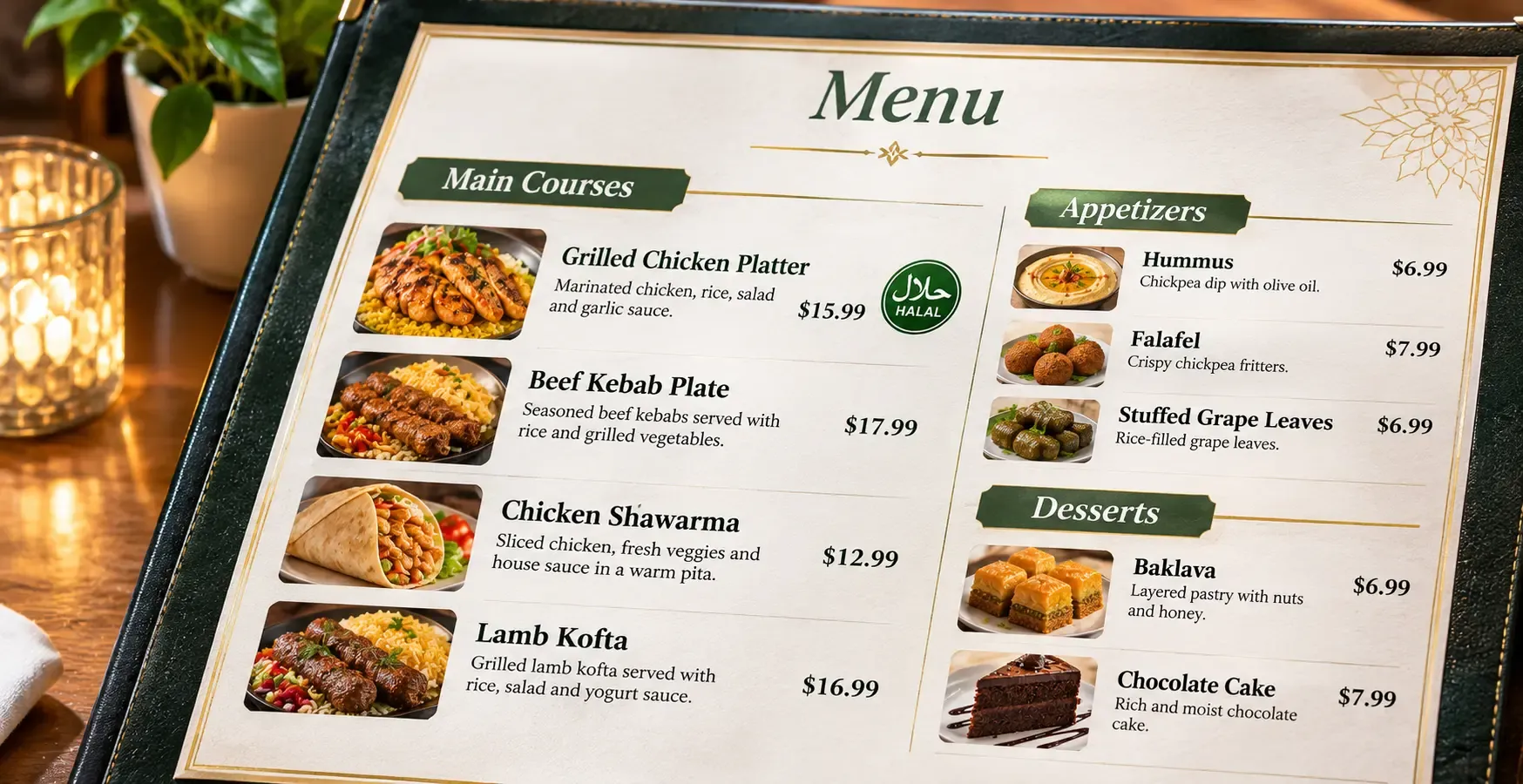
A halal icon (such as an "H") | Depends on the venue's own rules | The menu legend: which items does the icon cover? |
Icons vary a lot. At the University of Georgia, the dining halal symbol marks only chicken and beef items certified as halal, and vegetarian and seafood items aren't tagged. So an untagged veggie dish there isn't non-halal. It's simply unverified.
Which menu items can hide non-halal ingredients?
Pork names are easy to spot. The harder ones are alcohol in sauces and desserts, animal gelatine, animal rennet in cheese, and lard in pastry or beans. Treat those as Doubtful (mashbooh) until you know the source.
Alcohol is the most common surprise, because many people assume it cooks off. The USDA Table of Nutrient Retention Factors shows a sauce brought to a boil and taken off the heat keeps about 85% of its alcohol. Even a dish simmered for 2.5 hours keeps about 5%.
Desserts carry a quieter version of the same issue. Under the FDA's standard of identity, vanilla extract must contain at least 35% ethyl alcohol by volume. Scholars differ on alcohol used as a flavor carrier, and our ethyl alcohol guide sets out both views.
Menu term | What it can contain | Status until confirmed |
|---|---|---|
Bacon, ham, pancetta, prosciutto, lardons | Pork | Non-Halal ingredient |
Pepperoni, salami, chorizo | Often pork, sometimes beef | Doubtful: ask which meat |
Wine reduction, marsala, vodka sauce, beer-battered | Wine, spirits or beer | Non-Halal ingredient |
Teriyaki, glazes, some sushi rice | Mirin or cooking sake (rice wine) | Doubtful: ask |
Panna cotta, mousse, cheesecake, gummy toppings | Gelatine from pork, beef or fish | Doubtful |
Tiramisu, some cakes and frostings | Liqueur, marsala or vanilla extract | Doubtful |
Parmesan, pecorino, aged cheeses | Possible animal rennet | Doubtful |
Pie crust, tamales, refried beans | Possible lard | Doubtful: ask |
Shrimp, crab, lobster, calamari | Seafood | Depends on your school of thought (below) |
Cheese deserves a closer look. Rennet, the enzyme that sets cheese, can be animal, vegetable or microbial, and the Imam Mahdi Association of Marjaeya treats vegetable and microbial enzymes as permissible. Scholars differ on animal rennet from animals not slaughtered Islamically, so follow your own scholar on that one.
Got a packaged dessert, sauce or drink with your meal? Scan its barcode in Halal Scanner and see the result for that exact product. It's free to download.
Is seafood on a halal menu halal for everyone?
Not for every school of thought. The Hanafi school permits only what counts as "fish" from the sea, while the other three Sunni schools take a broader view. Neither is "the" Muslim position.
Islamic Services of America summarizes these differing madhab positions on shrimp and shellfish. Hanafi scholars also discuss whether shrimp counts as fish, and SeekersGuidance explains the Hanafi test for what counts as fish. Order seafood by your own madhab.
How do kitchens keep halal dishes separate?
A halal dish can lose its status in the kitchen through a shared grill, fryer, oil or utensils. The menu label rarely tells you how a kitchen handles this, so ask.
Some dining programs publish their rules, and they make a useful benchmark. USC Hospitality's halal dining guide says halal-friendly proteins don't share a griddle or grill with non-halal proteins unless the surface is cleaned and sanitized between uses. Fried items aren't labeled halal-friendly unless the fryer oil has been changed.
The same guide keeps any item with gelatin, alcohol, vanilla extract, wine vinegar or balsamic vinegar off its halal-friendly label. It also warns that cross-contact can still happen in a shared kitchen. That kind of honesty is what to look for on any menu.
Halal menus at schools, hospitals and campuses
Institutional menus are often easier to verify than restaurant menus, because the rules are written down. Read the dining policy, not just the icon.
State law can help. New York's Halal Foods Protection Act of 2005 requires restaurants, caterers and food carts that sell food represented as halal to register or file certifier details with the state Department of Agriculture and Markets. The department also lets you look up a food establishment's halal certification filing.
Illinois has its own Halal Food Act, with a later section on halal food at state-run hospitals and prisons. Our halal certification guide covers New Jersey and other states.
For a hospital stay or a school lunch plan, ask three things. Who supplies the halal meat? Are halal meals cooked separately or brought in sealed? Who can you contact with questions?
Questions to ask before you order
You don't need an app for the most important checks. These five questions work at any counter:
- Who certifies your halal meat? Ask to see a certificate with the certifier's name and a current date.
- Is the whole menu halal, or only some items? This settles most of the table above.
- Is the chicken hand-slaughtered or machine-slaughtered? Certifiers differ here, and our food truck halal guide explains both standards.
- Do halal and non-halal foods share a grill, fryer or utensils? Fries and fried chicken are the usual weak spot.
- Do any sauces or desserts use wine, mirin, vanilla extract, gelatine or lard? Kitchens often know the answer, even when the menu doesn't say.
If you follow a strict zabiha standard, the certifier matters most. Halal Monitoring Services (HMS), for example, certifies and monitors hand-slaughtered meat from the slaughterhouse through to the restaurant. Other certifiers accept different methods, so match the certifier to the standard you follow.
How to check a halal menu with Halal Scanner
Halal Scanner checks packaged food, not a restaurant's kitchen. It helps with the parts of a meal that come in a package, and with ingredients you spot on a menu.
- Download Halal Scanner. It's free to download, with premium features via subscription.
- Search for an ingredient you see on the menu. Type a word such as "gelatine" or "mirin" into the text search to see how it's classified.
- Scan packaged items at the table or counter. Bottled sauces, canned drinks and packaged desserts all have barcodes.
- Read the result: Halal, Doubtful or Non-Halal. For a Doubtful result, ask the restaurant which brand it uses, then scan that brand.
- Planning a halal menu at home? Save checked items to a shared halal list so your whole family shops from the same list.
The scan takes less time than reading the label. Download free on the App Store or Google Play.
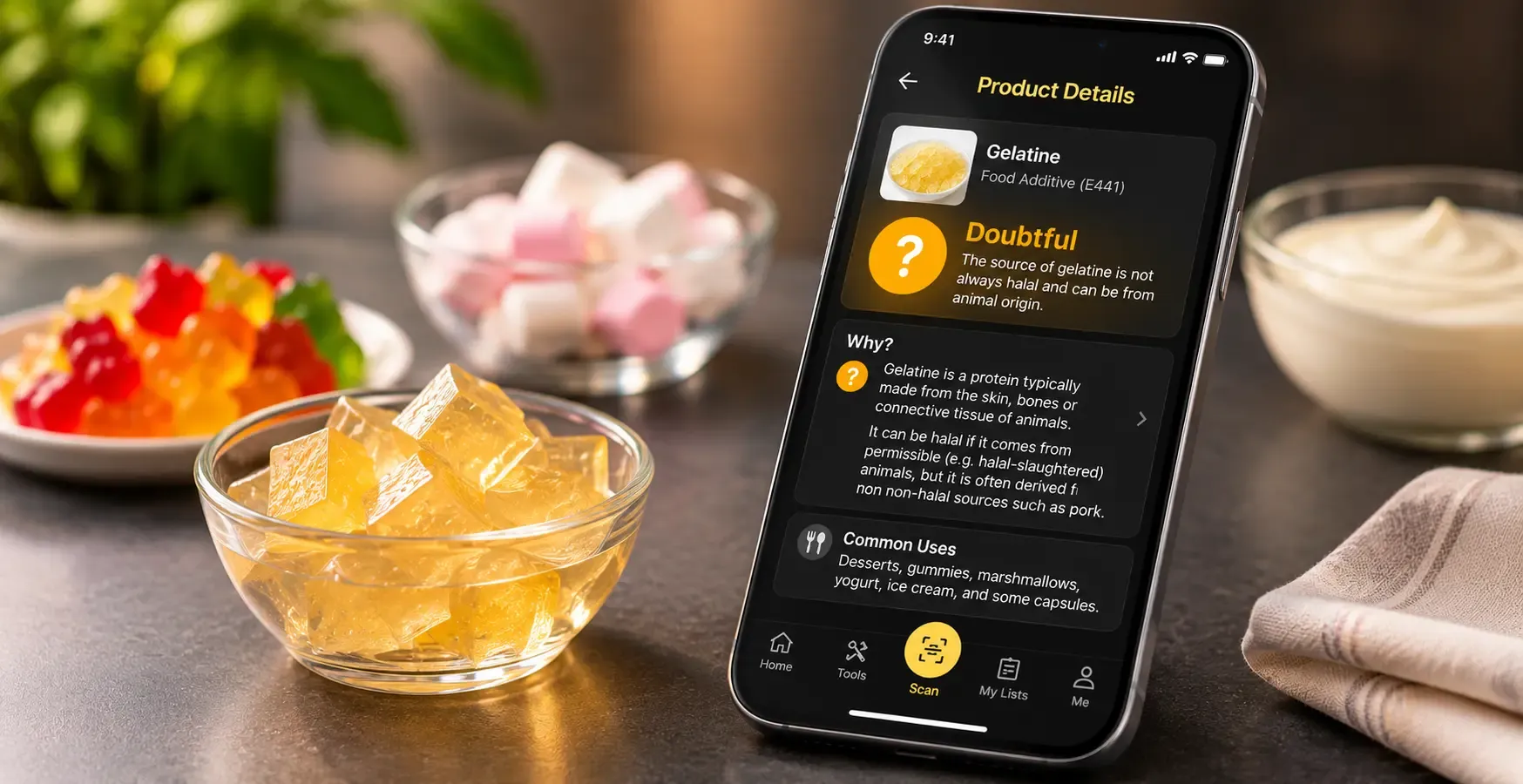
Why shoppers use Halal Scanner
Halal Scanner cross-references ingredients against verified halal data sources. It's a research tool, not a certifier, so for cooked restaurant food a current certificate from a recognized body is still your strongest proof.
- 1M+ product records
- 100K+ scans every day
- 500K+ users
- 50+ countries covered
Figures from Halal Scanner, November 2026.
The bottom line
A halal label on a menu starts the conversation; it doesn't end it. Check what the label covers, watch for alcohol, gelatine, rennet and lard in non-meat dishes, and ask how the kitchen keeps halal food separate. For everything with a barcode, download Halal Scanner free and check it in seconds.
Run a restaurant or catering business? See how partnering with Halal Scanner can help Muslim diners find you.