

Many Muslims can eat kosher food, but kosher does not automatically mean halal. Some scholars accept kosher meat under Quran 5:5, while others reject it because Allah's name is not said over each animal. Kosher products can also contain wine, alcohol-based flavourings or gelatine that halal rules do not allow.
Picture a supermarket in Chicago or Leeds (an illustrative scene). The halal shelf holds three items. Meanwhile, almost every cracker, sweet and yogurt carries a small "U in a circle" or a "K". Is that kosher stamp good enough for your family?
You are not alone in asking. In a 2023 ISPU survey of American Muslims, 83% said they prefer or require halal food. Within that group, 46% said they mostly buy halal-certified food but will buy uncertified items that are not clearly haram. That group meets kosher labels every week.
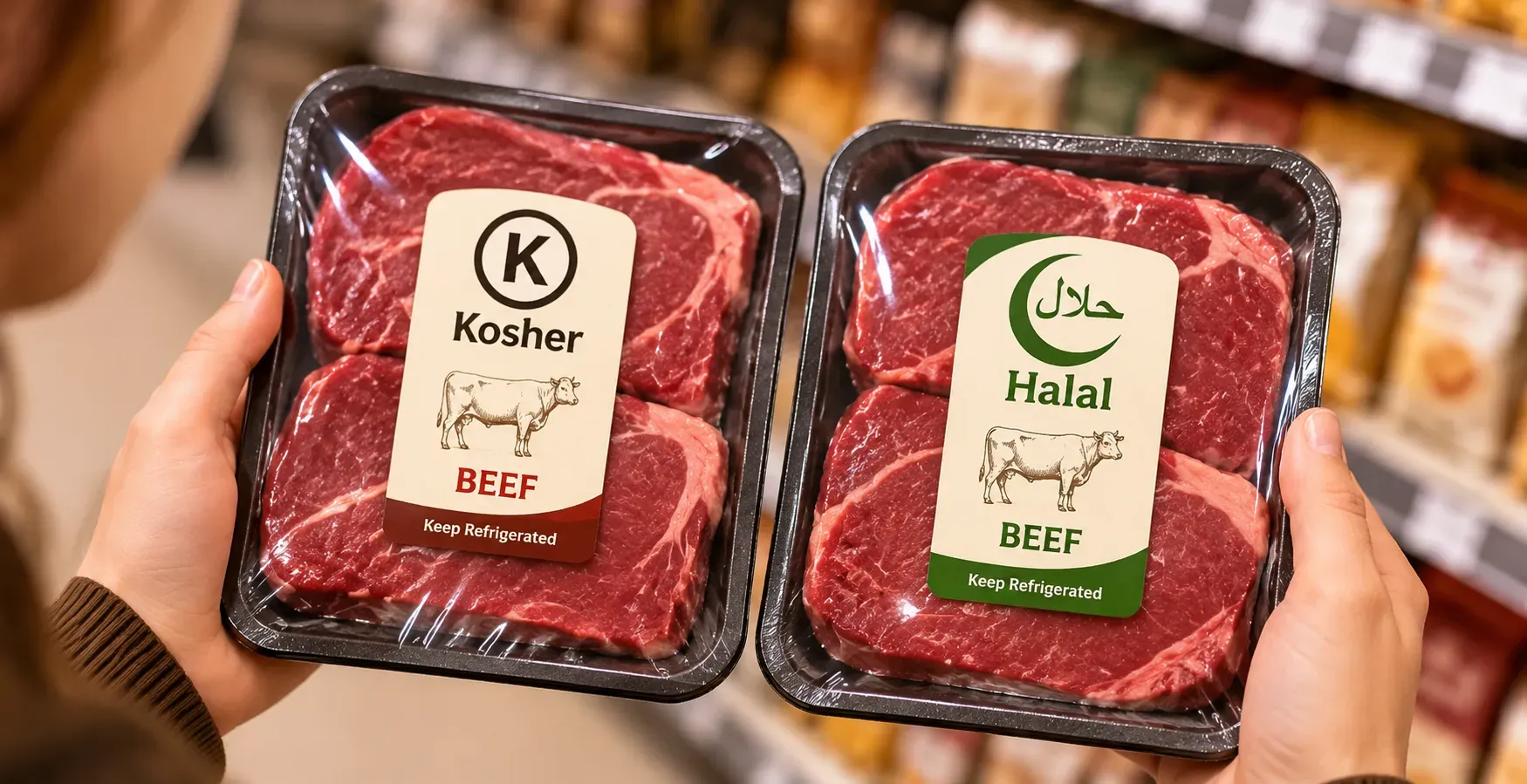
Is Kosher Halal? It Depends on the Product
Kosher and halal overlap, but they are two separate legal systems. Both ban pork and blood. Both require cutting the animal's throat. They split on alcohol, gelatine sources, who slaughters, and what is said at slaughter.
Kosher law centres on three issues: allowed animals, the ban on blood, and keeping meat and milk apart. That is how food scientists Joe Regenstein, Muhammad Chaudry and Carrie Regenstein summarise it in their review of kosher and halal food laws (Comprehensive Reviews in Food Science and Food Safety, 2003). Halal law covers allowed animals, blood, slaughter and invocation, carrion, and intoxicants. Alcohol is the widest gap: kosher law permits it, halal law forbids it.
Here is how common kosher-labelled product types usually sort for halal shoppers. These are general patterns, not verdicts on any brand, and recipes change from country to country.
Kosher product type | The issue for Muslims | Usual status |
|---|---|---|
Kosher fish (scaled fish, "F" mark) | Scaled fish is permitted in every school | Halal (still check additives) |
Pareve snack with no gelatine or alcohol listed | Ingredients are usually plant-based; flavourings can hide alcohol | Halal or Doubtful, depending on flavourings |
Kosher meat or poultry ("M" or Glatt mark) | Slaughter and invocation rules differ; scholars disagree | Doubtful |
Marshmallows, gummies, jelly desserts | Gelatine may be beef, fish or, under lenient rulings, pork | Doubtful until the source is confirmed; Non-Halal if pork |
Hard cheese | Rennet and enzymes may come from non-halal sources | Doubtful |
Kosher wine, liqueur sweets, wine sauces | Wine is kosher but not halal | Non-Halal |
Can Muslims Eat Kosher Meat? What Scholars Say
Scholars disagree, and both positions are held by mainstream authorities. The debate rests on two verses of the Quran.
Quran 5:5 states that the food of the People of the Book is lawful for Muslims. Many scholars read "food" as including meat slaughtered by Jews and Christians.
Quran 6:121 tells Muslims not to eat meat over which Allah's name was not mentioned. According to the 2003 Regenstein review, the majority of Islamic scholars hold that People of the Book food must still meet halal slaughter rules. The same review explains that an Orthodox Jewish slaughterer says a blessing at the start of a slaughter session, not over each animal.
A minority view, which the review attributes to Yusuf al-Qaradawi (1984), holds that the naming requirement does not apply to the People of the Book. Local muftis often add a practical test as well. Darul Iftaa Birmingham, a UK Hanafi fatwa service, advises Muslims to avoid kosher meat where halal meat is easy to buy.
For most halal shoppers, that makes kosher meat a Doubtful (mashbooh) item: not clearly haram, not clearly halal. Whether you eat it depends on the view your scholar follows.
Halal vs Kosher Meat: How the Slaughter Differs
The biggest differences are who slaughters, what is said, and what happens after the cut. The table below draws on the Regenstein review unless noted.
Point | Halal (zabiha) | Kosher (shechita) |
|---|---|---|
Who slaughters | An adult, sane Muslim (some scholars also accept Jews and Christians) | A trained Jewish slaughterer (shochet) |
What is said | Allah's name, at the time of slaughter | A blessing once at the start of a session, not per animal |
Stunning | Certifiers differ (see below) | Never stunned before slaughter |
After the cut | Full bleeding; no salting required | Soaking and salting within 72 hours to draw out blood |
Cuts eaten | The whole carcass | In the US and most Western countries, mainly the front quarters |
Camel and ostrich | Permitted | Not kosher |
Meat with dairy | Allowed | Never mixed |
Stunning is where halal certifiers split. A University of Bristol study of nine UK halal certifiers found most accepted pre-slaughter stunning, as long as it did not kill the animal before bleeding. The Halal Monitoring Committee, by contrast, campaigns for non-stun halal only.
The law is shifting too. On December 17, 2020, the EU Court of Justice ruled in Case C-336/19 that member states may require reversible stunning even for religious slaughter. That ruling upheld a Flemish ban affecting both kosher and halal meat in that region.
Kosher Food vs Halal Food: 4 Ingredients to Watch
Outside the meat counter, four ingredients cause most of the trouble. The Regenstein review names gelatine and alcohol as the two most common concerns for Muslims buying kosher products.
Alcohol and wine
Kosher law permits wine and grape alcohol made under rabbinical supervision. Halal law prohibits intoxicants (khamr), based on Quran 5:90–91. Alcohol is also used as a carrier for flavourings, so a "pareve" label does not rule it out. Scholars differ on tiny amounts of non-intoxicating ethanol; our guide to whether ethyl alcohol is halal sets out those views.
Gelatine
Gelatine is the most disputed ingredient of all. Some lenient kosher authorities have accepted pork gelatine on the grounds that processing turns it into a new substance, according to the 2003 review. Mainstream US kosher agencies reject that view.
There is a second catch. The Orthodox Union certifies kosher beef gelatine as pareve, so a pareve symbol does not mean "no animal gelatine". On the Islamic side, Shaykh Faraz Khan of SeekersGuidance explains that kosher gelatine is halal only if it comes from fish, plants or properly slaughtered animals. If it comes from pig or an unslaughtered animal, it is not halal.
Cheese enzymes
Hard cheese needs rennet or other enzymes to set. Darul Uloom Trinidad and Tobago warns that kosher cheese can use enzymes Muslims would reject, including enzymes of pork origin. Treat kosher hard cheese as Doubtful until the enzyme source is clear.
Shellfish (the reverse case)
Here kosher is stricter than halal. Kosher law bans all shellfish. The Shafi'i, Maliki and Hanbali schools permit sea creatures in general. The Hanafi school permits only fish, and Hanafi scholars differ on prawns. So a kosher label rarely creates a seafood problem for Muslims.
Can Jews Eat Halal? Why the Rule Is Not Mutual
Observant Jews do not eat halal meat. Kosher meat must be slaughtered by a shochet, inspected, deveined, then soaked and salted. Halal meat skips those steps, so it cannot be kosher, even though Quran 5:5 also says Muslim food is lawful for the People of the Book.
Aish, a Jewish educational site, states plainly that a Jew may not eat halal meat. Practice varies, though. The Regenstein review notes that Reform Jews generally do not treat kosher laws as essential, so some less observant Jews do eat halal food.
How to Read a Kosher Label as a Halal Shopper
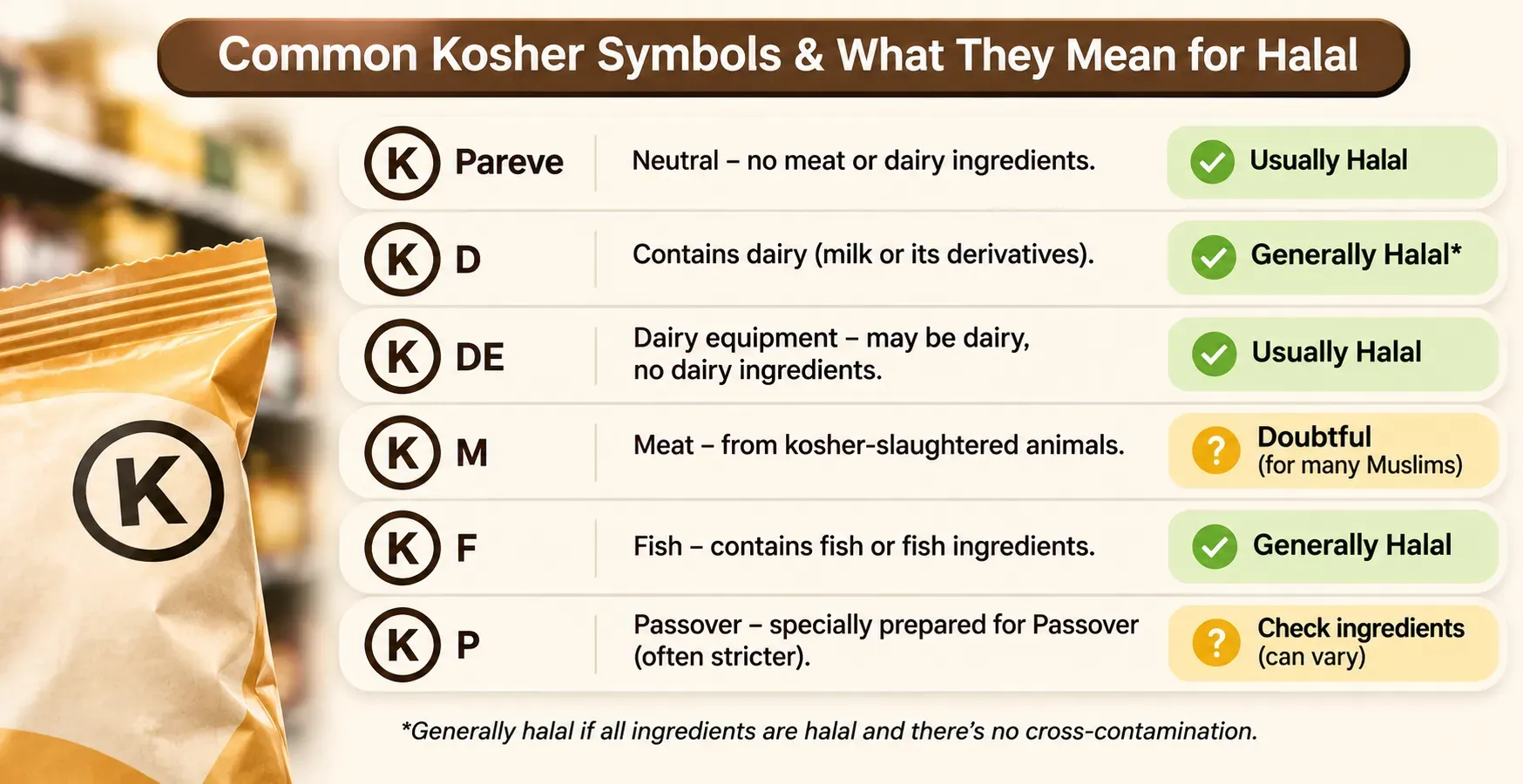
The letters beside a kosher symbol tell you most of what you need. These meanings follow the Orthodox Union's symbol guide.
- Plain OU or "pareve": no meat or dairy ingredients. It can still contain fish, eggs or beef gelatine.
- D or DE: contains dairy, or was made on dairy equipment.
- M or Glatt: kosher meat, so it falls into the Doubtful group for many Muslims.
- F: contains fish.
- P: at the OU this means kosher for Passover. Some other agencies use P differently, so check the agency's own key.
Three checks work without any app:
- Scan the ingredients for gelatine, wine, liqueur, rum, "alcohol", rennet and enzymes.
- Look for a halal mark you trust. In the UK, know whether your certifier accepts stunning, since HMC and HFA differ.
- Email the maker about the gelatine or enzyme source, and name your country, since recipes vary by market.
How to Check Kosher-Labelled Products With Halal Scanner
Halal Scanner checks the product in your hand against a verified database, so you don't have to decode every symbol yourself.
- Open the app and tap the scanner.
- Scan the barcode, or type an ingredient such as "gelatine" into the search if there is no barcode.
- Read the result: Halal, Doubtful or Non-Halal.
- If it says Doubtful, hold off. Contact the maker about the ingredient source, or pick a certified alternative.
- Save it to a shared halal list so whoever does the next shop sees the same answer.
The scan takes less time than reading the label. Halal Scanner is free to download on the App Store and Google Play, with premium features by subscription.
Why shoppers use Halal Scanner: 1 million+ verified products, 100,000+ daily scans, 500,000+ users, and coverage in 50+ countries (Halal Scanner figures). Results draw on verified halal data sources. The app is a research tool and does not replace certification from a recognized halal body.
The Bottom Line
Kosher food can be halal, but the kosher symbol alone does not prove it. Kosher meat is Doubtful for many Muslims, kosher products may contain wine or gelatine, and certifiers disagree on stunning. Read the symbol letters, check the ingredients, and ask your scholar where views differ.
When the label leaves you unsure, scan it. Halal Scanner is free to download on the App Store and Google Play, or start from the download page. For more ingredient guides, visit the Halal Scanner blog.