
You are standing in the baking aisle, looking at a bottle of vanilla extract for a weekend family dessert. The ingredients list seems simple enough, but then you spot it: ethyl alcohol. Your mind immediately jumps to a practical question. Is this the same alcohol that is strictly forbidden to drink? Should you put the bottle back on the shelf?
For Muslim shoppers, especially those living in Western countries, this is a weekly friction point. We all know that consuming intoxicating drinks is prohibited in Islam. But modern food manufacturing makes things complicated. When you see ethanol listed on a label for a packaged snack or flavoring, the ruling depends heavily on chemistry, origin, and concentration.
So, is ethyl alcohol halal?
Ethyl alcohol (ethanol) is generally considered halal when used in trace amounts as a solvent or carrier for flavorings, provided it is not sourced from the fermentation of dates or grapes, and the final product does not intoxicate.
Understanding why this is the case requires looking at both Islamic jurisprudence (fiqh) and food science.
The Difference Between Khamr and Ethyl Alcohol
To understand how scholars view ethanol in food, we have to look at the source. The Quran explicitly forbids khamr (intoxicants). Historically, khamr referred specifically to wine made from fermented grapes or dates.
Over time, Islamic scholars agreed that any substance consumed for the purpose of intoxication falls under the ruling of khamr. If a beverage intoxicates in large quantities, a small sip of it is also haram. There is zero flexibility on this principle.
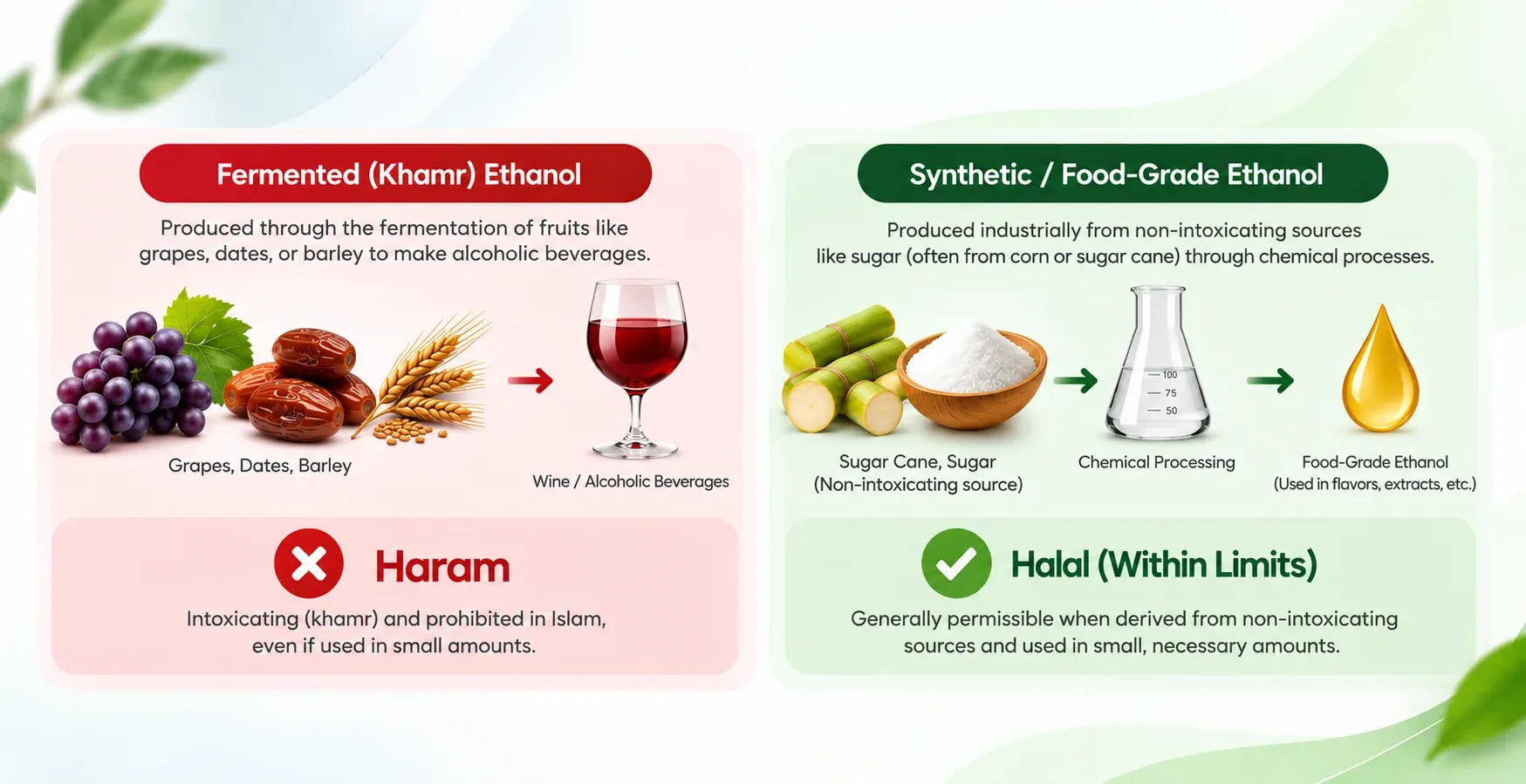
However, ethyl alcohol (also known as ethanol) is a specific chemical compound. While ethanol is the active intoxicating agent in alcoholic drinks, not all ethanol is produced for drinking. The ethanol used in food manufacturing is often synthetic or derived from alternative sources like molasses, corn, or petrochemicals.
Synthetic vs. Fermented Sources
When asking if ethanol alcohol is halal, certifying bodies look directly at how the chemical was made.
If the ethanol is extracted from the wine-making or brewing industry, it is universally considered haram and najis (spiritually impure). A Muslim cannot consume it, and it cannot be used in halal food production.
But what if the ethanol is produced synthetically in a lab, or fermented from sugar cane specifically to act as a chemical solvent? Major Islamic councils, including the Islamic Religious Council of Singapore (MUIS), have issued detailed rulings on this. They state that ethanol produced through synthetic means or non-khamr fermentation is not ritually impure. It can be used in food preparation as long as the final product is not intoxicating.
Ethanol Source | Production Method | Halal Status in Food (Subject to Limits) |
|---|---|---|
Grapes / Dates | Fermentation for beverages (Khamr) | Haram / Najis |
Brewing Industry | By-product of alcoholic drinks | Haram / Najis |
Sugar Cane / Corn | Fermentation for industrial solvents | Halal (if below strict trace limits) |
Petrochemicals | Synthetic hydration in a lab | Halal (if below strict trace limits) |
Rather than memorizing chemical sources, you can check your groceries instantly. Halal Scanner cross-references ingredients against verified data. It is free to download with premium via subscription on the App Store or Google Play.
The Role of Solvents in Food Manufacturing
You might wonder why food companies put alcohol in your snacks in the first place. They are not trying to make the food intoxicating. They are using it as a delivery system.
Many natural flavorings—like pure vanilla bean, lemon oil, or peppermint—do not dissolve easily in water. If a manufacturer tries to mix raw vanilla into a liquid cake batter, the flavor will clump together. Ethyl alcohol is incredibly effective at dissolving these oils, allowing the flavor to spread evenly through the product.
This means the ethanol acts as a "carrier." Once the flavoring is mixed into the final food product, the amount of alcohol remaining is microscopically small. Furthermore, if you use a flavoring like vanilla extract in baking, the heat of the oven causes much of that trace alcohol to evaporate.
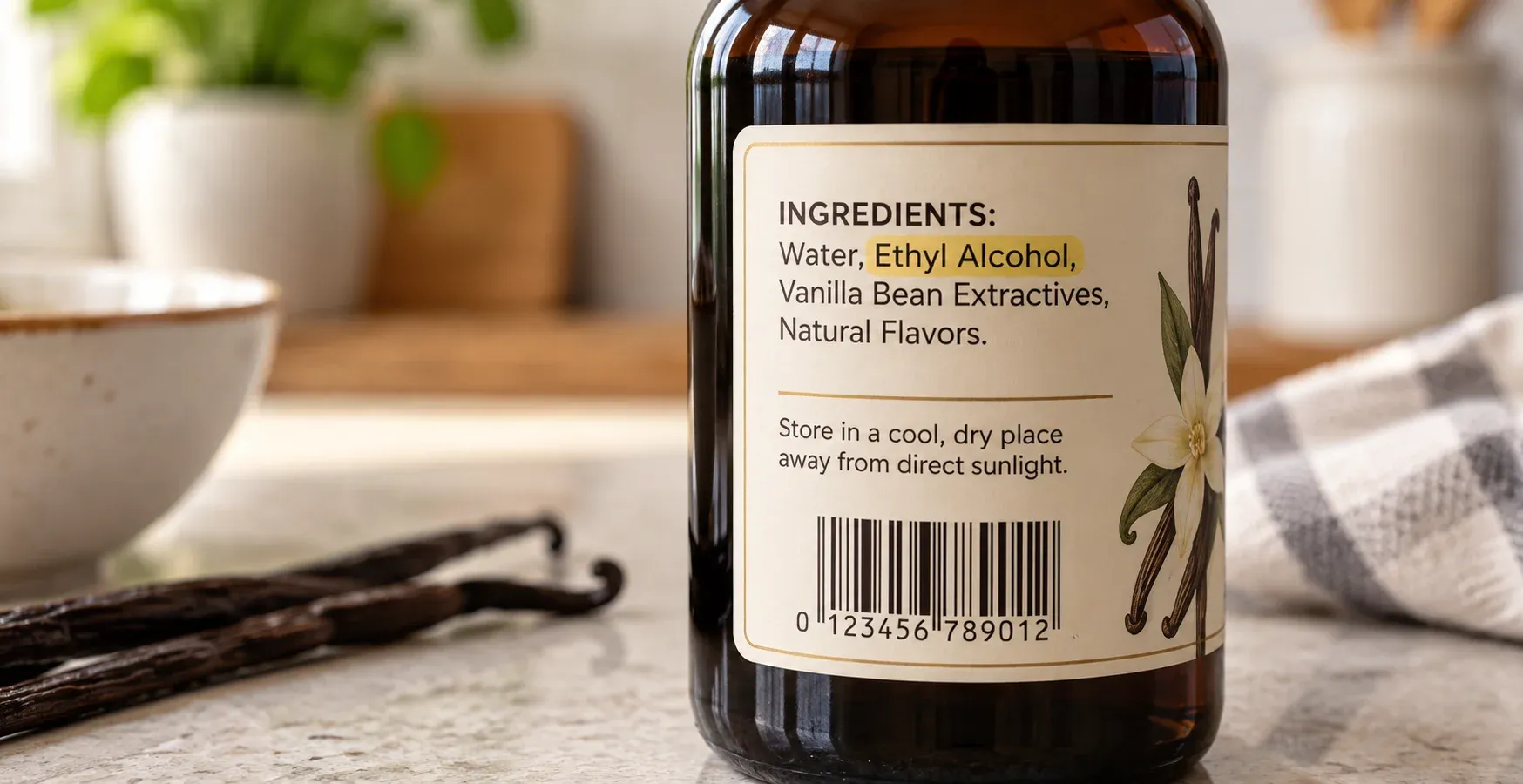
Prominent Islamic institutes, such as SeekersGuidance, reference rulings from leading scholars like Mufti Taqi Usmani. They clarify that using synthetic alcohol as a solvent for flavorings is permissible, because the alcohol loses its identity in the final product and cannot intoxicate anyone, regardless of how much of the food they eat.
The 0.1% to 0.5% Rule in Halal Certification
Because ethanol occurs naturally in tiny amounts in many foods—like overripe bananas, fruit juices, and rising bread dough—halal certifying bodies rely on scientific thresholds. They measure the final percentage of ethanol in a food or drink to ensure it complies with Islamic principles.
Different global authorities have slightly different cut-offs, but they all operate on the same principle: the amount must be too small to intoxicate, and it must not come from a khamr source.
The Majelis Ulama Indonesia (MUI) is one of the strictest and most respected certifying bodies globally. Their fatwa committee establishes clear limits for food and beverages.
Halal Certifying Body | Final Product Ethanol Limit | Application |
|---|---|---|
MUI (Indonesia) | Less than 0.5% | Food products (added flavorings) |
JAKIM (Malaysia) | Less than 0.5% | Food products and flavorings |
MUI / JAKIM | Less than 0.1% | Beverages (soft drinks, juices) |
IFANCA (USA) | Less than 0.1% | General consumer food products |
If a product exceeds these limits, it will be rejected for halal certification. This strict measurement protects Muslim consumers and ensures that the line between food science and religious compliance remains totally clear.
Navigating different international standards can be overwhelming. Halal Scanner's database covers over 50 countries, automatically checking products against verified halal data sources. The app is free to download with premium via subscription.
Hidden Ethanol: The "Natural Flavors" Problem
Here is where shopping gets difficult for a Muslim minority in the West. If you pick up a generic chocolate bar in the US or UK, the label probably will not list "ethyl alcohol." It will simply list "natural flavors" or "artificial flavors."
Under local labeling laws, food manufacturers do not have to list the solvents used to extract those flavors. The ethanol is considered an "incidental additive." This creates a massive blind spot for halal-conscious shoppers. You could be looking at a completely plant-based snack, but if the natural strawberry flavor was extracted using alcohol, the product's halal status becomes complicated.
This is why we use the three-state model for ingredient checking: Halal, Doubtful (Mashbooh), and Non-Halal.
When an ingredient label is vague, the product often falls into the Doubtful category. Unless you contact the manufacturer directly or find an official halal certification stamp on the packaging, you simply cannot know what carrier solvent was used, or whether it meets the 0.1% threshold.
How to Check This With Halal Scanner
You do not need a degree in chemistry to feed your family with peace of mind. When you are in the supermarket, you can manage this uncertainty efficiently.
Here is how you can verify products on the spot:
- Look for the trusted stamp: Before doing anything else, check the packaging for a recognized halal certification logo (like HFA, IFANCA, or MUI). If it carries a genuine stamp, the certifying body has already audited the ethanol levels for you.
- Contact the manufacturer: If you have time, you can email the brand and ask specifically: "Is the carrier solvent used for your natural flavorings derived from alcohol, and if so, what is the source and final percentage?"
- Open Halal Scanner: For an instant answer in the aisle, open the app and tap the barcode icon.
- Scan the barcode: Point your phone camera at the product's barcode. The app instantly cross-references the item against a massive database of verified halal data sources.
- Read the result: The screen will flash green for Halal, red for Non-Halal, or yellow for Doubtful. If a product contains undisclosed natural flavors that might hide alcohol solvents, the app will flag it as Doubtful so you can make an informed choice.
- Add to your shared list: If the product clears the check, tap to save it to your family's shared grocery list directly in the app.
The scan takes less time than reading the label. Halal Scanner is free to download with premium via subscription on the App Store or Google Play.
Built for Muslim Shoppers
Trusting a digital tool with your deen requires transparency. Halal Scanner is built to remove the anxiety from your weekly shop without cutting corners on religious accuracy.
The app's infrastructure is built on scale and community trust. It currently houses over 1 million verified products in its database, covering more than 50 countries. Every day, the platform processes over 100,000 daily scans from a community of 500,000+ trusted users.
Most importantly, the app respects Islamic legal categories. It does not force a binary "halal or haram" label onto complicated food science. By utilizing the Doubtful (mashbooh) classification, it alerts you to hidden risks—like unlabeled ethanol in natural flavorings—allowing you to consult with your local scholar and follow your specific standard of practice.
Want to see how your favorite snacks measure up? Tap the App Store or Google Play badge to start scanning today.
Navigating food labels should not feel like an advanced chemistry exam. While the fiqh surrounding ethyl alcohol is detailed and specific, applying it in the grocery store can be effortless. Equip yourself with the right knowledge, consult your scholars on matters of doubt, and use technology to handle the heavy lifting.
The scan takes seconds. Download Halal Scanner free on the App Store or Google Play today.