

Halal cold meats are cooked or cured sliced meats, such as turkey, chicken, beef or lamb, from animals slaughtered by Islamic rules. They must also use halal casings and additives and be kept away from pork during slicing and packing. To check, look for a named certifier, read the ingredients, and avoid shared slicers.
You're at the deli counter. The turkey looks fine and the label says "turkey breast". But the same slicer just cut ham, and the pack lists a casing with no animal named.
That's a normal week for many Muslims in the UK and US. Muslims make up 6.5% of people in England and Wales, about 3.9 million, according to the ONS Census 2021. Most deli counters are set up for everyone else.
If you'd rather not decode every pack, Halal Scanner checks a barcode against more than 1 million product records. It's free to download.
What Makes Cold Meats Halal or Not?
Three things decide whether halal deli meat is really halal: the meat, what's added to it, and how it's handled. If any one of the three fails, the pack fails.
- The meat. It must come from a permitted animal slaughtered by Islamic rules. Our guides to halal chicken and halal beef explain zabiha in full.
- The additives. Casings, gelatine, colours and flavourings can come from pork or contain alcohol.
- The handling. Shared slicers, storage and packing lines can bring pork into contact with halal meat.
Processed meat is where problems hide. A 2020 review in the journal Foods found that pork meat or lard can be added to halal processed meats, including salami. The reasons are lower cost, better texture and longer shelf life (Martuscelli et al., 2020).
Is Turkey or Chicken Deli Meat Automatically Halal?
No. Turkey and chicken are permitted animals, but a "turkey breast" label tells you nothing about how the bird was slaughtered.
Most halal certifiers treat uncertified poultry as non-halal. Some scholars allow meat slaughtered by Jews and Christians (Ahl al-Kitab) under conditions, and others don't. Our guide on whether Muslims can eat kosher sets out both views. Follow the position you and your scholar hold.
Hidden Ingredients in Halal Cold Cuts
The ingredients list is where most halal cold cuts pass or fail. Sliced turkey, chicken slices and halal salami can all carry the items below.
Ingredient | Where it shows up | Typical status | What to check |
|---|---|---|---|
Lard or pork fat | Some salami and pâté | Non-Halal | Any pork word in the list |
Natural casing | Salami, frankfurters, sausages | Non-Halal if pork; Doubtful if no animal named | Which animal the casing comes from |
Collagen casing | Snack sticks, thin sausages | Doubtful | The source animal and a certifier |
Gelatine (E441) | Jellied meats, glazes | Doubtful | Animal source and certification |
Carmine (E120) | Some red-coloured sausages | Doubtful (scholars differ) | Your scholar's view on insect-based colours |
Wine or alcohol-based flavouring | Some salami and glazes | Doubtful to Non-Halal | Whether alcohol is listed or used as a carrier |
Sodium nitrite (E250) | Most cured meats | Halal | A mineral salt, no animal source |
Carrageenan (E407) | Sliced turkey and chicken | Halal | Made from seaweed |
Status varies by certifier and by school of thought. Treat this as a guide, not a ruling.
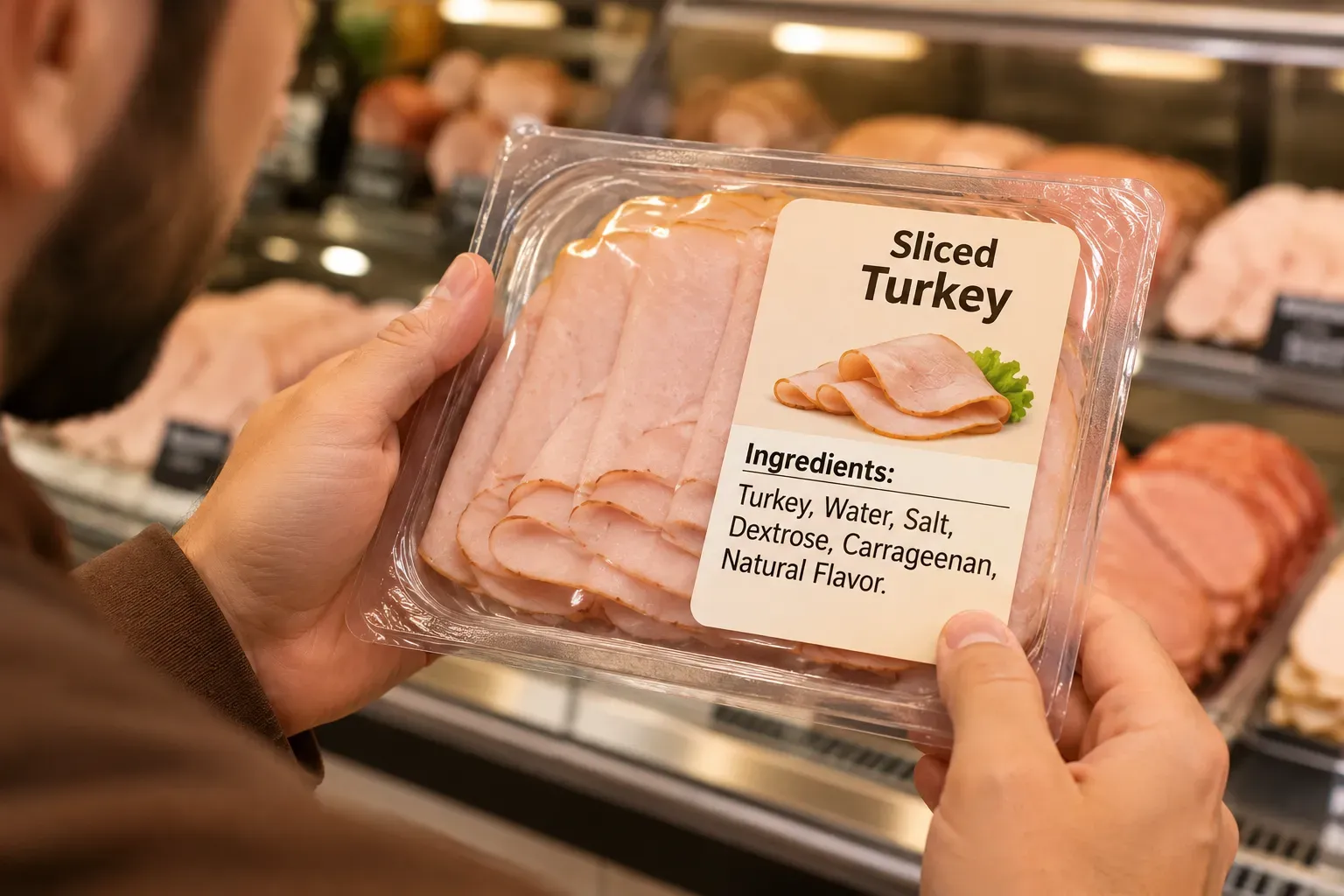
Casings deserve a second look. In the US, the USDA requires labels to name a natural casing's species when it differs from the meat inside, for example a beef sausage in a pork casing. In the UK, read the ingredients for the word "casing". If no animal is named beside it, treat the pack as doubtful.
Flavourings can carry alcohol too. Our ethyl alcohol guide explains where scholars draw the line.
Can a Deli Counter That Slices Pork Sell Halal Meat?
A counter can sell sealed, certified packs. Loose slices cut on a shared slicer are doubtful at best.
Slicers are hard to clean. A CDC study of retail delis found that many cleaned their slicers less often than advised. It named slicers as an important source of cross-contamination between products.
At the counter, you can:
- Ask whether halal meat has its own slicer and board.
- Choose pre-sealed, certified packs over loose slices.
- Check whether the shop is on a certifier's list. The Halal Monitoring Committee (HMC) monitors UK butchers, restaurants and takeaways.
Which Halal Logos to Look For
A trustworthy pack names its certifier, not just the word "halal". The word alone, with no body named, is a self-declaration.
UK certifiers also differ on stunning. A 2020 survey of UK halal standards found the HMC does not accept stunning, while the Halal Food Authority (HFA) accepts reversible electrical stunning. In the US, the IFANCA Crescent-M mark is common on processed foods. Scholars differ on stunning, so pick the standard you follow and look for its logo.
What you see | Result | Why |
|---|---|---|
A certifier you accept, no pork ingredients | Halal | Meat and additives are covered |
The word "halal" with no certifier named | Doubtful | Nobody outside the brand checked it |
Casing, gelatine or flavouring with no source | Doubtful | The source could be pork or alcohol |
Sliced at a counter that also slices pork | Doubtful | Shared blade, shared residue |
Uncertified turkey or chicken | Non-Halal for most certifiers | Slaughter method unknown |
Pork, lard or pork casing listed | Non-Halal | Prohibited ingredient |
Making a Halal Turkey Sandwich at Home
The surest halal turkey sandwich starts with a certified whole cut that you cook and slice yourself. Good cuts of halal meat for home-made slices include turkey breast, chicken breast and beef silverside or topside.
Roast the cut, let it cool, chill it, then slice it thin. You choose the salt and spices, and no shared slicer touches it.
One health note. The NHS counts sliced luncheon meats, including chicken and turkey, as processed meat. If you eat more than 90g of red and processed meat a day, it advises cutting down to 70g.
If you're pregnant, the NHS says cold pre-cooked meats such as chicken are fine if kept chilled and eaten before the use-by date. Cold cured meats such as salami should be cooked until steaming hot. That applies to halal salami too.
How to Check Cold Meats With Halal Scanner
Halal Scanner reads the barcode on a packed product and checks it against more than 1 million product records. Here's how to use it on cold meats.
- Scan or search. Open the app and scan the pack's barcode, or type the product name if you're shopping online.
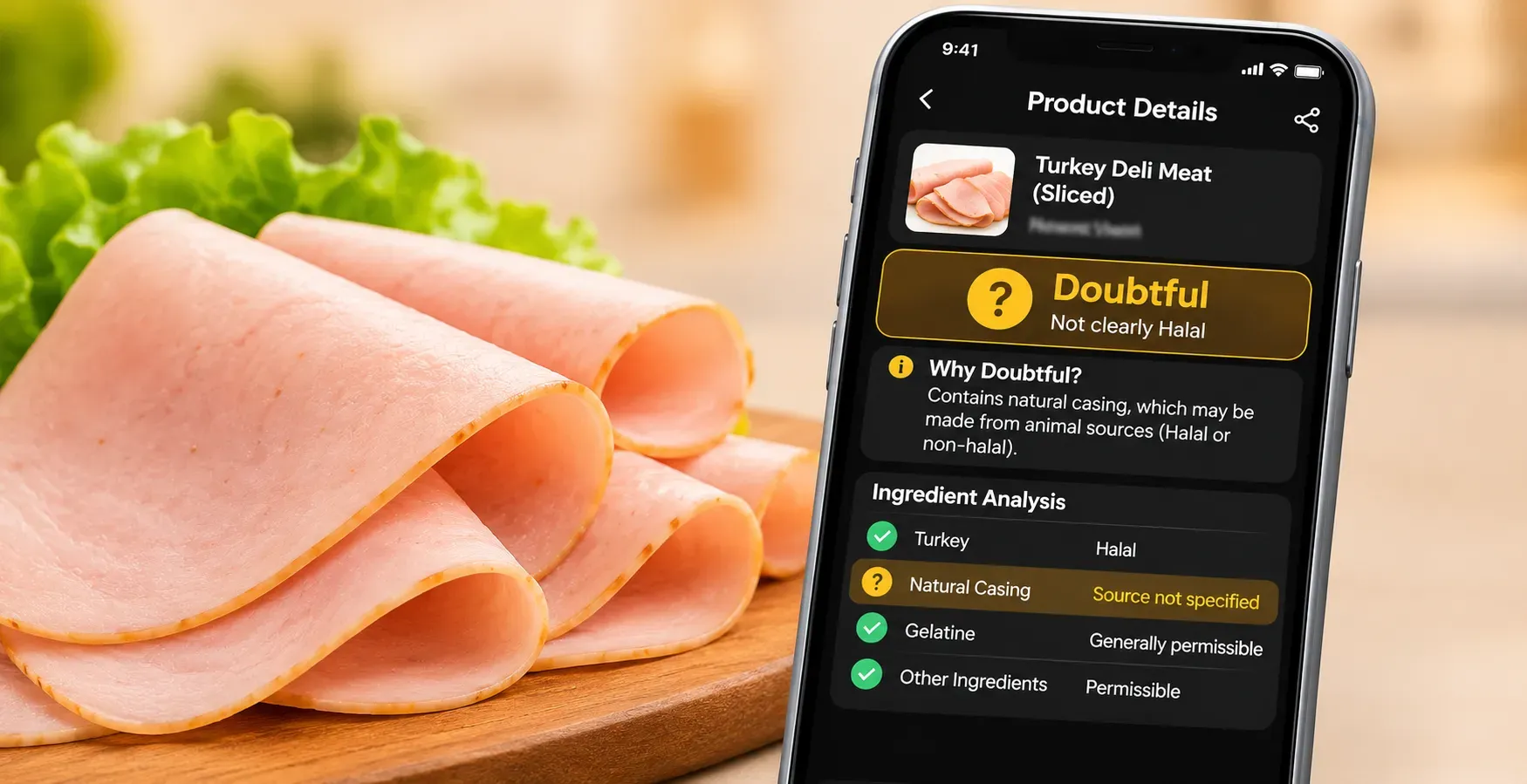
- Read the result. You'll see Halal, Doubtful or Non-Halal, with the ingredients that led to it.
- Handle Doubtful results. Tap the flagged ingredient, then check the certifier on the pack or ask the brand for its certificate.
- Save what passes. Add approved products to a shared halal list, so whoever shops next buys the same ones.
Loose slices from the counter have no barcode. For those, use the counter questions above.
The scan takes less time than reading the label. Download Halal Scanner free on the App Store or Google Play.
Why Shoppers Check With Halal Scanner
Halal Scanner is used by more than 500,000 people, with over 100,000 scans a day across 50+ countries (HalalScan figures, November 2026). Each result is checked against verified halal data and shown in three states, not a simple yes or no.
It's a checking tool, not a certifier. A logo from a recognised halal body is still the main assurance.
Shop Cold Meats With Confidence
Halal cold meats come down to three checks: a certifier you trust, clean ingredients and no shared slicer. Read the casing, gelatine and flavouring lines, and buy sealed certified packs when the counter is mixed.
For the packs in your basket, Halal Scanner gives you a result in seconds. Download it free and save your approved cold cuts to a shared halal list.
Run a deli, butcher or food brand that serves Muslim shoppers? Partner with HalalScan.