
Chicken is a halal animal, but a piece of chicken is only halal if the bird was alive, slaughtered by a Muslim with Allah's name, and properly bled. Most real-world doubt comes from three places: machine slaughter, stunning before the cut, and chicken ingredients hidden in processed food.
Picture a weekly shop in Birmingham or New Jersey. The tray of thighs says "halal." The box of nuggets says nothing. The stock cubes list "chicken extract." Each one needs a different check.
This guide explains what makes chicken halal, where scholars and certifiers disagree, and how to check a product before it reaches your basket.
Quick answer: is this chicken halal?
Situation | Status | Why |
|---|---|---|
Hand-slaughtered by a Muslim with Allah's name, no stunning, certified by a body you trust | Halal | Meets the zabiha conditions accepted by all major certifiers |
Hand-slaughtered after a reversible water-bath stun, under a certifier that allows it | Halal for many scholars, Doubtful for others | Certifiers and scholars differ on stunning |
Machine-slaughtered, with Allah's name said once when the line starts | Halal for some scholars, Doubtful or rejected by others | Scholars differ on whether one tasmiyah covers every bird |
Ordinary supermarket chicken with no halal certification | Doubtful (many scholars treat it as not halal) | Slaughter method and tasmiyah cannot be confirmed |
A bird that died before the cut, from the stun or any other cause | Non-Halal | Carrion is forbidden in Quran 5:3 |
Processed chicken with wine, pork gelatine or an unclear animal ingredient | Non-Halal or Doubtful | Haram or unverified ingredients |
Religious guidance note: this article is educational and is not a fatwa. For a ruling on your own situation, ask a qualified scholar or your local halal certifier.
For packaged chicken products, Halal Scanner can check the barcode and show a Halal, Doubtful or Non-Halal result. It is free to download on iOS and Android.
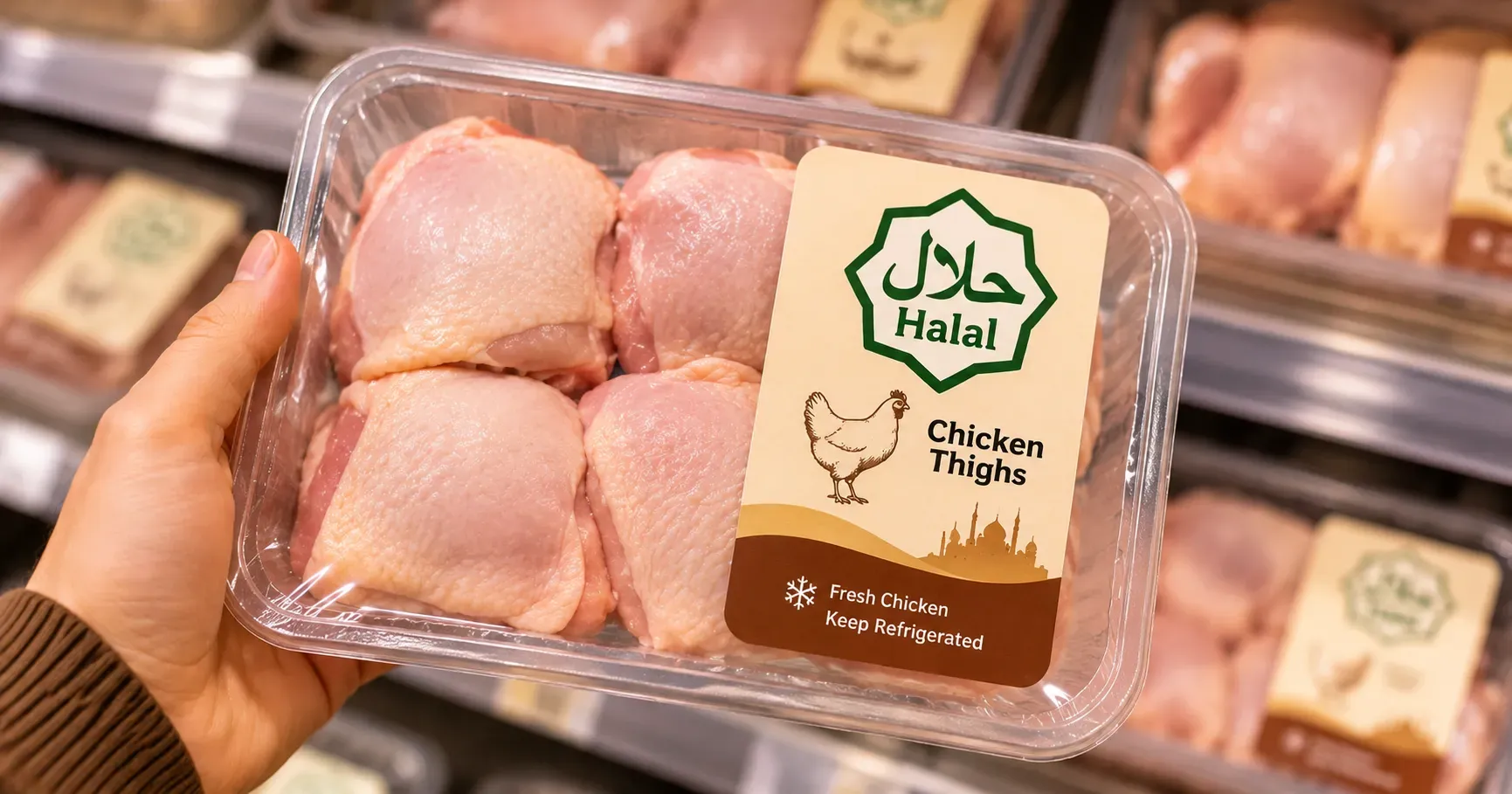
Is Chicken Halal in Islam?
Yes. Chicken is a lawful animal in all Sunni schools and among Shia scholars. No verse or authentic hadith forbids poultry. The rules are about how the bird dies and what is done to the meat afterwards.
Quran 5:3 forbids carrion, flowing blood, pork, meat dedicated to other than Allah, and animals killed by strangling, a blow, a fall, goring or a predator. The verse makes an exception for animals properly slaughtered before they die. So the species is never the issue. The slaughter is.
A peer-reviewed paper in Poultry Science (2016) notes that halal poultry rules come from the Quran and Hadith. It also notes that certification bodies interpret them differently, which is why two "halal" chickens can be produced in different ways.
What makes chicken halal: the zabiha conditions
Zabiha (or dhabiha) is the Islamic method of slaughter. For chicken, the core conditions are:
- The bird is alive and healthy when its throat is cut.
- The slaughterer is a Muslim. Many scholars also accept a Christian or Jewish slaughterer under Quran 5:5; others do not apply this to modern industrial meat. Our beef guide covers this difference in detail.
- Allah's name is said (the tasmiyah, "Bismillah, Allahu Akbar") at the time of slaughter.
- A sharp blade cuts the throat so the blood drains out. The UK's Halal Monitoring Committee (HMC) requires at least 3 of the 4 main vessels to be cut.
Classical scholars name the four vessels as the windpipe, the food pipe and the two jugular veins.
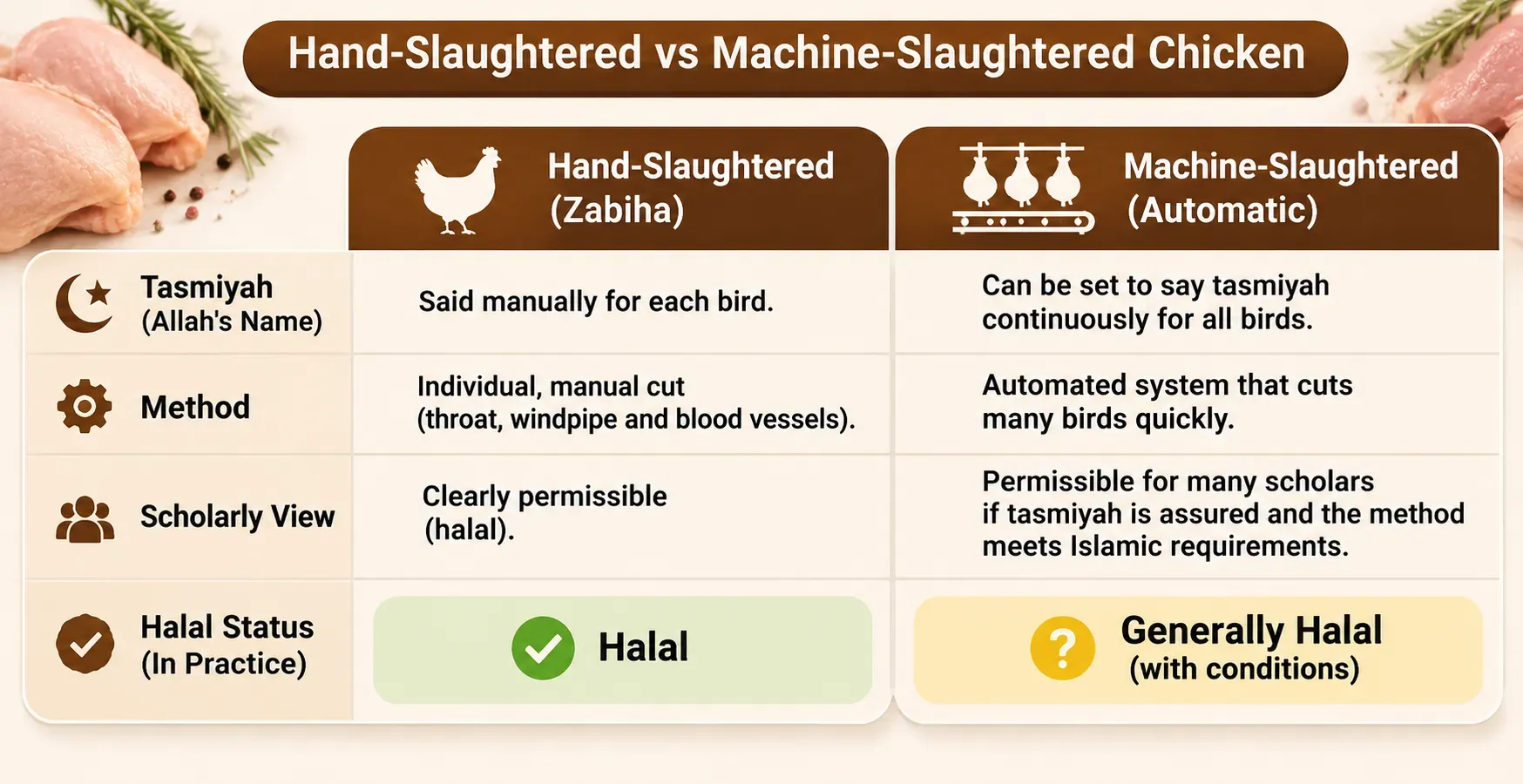
Hand-Slaughtered vs Machine-Slaughtered Chicken
Chicken is the one meat where machine slaughter is common. Large plants process thousands of birds an hour, so many use a rotating blade instead of a person with a knife. This is the biggest halal question for chicken, and scholars genuinely disagree on it.
In machine slaughter, birds hang upside down on a moving line and pass a rotating blade. In some plants, a Muslim says the tasmiyah once when the machine starts. In others, Muslim slaughtermen stand beside the line to catch any bird the blade misses.
The view that permits it. The Islamic Services of America explains that many scholars accept machine slaughter if certain conditions are met:
- A Muslim operator starts the machine with intention.
- The operator says the tasmiyah.
- The blade correctly cuts the neck vessels.
The view that rejects it. Many Hanafi scholars, including the Askimam fatwa service, say Allah's name cannot be said over each bird on a running machine. They therefore advise against machine-slaughtered chicken as a matter of caution.
Both positions are held by serious scholars. Neither is "the" Muslim view.
Notes | Hand-slaughtered chicken | Machine-slaughtered chicken |
|---|---|---|
Who cuts the throat | A Muslim slaughterman, bird by bird | A rotating blade on a moving line |
Tasmiyah | Said over each bird | Often said once when the line starts |
Scholarly view | Accepted by all major schools | Accepted by some, rejected by others |
Common label wording | "Hand slaughtered," "zabiha" | Often not stated on the pack |
Does "halal" on the pack tell you which method was used?
Not always. In the UK, the two largest certifiers both require hand slaughter for poultry today:
- The Halal Food Authority (HFA) states in its FAQ that it does not accept mechanical slaughter, and that Muslim slaughtermen cut every bird by hand.
- The HFA ended mechanical poultry slaughter in its certified plants from 3 March 2014.
That change is a reminder that certifier rules change. Always check a body's current standard.
In the US, the gap is wider. A 2011 petition asked the USDA to require halal and zabiha labels to state whether birds were hand- or machine-slaughtered. The USDA denied it.
A 2025 petition asked the agency to define "zabiha halal" as hand-slaughtered without stunning. Until a rule like that exists, the word "zabiha" on a US pack is only as reliable as the certifier behind it.
Is Stunned Chicken Halal?
Scholars and certifiers differ. Most commercial chickens are stunned in an electrified water bath before the cut. Some certifiers accept this if the stun is reversible and the bird is still alive at slaughter. Others reject any stunning, because a stun can kill some birds before they are cut.
Stunning is the normal practice in British poultry plants. In the government's 2024 slaughter survey for England and Wales, 97% of poultry were stunned before slaughter, up from 95% in 2022. That report counts halal stun slaughter as stunned slaughter. So a halal label alone does not tell you whether the bird was stunned.
The two main UK certifiers take opposite positions:
Certifier | Stunning chicken | Machine slaughter | How to check |
|---|---|---|---|
Halal Monitoring Committee (HMC) | Not accepted; every bird cut by hand | Look for HMC's serialised label; search its outlet list | |
Halal Food Authority (HFA) | Controlled water-bath stun allowed, with a vet checking birds do not die before slaughter | Not accepted | Look for the HFA logo; check the HFA standard |
If you follow a no-stun standard, choose a certifier that matches it. If your scholar accepts a reversible stun, a wider range of halal-certified chicken is open to you. For survey data on how scholars and shoppers view stunning, see our beef guide.
Fresh chicken from the butcher depends on the certifier. Packaged chicken products are faster to check: scan the barcode in Halal Scanner and see the result for that exact product.
Halal Chicken vs Regular Chicken: What Actually Differs
The difference is in slaughter and supervision, not in the bird itself. Halal and regular chicken can come from the same breed and the same farms. What changes is who cuts the throat, whether Allah's name is said, whether stunning is used, and whether a certifier monitors the line.
Some websites claim halal chicken has less fat or more nutrients. Halal rules govern slaughter and handling, not the nutrition label. Judge the product by its certification and ingredients, not by health claims.
One label term causes confusion. "Mechanically separated chicken" describes meat removed from bones by machine after slaughter. It says nothing about whether the bird was slaughtered by hand or by machine.
Chicken Ingredients in Processed Food
Chicken-based ingredients follow the same rule as fresh chicken. They are halal only if the birds were slaughtered Islamically and nothing haram was added. Processed products add a second layer, because the recipe may contain other animal ingredients or alcohol.
Ingredient on the label | What it can contain | What to check |
|---|---|---|
Chicken extract, stock or broth | Chicken meat and bones | Halal slaughter of the birds; no wine in the recipe |
Chicken fat | Rendered chicken fat | Halal slaughter of the birds |
"Chicken flavour" or natural flavourings | Real chicken extract, or flavourings with no chicken at all | The source, plus any alcohol used as a carrier |
Gelatine (in some glazes, jellied or coated products) | Pig, cattle or fish | Source animal plus a halal mark |
E471 (mono- and diglycerides) | Plant oils or animal fats | A halal or vegetarian mark, or ask the maker |
Wine or mirin in a marinade | Alcohol from grapes or rice | Most scholars treat these as non-halal |
Flavourings can use ethanol as a solvent. Scholars differ on trace amounts, and our guide to ethyl alcohol in food sets out the views.
Halal chicken can also lose its status after slaughter. A shared fryer with pork products, or a grill used for bacon, creates cross-contamination. When eating out, our halal menu guide lists what to ask before you order.
How to Check If Chicken Is Halal Without an App
You can check most chicken with a few habits. Each step below works without Halal Scanner.
- Find the certifier, then check its standard. A logo tells you who certified the chicken, not how. Match the certifier's rules on stunning and machine slaughter to the standard you follow.
- Look for HMC's serialised label. HMC advises shoppers to check for its coloured, serialised label on the chicken. Its certificates also list each certified item, so read the list.
- Ask the butcher two questions. Which body certifies your chicken? Is it hand-slaughtered without stunning? A trustworthy shop will answer and show the certificate.
- Do not rely on "zabiha" alone in the US. The word is not defined by federal labelling rules. Check the named certifier's published standard.
- Travelling? Certifiers and rules change by country. Our international halal food guide explains what to check abroad.
How to Check Chicken Products With Halal Scanner
Halal Scanner checks a packaged product's ingredients against its database and returns one of three results: Halal, Doubtful or Non-Halal. It works best for barcoded products, such as nuggets, stock cubes, chicken sausages, ready meals and chicken-flavoured snacks. For fresh butcher chicken without a barcode, use the certifier checks above.
- Scan the barcode. Open Halal Scanner and point your camera at the barcode.
- Or search an ingredient. No barcode? Type "chicken extract," "gelatine" or "E471" into the text search.
- Read the result. You will see Halal, Doubtful or Non-Halal for that exact product, not for chicken in general.
- Handle a Doubtful result. Doubtful (mashbooh) usually means a source is not stated, such as plain "chicken fat" or "flavourings." Check for a certifier logo, contact the maker, or set it aside if you follow a strict standard.
- Save it to a shared halal list. Add checked products to a shared halal list. One person builds it at home, another shops from it in the store.
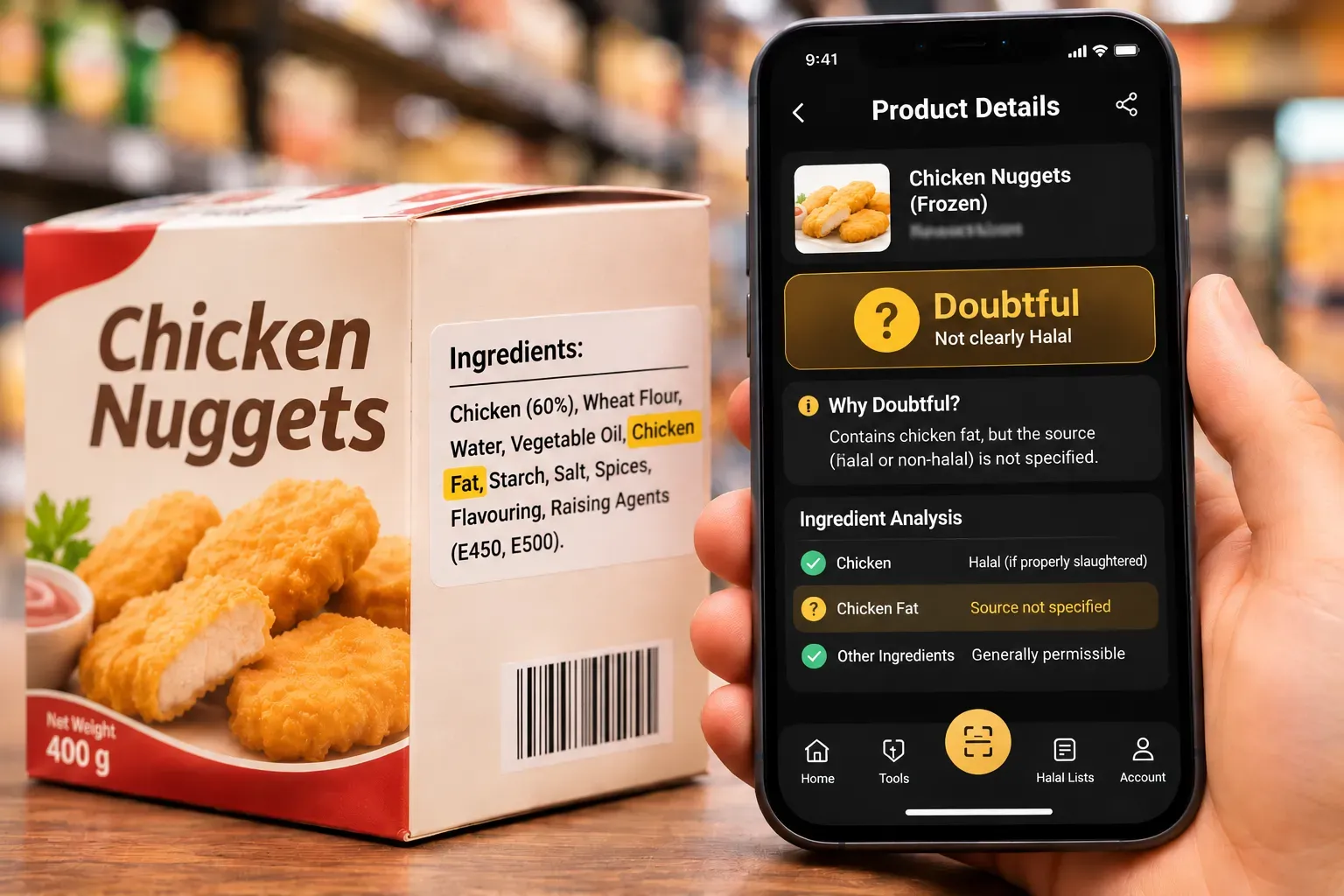
The scan takes less time than reading the label. Halal Scanner is free to download, with extra features available by subscription. Tap the App Store or Google Play badge below to get it.
Download on the App Store · Get it on Google Play
Halal Scanner is a research and verification tool. It does not replace certification from a recognised halal body or the advice of your scholar.
Why Shoppers Trust Halal Scanner
Halal Scanner reports these figures for its service:
Measure | Figure |
|---|---|
Product records in the database | 1 million+ |
Scans per day | 100,000+ |
Users | 500,000+ |
Countries covered | 50+ |
The app also includes Qibla direction, prayer times, a mosque finder and other Islamic tools. See how it works or browse checked products.
The Bottom Line
Chicken is halal in Islam. What decides a specific pack is how the bird was slaughtered, whether a stun or machine was involved, and what else went into the product. Scholars differ on stunning and machine slaughter, so match the certifier to the standard you follow.
Check for a trusted certifier first. For packaged products, scan the barcode. Download Halal Scanner to get a Halal, Doubtful or Non-Halal result before you buy. You can find more ingredient guides on the Halal Scanner blog.