
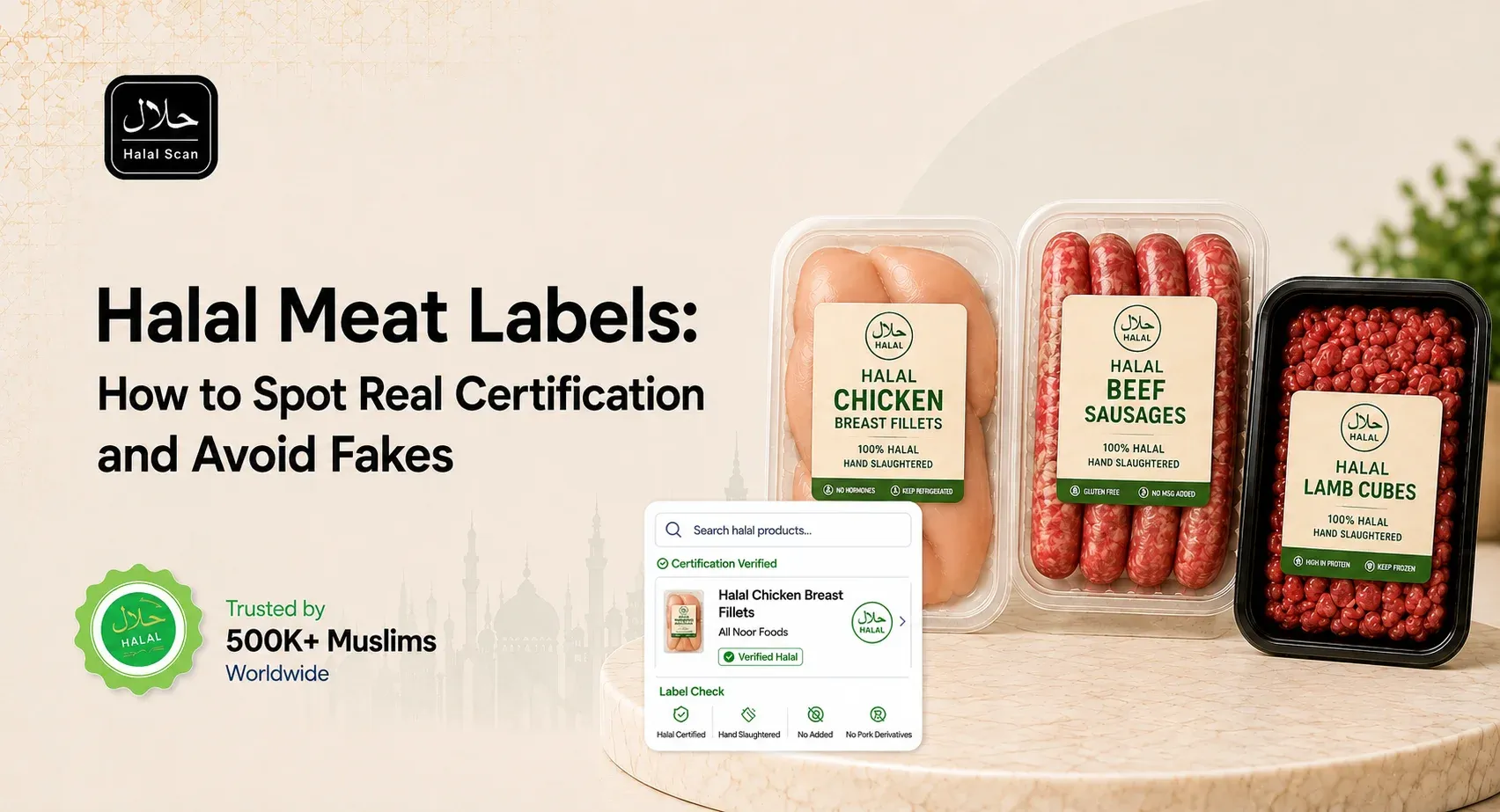
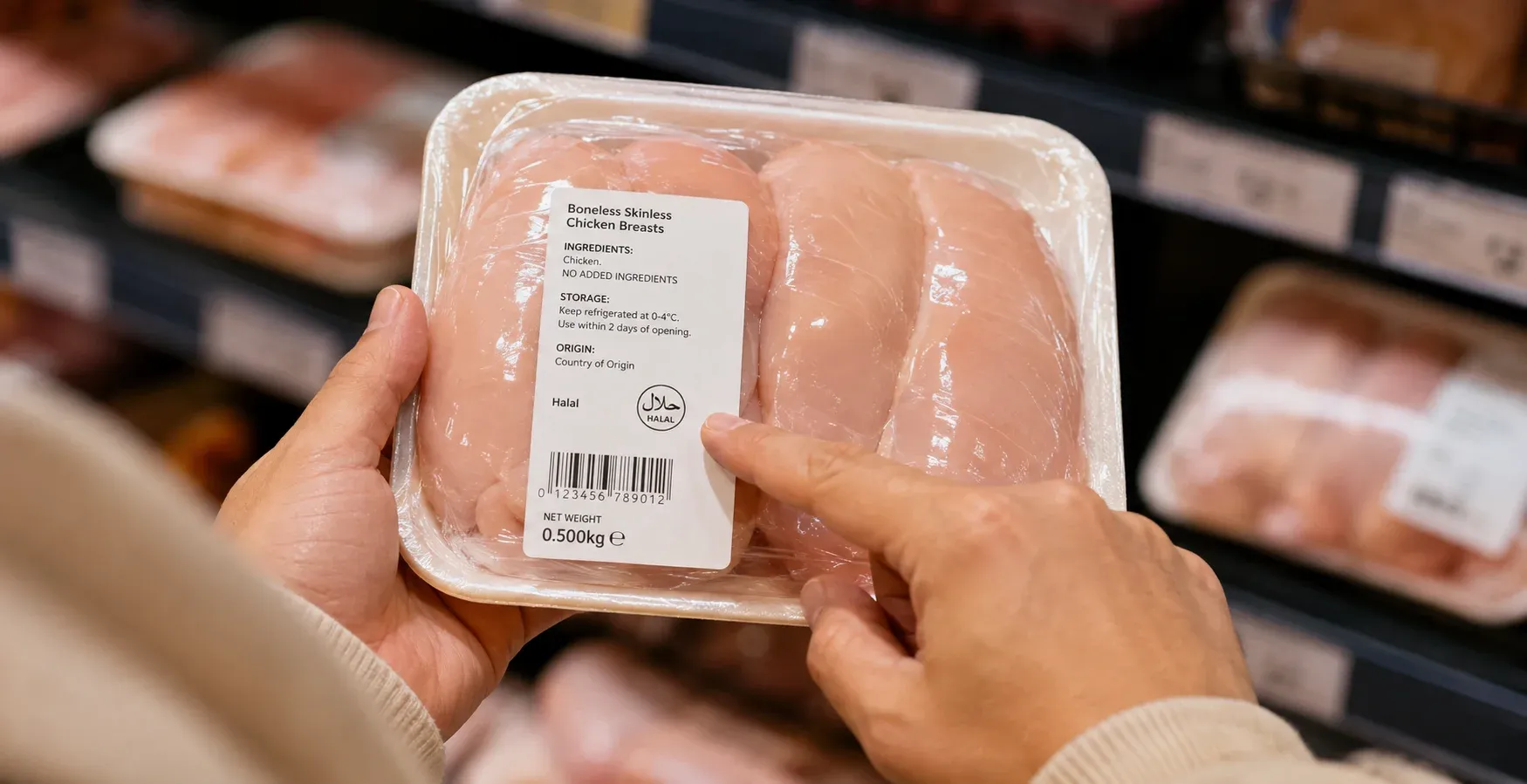
You are standing in the meat aisle of a local North American supermarket. You pick up a pack of chicken breasts, and right there on the plastic is a small green circle with the word "Halal" in Arabic. It looks official enough.
But without the name of a recognized certifying body attached to it, that stamp might mean nothing. In countries where halal food regulations are not strictly enforced by the government, anyone can print a graphic on a package. The responsibility of verifying a halal meat label falls entirely on you.
What Is a Halal Certification Label?
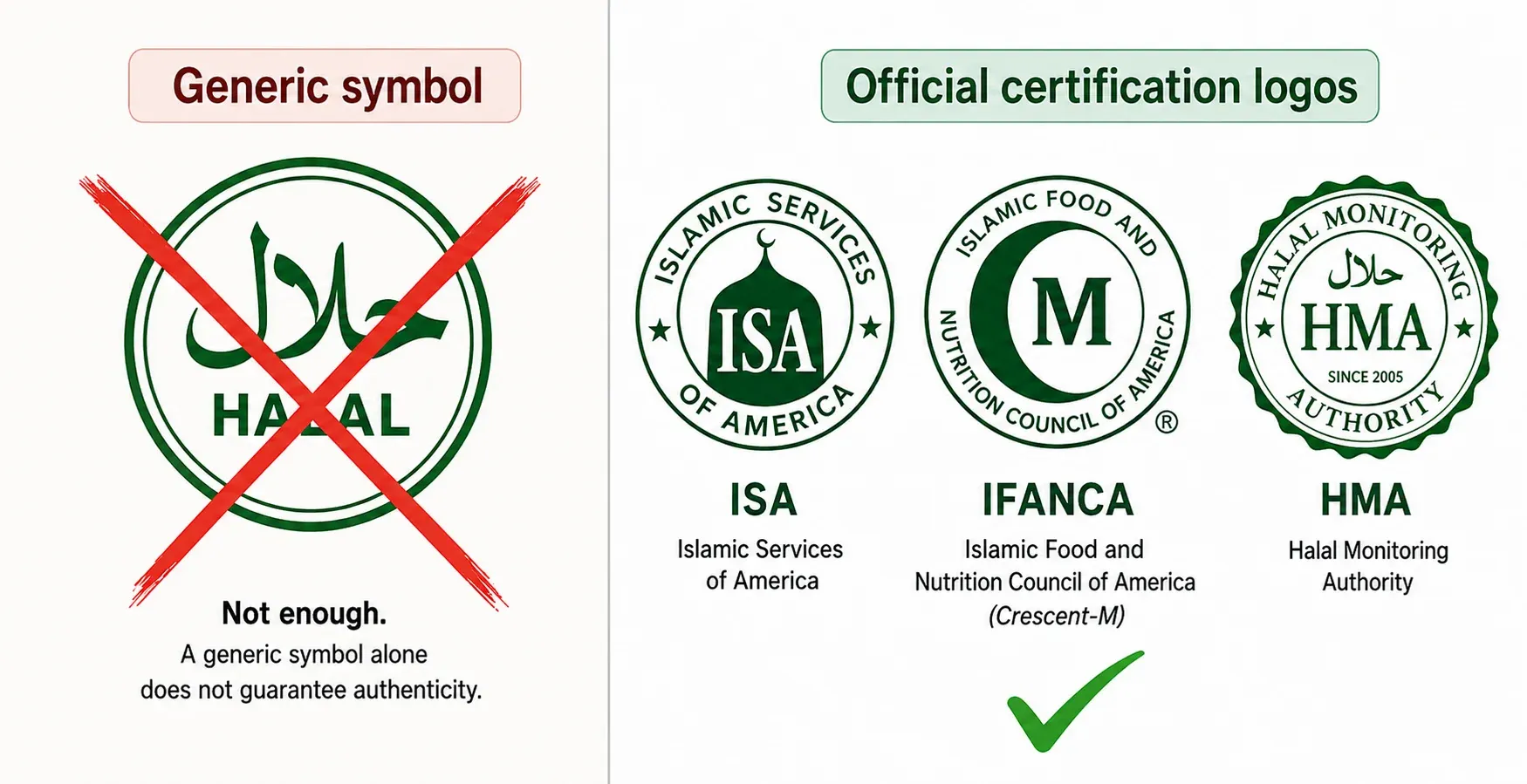
A legitimate halal symbol on food is a registered trademark issued by an independent Islamic auditing organization. It indicates that inspectors have verified the product’s ingredients, facility, and processing methods meet specific halal dietary standards. A generic Arabic "halal" stamp without an organization's name is not necessarily a certification.
The Problem With Generic Halal Stamps
A quick internet search for "halal symbol" brings up thousands of free vector graphics. Any manufacturer can download these generic logos and print them on food packaging.
Brands often do this assuming their vegetarian or plant-based product is naturally halal. They do this without realizing that equipment cross-contamination, hidden alcohol in flavorings, or shared fryers can make the product doubtful (mashbooh).
When you see a plain green circle with no certifier name, proceed with caution. It is a marketing graphic, not proof of an independent halal audit.
Feature | Generic Halal Stamp | Official Certification Logo |
|---|---|---|
Issuer | Graphic designer or stock website | Islamic auditing organization |
Oversight | None | Facility inspections, ingredient tracking |
Visuals | Plain Arabic text, no brand name | Includes the certifier's specific acronym or name |
Reliability | High risk for non-halal / doubtful ingredients | Indicates certification by the named certifying organization |
What Does Legitimate Halal Certification Look Like?
Real halal certification labels in the USA and Canada come from recognized organizations with specific certification processes. You want to look for identifiable, registered emblems rather than generic clip art.
For example, the Islamic Services of America (ISA) and the Islamic Food and Nutrition Council of America (IFANCA) both use distinct certification logos. In Canada, the Halal Monitoring Authority (HMA) emblem is widely recognized.
These symbols indicate that a certifying organization has conducted an assessment of the relevant ingredients, processing, and facility practices. Depending on the certification requirements, inspectors may review ingredients such as gelatin, verify the zabiha slaughter process for meat, and assess procedures designed to prevent contamination.
Rather than memorizing every regional halal emblem on food packaging, you can scan the barcode and get product information in seconds with Halal Scanner.
How to Check This With Halal Scanner
Even when you recognize a halal certified symbol, product formulas can change and certifications can lapse. Here is how to verify product information instantly at the supermarket:
Open the app: Launch Halal Scanner while you are standing at the shelf.
Scan the barcode: Point your camera at the product's barcode label.
Use Image Scanner: If you cannot scan a barcode, use the Image Scanner to capture the product label or ingredient list and review the available product information.
Read the result: Halal Scanner cross-references its database and provides a clear classification of Halal, Doubtful, or Non-Halal when information is available.
Review the details: If a product comes up as Doubtful (mashbooh), the app flags the specific high-risk ingredient—like E471 or an unspecified natural flavor—so you can make a more informed choice.
Save to a list: Add verified safe items to a shared halal list so your family can shop from it later.
The scan takes less time than reading the label manually. Download Halal Scanner from the App Store or Google Play.
The Scale of Verified Halal Data
You are not alone in checking your groceries. Halal Scanner's database draws on halal-related sources across 50+ countries. The platform helps users verify product information through barcode scanning and other product data.
Each day, over 500,000 users worldwide perform over 100,000 scans against a database containing information on more than one million products.
What If the Food Has No Halal Emblem?
Sometimes, safe products may not display the halal stamp at all. Brands must incur a cost to obtain halal certification, and hence, many brands may choose to forgo certification.
In such cases, users must check the ingredients themselves. Potential problems include the amino acid L-Cystine, which in some cases may be derived from feathers; cheese that contains rennet, which in itself may be halal, but is derived from a cow's stomach; and carmine (also known as E120), which is a red colorant; and possible hidden alcohol in various flavorings like vanilla extract.
If you don't have time to manually check E-numbers and enzyme sources in the aisle, open Halal Scanner to search the database. It is available with free features and takes some of the guesswork out of your weekly shop.
Shop With Confidence
Finding a trusted halal meat label should not feel like a guessing game. By knowing which official symbols to look for and using technology to check product information, you can make more informed choices about the food you buy.
Ready to take the guesswork out of grocery shopping? Get Halal Scanner from the App Store or Google Play and start checking your products.