
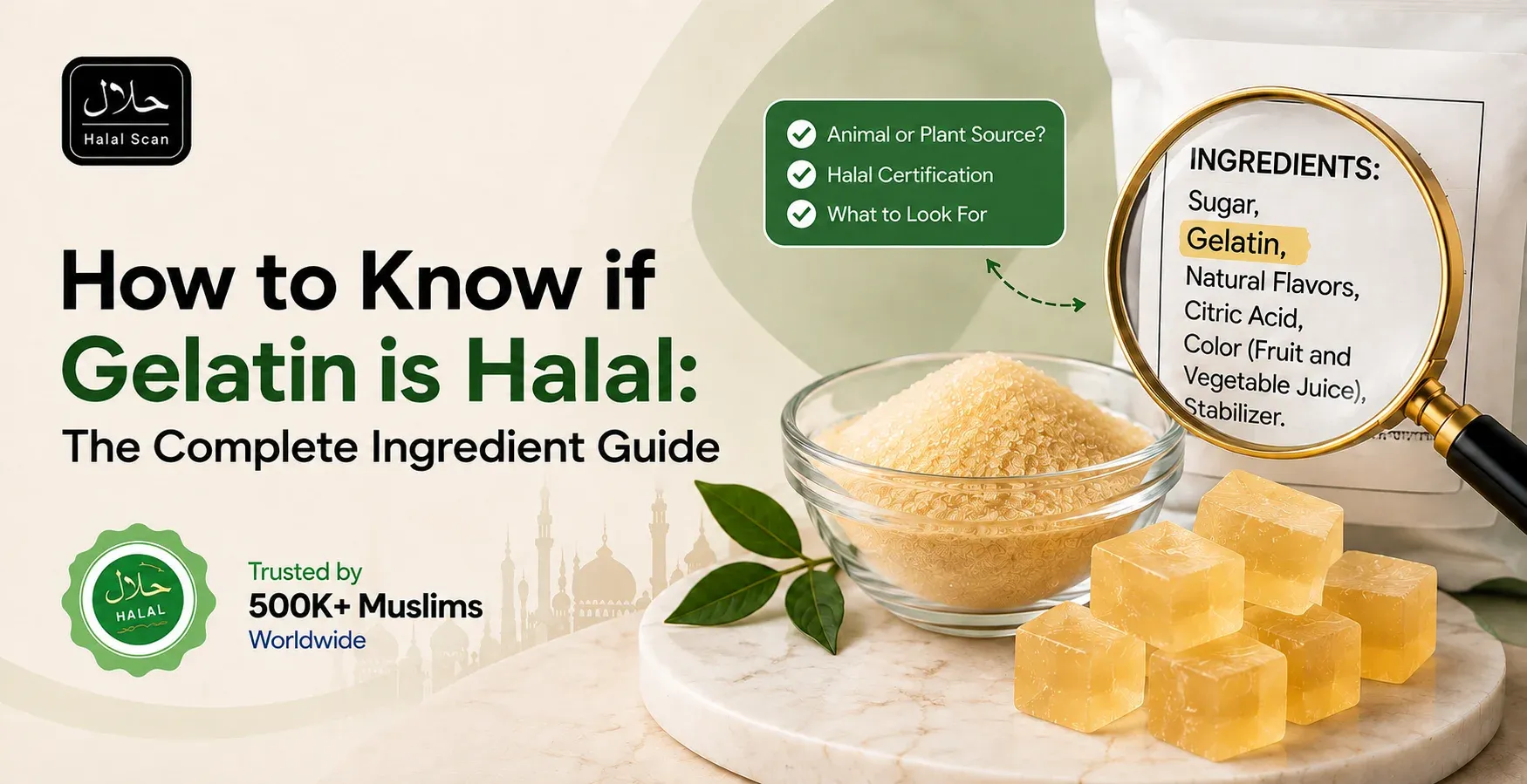
You are standing in the supermarket aisle, looking at a packet of gummy vitamins for your family. The ingredients list looks harmless until you spot one word: gelatin. Is it from beef? Pork? Fish? And if it is from beef, was the animal slaughtered according to Islamic guidelines? In Western supermarkets, a simple ingredients label rarely gives you the whole story, leaving you guessing about what goes into your shopping cart.
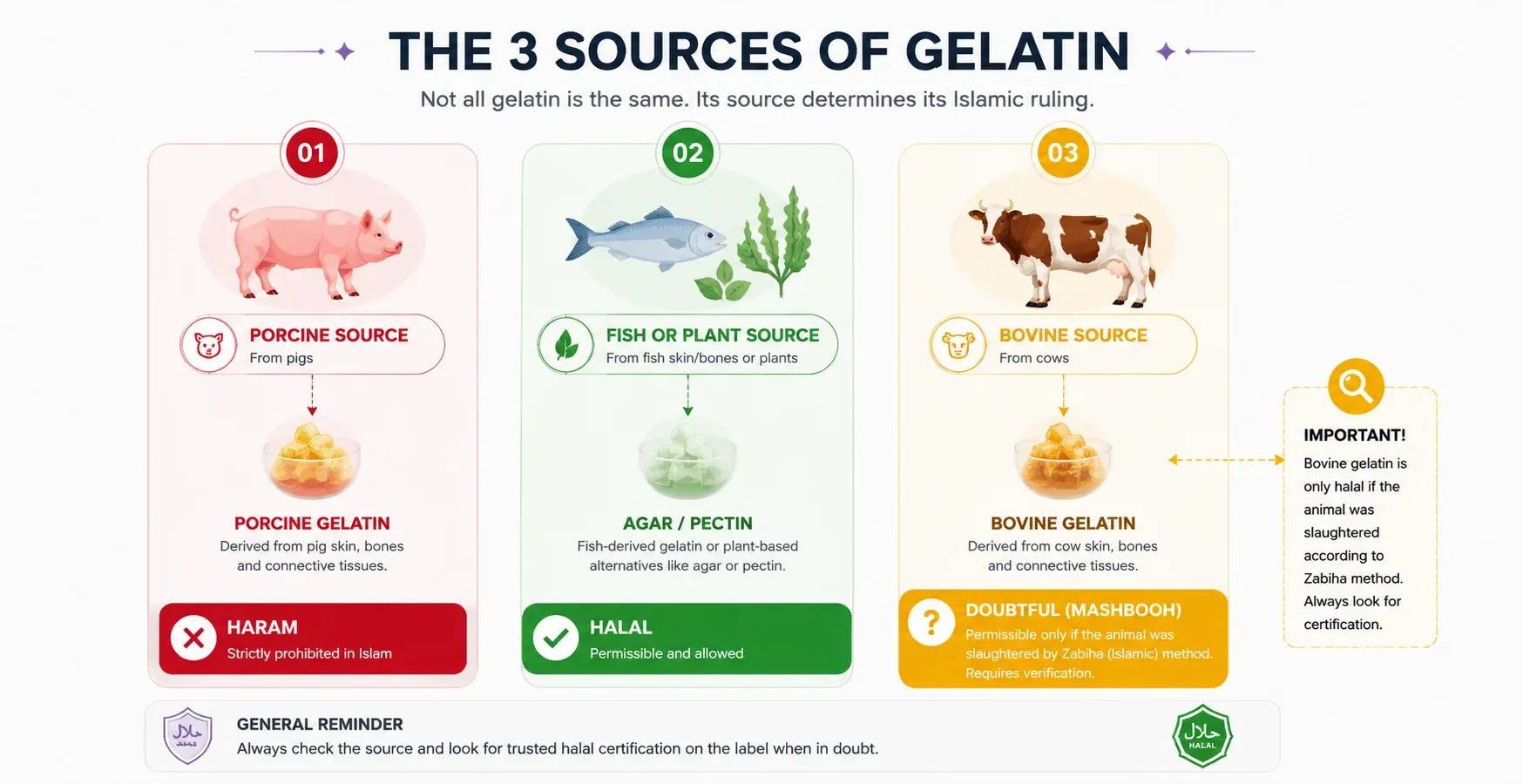
To know if gelatin is halal, you must identify its source animal and slaughter method. Gelatin derived from permissible fish species is generally halal, while plant-based alternatives such as agar and pectin are generally halal by their source. However, the complete product should still be checked for other ingredients and processing aids. Gelatin from pigs (porcine) is strictly haram. Bovine (beef) gelatin is only halal if the animal was slaughtered according to Islamic guidelines (zabiha). If the source or slaughter method is unknown, its status is considered doubtful (mashbooh).
Understanding how gelatin is made, and why its source matters, is the key to shopping with confidence.
Why Western Food Labels Hide the Truth About Gelatin
Gelatin (often listed as E441 in Europe) is a protein derived from collagen. It is extracted by boiling the skin, bones, and connective tissues of animals. Because it is a cheap, highly effective gelling agent, manufacturers use it in everything from marshmallows and yogurts to cosmetics and pill capsules.
The problem for Muslim shoppers in countries like the US, UK, Canada, and Australia is that food regulators do not require manufacturers to specify the animal source. A label might simply read "gelatin." Unless the packaging explicitly states "fish gelatin" or carries a verified halal certification, that ingredient could easily be derived from pigs.
Is Bovine Gelatin Halal? (And What "BSE Free" Actually Means)
When a label specifies "bovine gelatin," it means the ingredient comes from cattle. While cattle are permissible animals in Islam, this does not automatically make the gelatin halal.
For bovine gelatin to be halal, the cattle must have been slaughtered according to strict Islamic requirements (zabiha). If the cattle were processed in a standard commercial slaughterhouse without Islamic protocols, the resulting meat—and the gelatin derived from its bones and skin—is generally considered haram by most Islamic scholars.
You may also see the term “BSE-free bovine gelatin.” BSE (Bovine Spongiform Encephalopathy), commonly known as “mad cow disease,” is a disease that affects cattle. BSE-related claims refer to the safety and sourcing of bovine materials with respect to BSE risk. They are separate from halal certification and do not indicate that the gelatin was produced according to Islamic dietary requirements or that the cattle were slaughtered according to halal practices. FDA and EU regulations include measures to control BSE risks associated with cattle-derived materials, including gelatin.
Sources:
- FDA – Use of Materials Derived From Cattle in Human Food and Cosmetics
- EFSA Journal – BSE risk posed by ruminant collagen and gelatine derived from bones
The Fiqh and Science of Transformation (Istihalah)
When researching gelatin, you will inevitably encounter the Islamic legal concept of istihalah (chemical transformation).
Istihalah occurs when an impure substance undergoes a complete chemical change, turning into an entirely new, pure substance. A classic example is wine turning into vinegar. Some have argued that boiling animal bones into gelatin is a form of istihalah, which would theoretically make even pork-derived gelatin pure.
However, modern food science and the vast majority of contemporary Islamic scholars disagree with this application for gelatin. As detailed in academic studies published in ScienceDirect, the extraction of gelatin from collagen is a physical change, not a complete chemical metamorphosis. The protein structure remains largely intact. Consequently, leading Islamic authorities—such as those cited by IslamQA—maintain that porcine gelatin remains haram, and bovine gelatin remains tied to the halal status of the slaughter.
Sources:
- ResearchGate – Istihalah: Analysis on the Utilization of Gelatin in Food Products
- Academia.edu – Theoretical Concept of Istihalah in Gelatine Application: A Review
Is Beef Gelatin Halal in Sweets?
Whether it is gummy bears, marshmallows, or fruit snacks, sweets rely heavily on gelatin for their chewy texture.
Is beef gelatin halal in sweets? Only if you can verify the sourcing. Many popular candy brands source their bovine gelatin globally, often buying the cheapest batch available on the commodities market. Because supply chains frequently mix zabiha and non-zabiha bovine gelatin, sweets containing generic beef gelatin fall directly into the category of mashbooh (doubtful) unless a recognized halal authority has audited the production line. According to the sources FAO – Production, Properties and Uses of Carrageenan,
Gelling Alternatives to Look For
- Pectin: Fruit-derived, generally considered halal.
- Agar-Agar: Seaweed-derived, generally considered halal.
- Carrageenan: Seaweed-derived (red algae), generally considered halal.
Is Bovine Gelatin Halal in Medicines?
The pharmaceutical industry uses gelatin extensively to manufacture softgel capsules and hard pill casings.
Is bovine gelatin halal in medicines? The dietary rules remain the same: if the bovine source is not zabiha, it is not halal. However, medicine introduces a different fiqh context: necessity (darurah). If a doctor prescribes a life-saving medication wrapped in a gelatin capsule, and no halal or vegetarian alternative exists, scholars generally permit its use out of medical necessity.
For daily supplements, vitamins, and over-the-counter painkillers, necessity does not apply. You are expected to seek out halal-certified, vegetarian, or tablet-form alternatives.
How to Check Gelatin Sourcing With Halal Scanner
Memorizing E-numbers and emailing manufacturers takes too much time when you are managing a busy weekly shop. Here is how you can verify products efficiently:
- Look for recognized halal logos. A stamp from recognized bodies like IFANCA, HMC, or JAKIM is your strongest guarantee.
- Check for Vegan or Kosher labels. A certified "Vegan" label means the product contains zero animal gelatin. A Kosher label (like the OU symbol) means it contains no pork, but you still need to verify if their specific standard accepts non-zabiha beef gelatin.
- Scan it instantly with Halal Scanner. Instead of guessing, open the app and scan the barcode.
- Read the three-state result. Halal Scanner cross-references the product against verified databases. It will clearly return a status of Halal, Doubtful, or Non-Halal based on the specific ingredients and brand transparency.
- Save safe products. Found a gummy candy that is actually halal? Save it to a shared halal list in the app so your family knows exactly which brand to buy next time.
The scan takes less time than reading the label. Halal Scanner is free to download, with premium features available for advanced dietary tracking. Tap the App Store or Google Play badge to get started.
Halal Scanner supports your dietary choices with a database the company reports includes over 1 million verified products. According to the app's own figures, it has 500,000+ users across 50+ countries, performing more than 100,000 scans a day to help keep their families' diets pure. Download Halal Scanner to join them.
Shop with Certainty
Food is deeply tied to faith. You shouldn't have to compromise your deen just because a manufacturer chose a vague label. Now that you know what to look for, you can take the guesswork out of the grocery aisle.
Scan any product and get the result in seconds. Download Halal Scanner for free on the App Store or Google Play.