
You are standing in the supermarket aisle holding a box of crackers. You check the back. The ingredients list includes whey powder, E471, and natural flavorings. Your weekly shop pauses while you pull out your phone, trying to figure out if the whey involves animal rennet, or if that E-number comes from soy or pork.
Trying to decipher complex food labels is exhausting. When you cannot rely on a clear halal certification stamp, grocery shopping becomes a time-consuming research project.
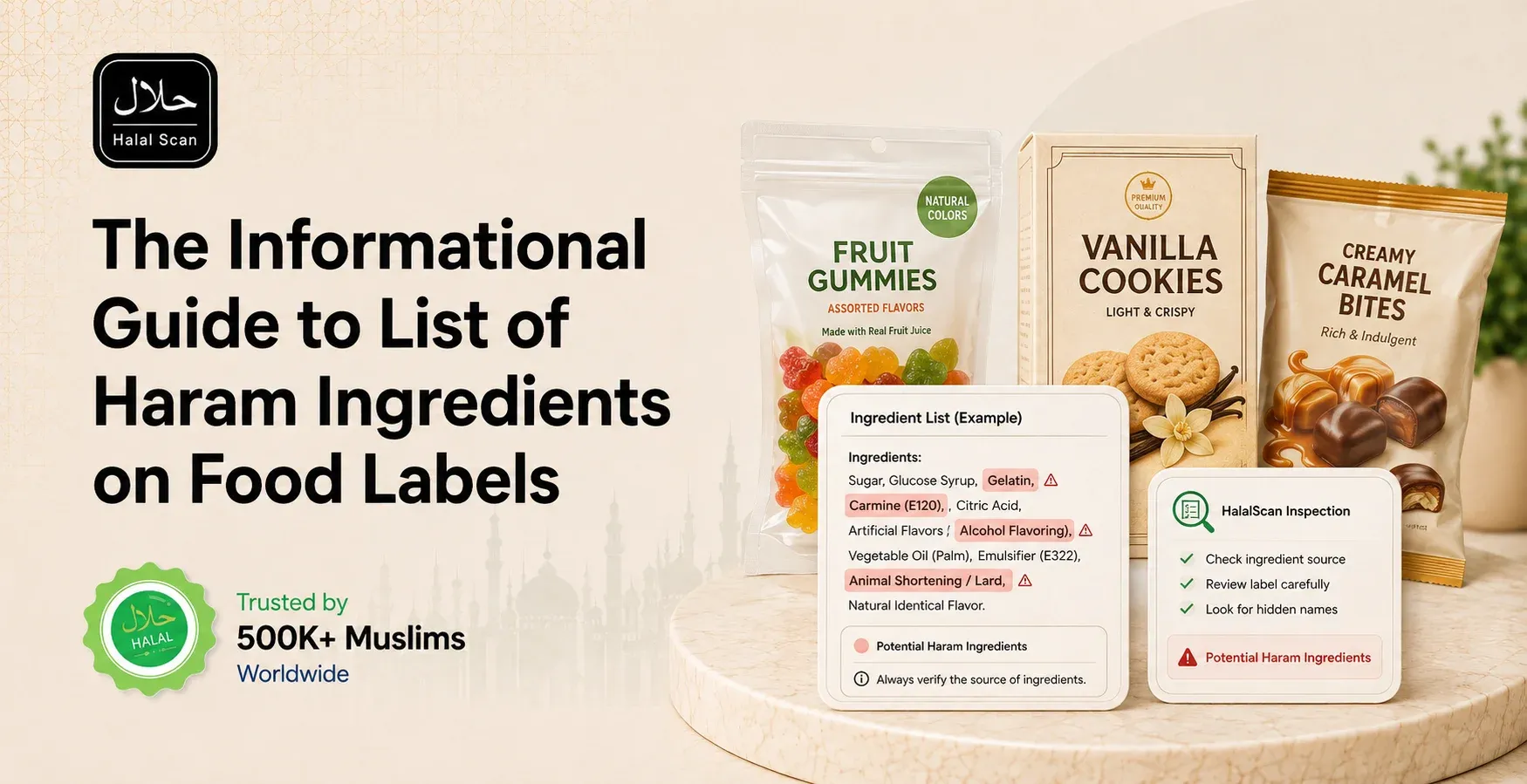
Identifying the list of haram ingredients requires checking labels for clear animal-derived additives (like pork gelatine), intoxicating substances (like alcohol in extracts), and cross-contamination risks. However, many common ingredients are "mashbooh" (doubtful), meaning their source plant, synthetic, or animal is not declared on the packaging.
The Three Categories: Halal, Haram, and Mashbooh
When checking a label, many shoppers look for a simple "halal or haram" binary. In modern food science, this binary often fails. Ingredients frequently fall into a third category known in Islamic jurisprudence as mashbooh.
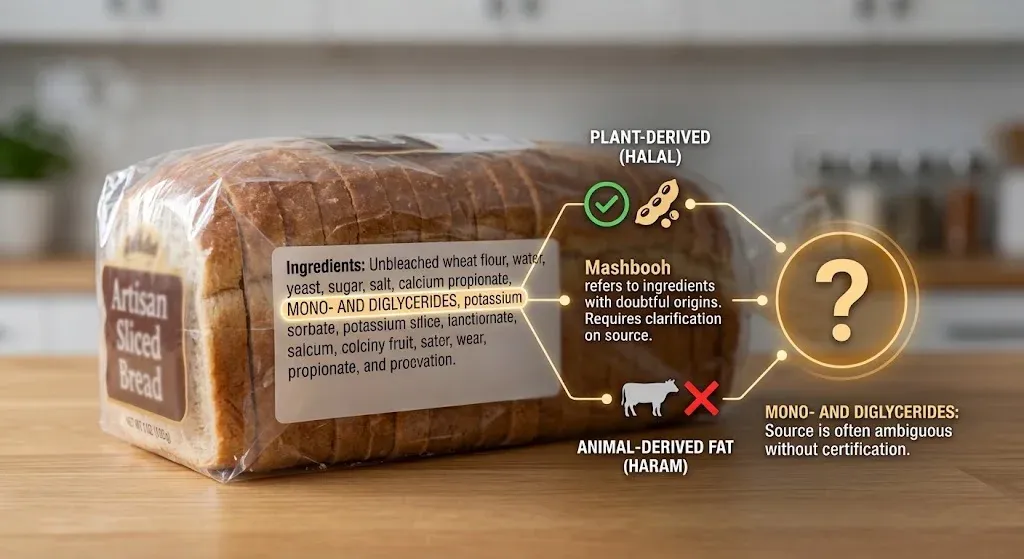
Mashbooh means doubtful or questionable. It applies to an ingredient that could be halal or haram depending on its undisclosed origin.
For example, mono- and diglycerides of fatty acids (often used to keep bread soft) can be derived from soybean oil (halal) or animal fat (haram). If the label does not specify "plant-derived," the ingredient is mashbooh. Different scholars have varying guidelines on how to approach mashbooh items, but the general consensus is to avoid them until you can verify the source.
High-Risk Hidden Haram Ingredients
Some ingredients are obvious red flags, such as "pork fat" or "wine vinegar." Others hide behind chemical names or vague industry terms.
Gelatine (E441)
Gelatine is a protein obtained by boiling skin, tendons, ligaments, and/or bones with water. In Western countries, commercial gelatine is overwhelmingly derived from pigs (porcine) or non-zabiha cattle (bovine). Unless a product explicitly states "fish gelatine," "beef gelatine (halal certified)," or uses a plant-based alternative like pectin or agar-agar, it should be heavily scrutinized. There is a scholarly difference of opinion regarding istihalah (chemical transformation) of gelatine, but many major organizations, including the Halal Food Authority (HFA) standards, consider standard commercial gelatine to be non-compliant.
L-Cysteine (E920)
L-cysteine is an amino acid used extensively in commercial baking to condition dough. While it can be synthesized in a lab, a massive portion of commercial L-cysteine is derived from animal sources—specifically poultry feathers or human hair. You will often find this in mass-produced bagels, pizza crusts, and bread rolls.
Carmine / Cochineal (E120)
Carmine is a bright red food coloring used in candies, yogurts, and juices. It is derived from crushed cochineal insects. While some scholars permit it, many major halal certification bodies and Islamic councils classify insect-derived food coloring as haram.
Natural Flavors
This is one of the most frustrating terms on a label. "Natural flavors" simply means the flavor was derived from a plant or animal source. It can legally hide the presence of alcohol (used as a carrier solvent for the flavor) or animal extracts. For instance, vanilla extract legally requires a minimum of 35% alcohol by volume in the US.
E-Numbers: A Quick Reference Guide
E-numbers are codes used in Europe, Australia, and other regions to identify food additives. While many are perfectly safe and halal (like E300, which is just Vitamin C), others carry high risks.
E-Number Risk Classification
Ingredient / E-Number | Common Use | Halal Status | Reason |
|---|---|---|---|
E120 (Carmine) | Red coloring in sweets | Non-Halal (majority view) | Derived from crushed insects. |
E441 (Gelatine) | Gelling agent in marshmallows | Doubtful (Mashbooh) | Usually porcine or non-zabiha beef unless specified. |
E471 (Mono- and diglycerides) | Emulsifier in baked goods | Doubtful (Mashbooh) | Can be plant or animal fat. |
E920 (L-Cysteine) | Dough conditioner | Doubtful (Mashbooh) | Often sourced from feathers or hair. |
E1520 (Propylene Glycol) | Solvent for flavors | Halal | Synthetic alcohol alternative, not intoxicating. |
Rather than memorizing every code, you can scan the barcode and get the result for this specific product in the app—free on iOS and Android.
How to Check This With HalalScanner
Reading labels requires you to know the origin of complex chemical compounds. HalalScanner removes this friction by doing the cross-referencing for you.
Here is how to check your groceries in seconds:
- Open the App: Tap the barcode scanner icon on the home screen.
- Scan the Product: Hold your camera over the item's barcode.
- Read the Result: The app immediately displays one of three states: Halal, Doubtful, or Non-Halal, based on verified ingredient data for that exact product.
- Share to a List: If it is halal, tap to save it to your Shared Halal List so your family knows it is safe to buy next time.
If you don't have the app yet, you can still protect yourself by doing two things: First, memorize the high-risk codes (E120, E441, E471). Second, always look for a recognized halal certification logo on the front of the packaging.
The scan takes less time than reading the label. Download for free on the App Store or Google Play using the badge below.
Trusting Halal Certification Bodies
A certified halal stamp is the gold standard, but not all stamps are created equal. You must ensure the certification comes from a recognized, audited organization.
HalalScanner's database draws on verified halal sources across 50+ countries. When you see these logos on a package, the product has undergone strict third-party auditing from authorities such as the Islamic Food and Nutrition Council of America (IFANCA):
Region | Recognized Certifying Body | Scope |
|---|---|---|
North America | IFANCA, HFSAA | Strict auditing of ingredients and facility cross-contamination. |
Europe / UK | HFA (Halal Food Authority) | Monitors meat processing and consumer packaged goods. |
Southeast Asia | JAKIM (Malaysia), MUI (Indonesia) | Highly robust, globally recognized standards managed by the Department of Islamic Development Malaysia. |
Shop With Confidence
Navigating food labels does not have to be a source of stress. By understanding the difference between halal, haram, and mashbooh, and knowing which high-risk ingredients to watch for, you can make informed choices for your family.
For the moments when a label leaves you guessing, let technology do the heavy lifting. One person builds the list, another shops from it in real time. It's free to set up in the app.
Tap the App Store or Google Play badge to download HalalScanner today.