
Yes, plain bread made from wheat flour, water, yeast, and salt is halal. However, commercial supermarket loaves frequently fall into the Doubtful (mashbooh) or Non-Halal category because industrial bakeries add emulsifiers like E471, dough conditioners like L-cysteine (E920), animal shortening, or pan-release oils that may come from pork or non-zabiha cattle.
You stand in the bakery aisle holding a bag of sliced white bread for your children's school lunches. The front label says "100% plant-based flour," yet the fine print on the back lists mono- and diglycerides, enzymes, and E920. You want to put breakfast on the table without spending twenty minutes researching chemical codes on your phone.
To check any loaf in seconds, you can use Halal Scanner, a consumer verification app that is free to download with premium via subscription on the App Store and Google Play. Part of our broader [Halal Ingredients Guide]([BLOG URL]), this breakdown explains how commercial bread is made, which additives trigger a Doubtful result, and how to verify halal bread brands wherever you shop.
Educational & Religious Disclaimer: This article provides food-science education and general Islamic dietary references. Ingredient formulations vary by country and factory batch. Halal Scanner is a research and verification tool that cross-references verified halal data sources; it does not replace official halal certification or personal consultation with a qualified Islamic scholar.
Which Hidden Ingredients Make Bread Doubtful or Non-Halal?
Five primary ingredient groups determine whether commercial bread is classified as Halal, Doubtful (mashbooh), or Non-Halal: dough conditioners (L-cysteine), emulsifiers (E471, E472, E481), fats and shortenings, baking enzymes, and pan-greasing release agents. Each additive can be sourced from either halal plants or prohibited animal byproducts.
1. L-Cysteine (E920) Dough Conditioner
L-cysteine (labeled as E920 in Europe, the UK, and Australia) is an amino acid that softens gluten so commercial dough stretches quickly in factory machinery. It is commonly added to burger buns, pizza crusts, bagels, and pita bread.
Chemists produce L-cysteine from three main sources:
- Human hair or hog bristles: Categorized as Non-Halal across all major schools of Islamic jurisprudence (Hanafi, Shafi'i, Maliki, and Hanbali) because consuming human body parts or porcine derivatives is prohibited.
- Duck and chicken feathers: Subject to scholarly disagreement. Some scholars classify poultry-feather L-cysteine as Non-Halal if the birds were not slaughtered according to zabiha standards, while others view the chemical extraction as a complete transformation (istihalah).
- Microbial fermentation (corn sugar): Classified as Halal by certifying bodies including the Islamic Food and Nutrition Council of America (IFANCA) and the Department of Islamic Development Malaysia (JAKIM).
2. Mono- and Diglycerides of Fatty Acids (E471, E472e, E481)
Emulsifiers bind water and oil together so sliced bread stays moist. On ingredient labels, they appear as E471 (mono- and diglycerides), E472e (DATEM), or E481 (sodium stearoyl lactylate).
Chemically, manufacturers synthesize these glycerides by reacting glycerol with fatty acids derived from either plant oils (palm, soy, rapeseed) or animal fats (pork lard or non-zabiha beef tallow). Because the chemical code E471 is identical regardless of origin, any uncertified loaf containing E471 is classified as Doubtful (mashbooh) until the manufacturer confirms a 100% vegetable source.
3. Shortening, Lard, and Brioche Glazes
Tortillas, pastries, and sandwich loaves require fat for tenderness. While many modern bakeries use palm or canola oil, traditional recipes in North America and Europe still use lard (pork fat) or animal shortening. Brioche buns and crusty loaves may also use egg washes blended with whey powder or animal-derived vitamin D3 (cholecalciferol extracted from sheep's wool grease, lanolin).
4. Baking Enzymes (Amylase, Protease, Lipase)
Enzymes break down starch and keep bread fluffy. Most industrial baking enzymes come from microbial fungi or plants, which are Halal. However, certain lipases and proteases are extracted from animal pancreatic tissue. Furthermore, under FDA and EU "carry-over" labeling rules, enzymes deemed processing aids that become inactive in the oven do not always have to appear on the printed ingredient label.
5. Pan-Release Agents and Divider Oils
Even when the dough itself is 100% plant-based, factories spray metal baking tins and dough dividers with lubricating oils so loaves slide out cleanly. If a facility uses animal-tallied grease or shares unwashed pans with pork-filled pastries, cross-contamination compromises the loaf.
Reference Table: Bread Ingredient Risk Classification
Ingredient / E-Number | Function in Bread | Possible Sources | Halal Scanner Status |
|---|---|---|---|
Wheat Flour, Water, Salt | Base dough structure | Plant and mineral | Halal |
L-Cysteine (E920) | Softens dough and speeds mixing | Human hair, pig bristles, poultry feathers, or corn fermentation | Doubtful / Non-Halal (unless microbial/plant verified) |
Mono- & Diglycerides (E471) | Keeps crumb soft and extends shelf life | Soybean/palm oil OR pork lard/beef tallow | Doubtful (Mashbooh) |
DATEM (E472e) & SSL (E481) | Strengthens dough volume and texture | Vegetable fatty acids OR animal fats | Doubtful (Mashbooh) |
Enzymes (Amylase / Lipase) | Improves rise and crust browning | Microbial/fungal OR porcine/bovine pancreas | Doubtful (Mashbooh) |
Soy Lecithin (E322) | Natural plant emulsifier | Soybeans or sunflower seeds | Halal |
Ascorbic Acid (E300) | Vitamin C dough enhancer | Plant fermentation | Halal |
Lard / Animal Shortening | Flaky texture in tortillas and rolls | Pork fat or uncertified cattle fat | Non-Halal |
Rather than memorizing every chemical name before your weekly grocery run, you can scan the barcode on any loaf using Halal Scanner—free to download with premium via subscription on iOS and Android—to see whether its specific ingredients are Halal, Doubtful, or Non-Halal.
How to Identify Halal Bread Brands in Your Supermarket
To find halal bread brands without guessing, look for an accredited halal certification seal on the wrapper, verify "Suitable for Vegans" or Kosher Pareve symbols for plant-only emulsifiers, or scan the barcode against a verified database because brand formulas change across countries and local bakeries.
Many shoppers search for a static list of "halal bread brands," but relying on a brand name alone is risky. A multinational bakery brand often uses vegetable E471 in its UK or Malaysian factories while using animal-derived mono- and diglycerides under the exact same brand name in North America or continental Europe. Even within a single country, regional contract bakeries swap suppliers when palm oil prices fluctuate.
Instead of trusting a static blog list that may be six months out of date, use this four-part audit to evaluate bread brands on the shelf:
- Check for Recognized Halal Certification Logos: Look for stamps from established bodies with strict factory audit standards, such as IFANCA or HFSAA in North America, the Halal Food Authority (HFA) or HMC in the UK, JAKIM in Malaysia, or MUI in Indonesia ([CERTIFICATION STATUS] varies by regional bakery plant).
- Use Vegan and Kosher Symbols as Secondary Clues: In Western supermarkets where halal-stamped bread is scarce, a certified Vegan logo or a Kosher Pareve symbol (such as the OU or Kof-K mark without a "D" for dairy) confirms that the emulsifiers (E471, E481) and L-cysteine do not come from pork or non-slaughtered meat. Be sure to double-check the label for added alcohol in specialty glazed breads.
- Read the "Contains" and "Vegetable Source" Callouts: Quality bakery brands explicitly print "Mono- and diglycerides (vegetable source)" or "Enzymes (non-animal)" on the back label. If the source is not stated, treat the additive as Doubtful.
- Contact the Manufacturer With Batch Numbers: If you buy a store-brand loaf every week, email the supermarket's customer service team with the barcode number to ask whether their E471, E472e, and pan-release oils are 100% plant-derived.
Reference Table: How to Evaluate Bread Labels by Region
Label Marker on Packaging | What It Confirms for Bread | What You Still Need to Check |
|---|---|---|
Accredited Halal Logo (IFANCA, HFA, JAKIM) | Emulsifiers, enzymes, L-cysteine, and pan oils are verified halal | Confirm the certifying body is active and recognized by your local community |
Certified Vegan Label | Zero animal fats, dairy whey, egg washes, or feather/hair L-cysteine | Check specialty loaves or brioche for alcohol-based flavorings |
Kosher Pareve Symbol (OU, OK, Star-K) | No meat, lard, or dairy derivatives used in dough or pan grease | Verify no wine vinegar or alcohol extracts are listed in artisan loaves |
"Suitable for Vegetarians" (UK/EU) | No slaughterhouse fats (lard/tallow) | May still contain feather-derived L-cysteine (E920) or alcohol carriers |
No Dietary Stamp (Standard Label) | Nothing guaranteed regarding additive origins | Every E-number (E471, E481, E920) and enzyme is Doubtful until verified |
Halal Scanner's database cross-references verified halal data sources across 50+ countries and 1 million+ products—letting you check any supermarket loaf in seconds without guessing.
How to Check Bread With Halal Scanner (Scan It Now)
When you are standing in the grocery aisle with a full cart, you do not have time to look up whether E472e or calcium stearoyl lactylate is plant-based. Here is how to verify any packaged loaf using Halal Scanner features:
- Open the Halal Scanner App: Launch the app on your iPhone or Android phone and tap the camera scanner icon on the home screen.
- Scan the Loaf's Barcode or Search by Text: Point your camera at the barcode on the bread bag. If you are looking at a fresh in-store bakery label without a standard barcode, use the text-based ingredient search to type in codes like E471, E920, or DATEM.
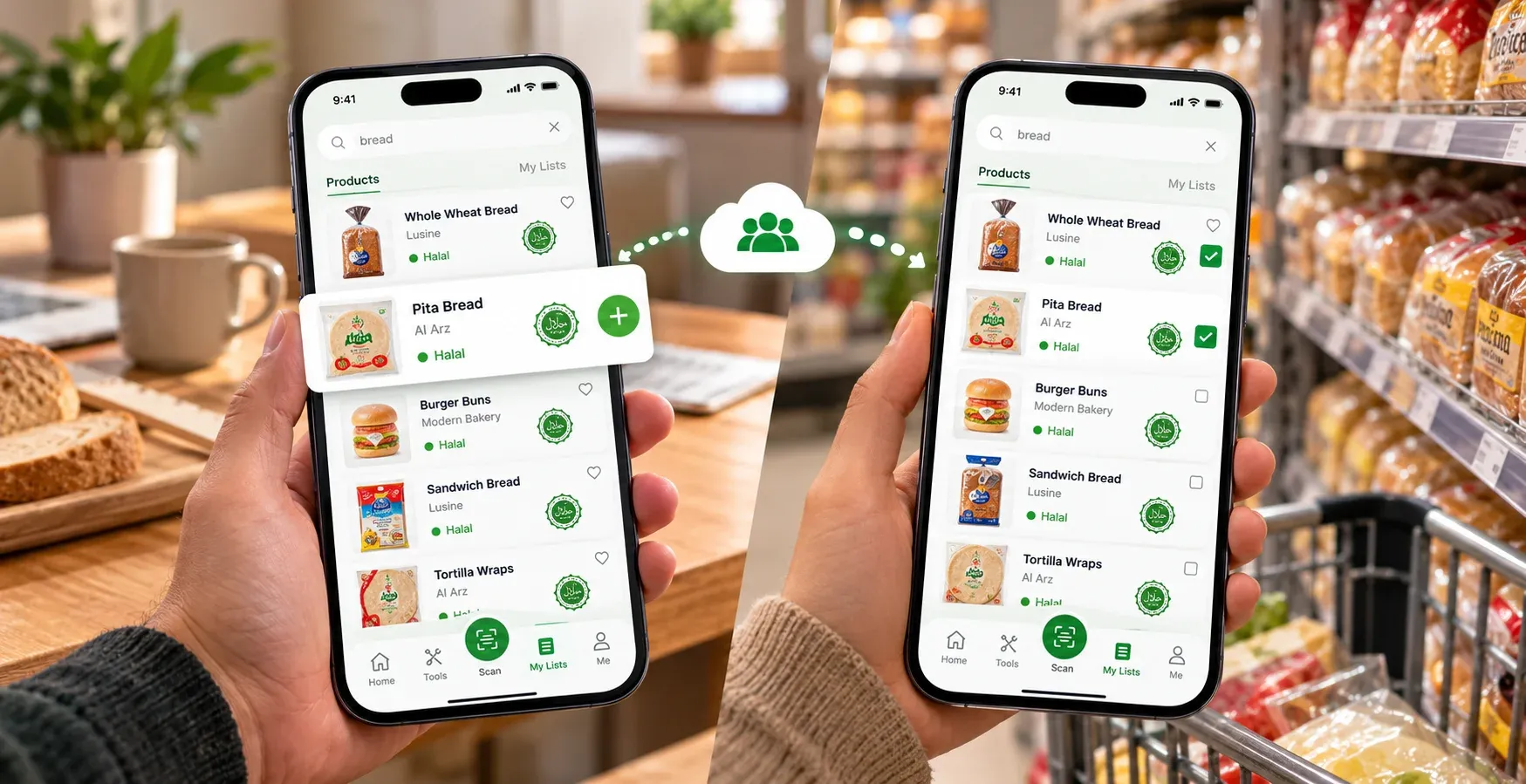
- Read the Three-State Classification: In seconds, the app cross-references the product against verified halal data sources and displays one of three clear statuses: Halal, Doubtful, or Non-Halal, highlighting the exact emulsifier or conditioner responsible.
- Decide How to Handle Doubtful Loaves: If a loaf returns a Doubtful status because the manufacturer uses unspecified mono- and diglycerides, you can immediately scan the loaf sitting next to it on the shelf until you find a verified Halal option that matches your family's dietary standard.
- Save It to Your Shared Halal List: Once you find safe sandwich bread, burger buns, and tortillas, add them to a Shared Halal List. For example, one spouse can build the verified weekly bakery list at home while the other shops from that exact list in real time at the supermarket.
While you have the app open for your grocery trip, you can also check local Prayer Times, find the Qibla direction, locate the nearest masjid with the Mosque Finder, or read Daily Duas—all built into the same interface.
The scan takes less time than reading the back of the wrapper. Halal Scanner is free to download with premium via subscription, tap the badge for the App Store or Google Play, or visit our download page to get started.
Take the Doubt Out of Your Weekly Bakery Shop
Checking whether bread is halal should not turn a ten-minute grocery errand into a chemistry lesson. By watching out for E920, unspecified E471 emulsifiers, and bakery pan grease—and verifying barcodes before you reach the checkout—you can feed your household with complete confidence.
Tap the App Store or Google Play badge on our Halal Scanner download page—free to download with premium via subscription on iOS and Android—and scan your first loaf in seconds.