
Pure butter made exclusively from cow milk and salt is naturally halal. However, commercial butter becomes doubtful (mashbooh) when manufacturers add whey cream, animal derived starter cultures, or complex emulsifiers like E471. You must verify the specific processing methods and additives used in your local dairy products to avoid haram ingredients.
If you are standing in a supermarket aisle looking at a block of butter, the basic ingredients list usually looks safe. Pure milk fat is universally accepted as permissible by all major Islamic scholars. The Halal Foundation ingredient list categorizes pure cow milk derivatives as universally acceptable.
But modern food manufacturing introduces hidden complexities. Understanding how butter goes from a farm product to a factory packaged good reveals why some products easily pass certification, while others fall firmly into the doubtful category.
What Keeps Standard Butter Permissible
Traditional butter requires only two ingredients: pasteurized cream and salt.
Sweet cream butter is the most common variety found in North American and European grocery stores. Manufacturers churn fresh cream until the butterfat separates from the buttermilk. Because this process relies entirely on mechanical agitation rather than chemical additives or enzymes, the resulting product remains entirely permissible.
According to general guidelines from Halal Certification Ireland, unflavored sweet cream butter that contains no additional ingredients carries virtually zero risk of cross contamination with haram animal byproducts. The core ingredient is pure dairy.
When Butter Becomes Doubtful (Mashbooh)
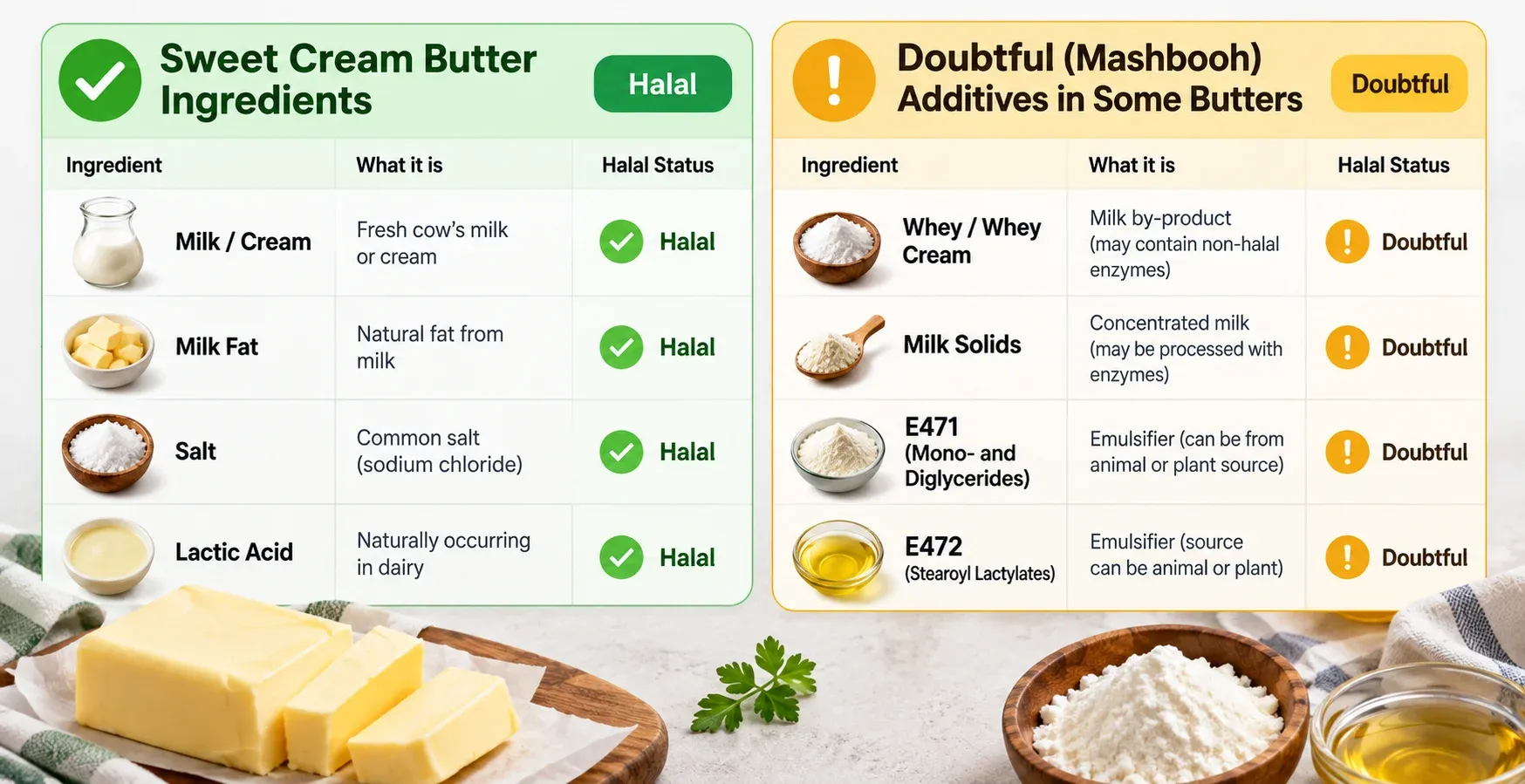
The risk level shifts when you move away from plain sweet cream blocks. Three specific manufacturing practices can push a dairy product into the mashbooh category. Islamic scholars at IslamQA note that while the base is pure, external additives require strict scrutiny.
1. Whey Butter and Animal Rennet
Some artisanal or budget brands are produced using whey cream. Whey is the liquid byproduct leftover from the cheese making process.
To make cheese, manufacturers use an enzyme called rennet to curdle the milk. Traditionally, rennet is extracted from the stomach lining of calves. If the calf was not slaughtered according to strict zabiha standards, the rennet is haram. Consequently, any whey butter produced using that specific rennet inherits the same non halal status. Unless a product explicitly states it uses microbial rennet or carries a recognized certification stamp, whey butter remains doubtful. Consumer platforms like DeenUp regularly warn shoppers about hidden whey derivatives in seemingly pure dairy.
2. Starter Cultures and Lactic Acid
European style cultured butter relies on bacterial fermentation to develop a tangy flavor. Manufacturers add specific starter cultures to the cream before churning.
While the lactic acid produced by these bacteria is generally acceptable, the medium used to grow the bacteria initially might contain animal derivatives. Most commercial starter cultures today are grown on dairy or plant based mediums, but without verified supply chain data, absolute certainty is difficult.
3. Spreadable Butter and E Numbers
Spreadable butter products often blend dairy fat with vegetable oils to keep the product soft straight from the fridge. To stabilize this mixture, manufacturers frequently introduce emulsifiers.
The most common emulsifier is E471 (mono and diglycerides of fatty acids). While E471 can be derived from plant oils like soy or palm, it can also be extracted from animal fats, including pork. If a spreadable dairy blend lists E471 without specifying a plant origin, the product is highly doubtful.
Dairy Ingredient Risk Assessment
Ingredient or Process | Typical Source | Halal Classification | Reason for Status |
|---|---|---|---|
Pasteurized Cream | Cow milk | Halal | Natural extraction process |
Salt | Mineral deposits | Halal | No animal involvement |
Whey Cream | Cheese byproduct | Doubtful | Depends entirely on rennet source (calf vs microbial) |
Cultured Bacteria | Fermentation | Doubtful | Growth medium may contain animal extracts |
E471 (Emulsifier) | Plant or animal fats | Doubtful | Often extracted from pork or non zabiha beef fat |
Lactic Acid | Carbohydrate fermentation | Halal to Doubtful | Generally safe but requires media verification |
Global Standards for Butter Verification
Different regions handle dairy processing in distinct ways. If you travel or buy imported goods, the origin country changes the risk profile.
In Muslim majority countries, local regulations usually dictate that imported food items must meet national halal standards. However, in Western markets, pure milk products do not automatically require certification. This leaves the burden of ingredient verification entirely on the shopper.
Regional Halal Certification Bodies to Look For
Region | Primary Certification Body | What They Verify |
|---|---|---|
United Kingdom | Checks starter cultures and rennet sources in local dairy | |
United States | Audits manufacturing facilities for cross contamination | |
Malaysia | Sets strict national standards for all imported dairy | |
Europe | Reviews E number origins in spreadable products |
How to Check This With Halal Scanner
Instead of memorizing the origins of every commercial starter culture or emulsifier, you can verify your groceries directly. Halal Scanner draws on verified data from 50+ countries to cross reference ingredients instantly.
Here is how to check your dairy products:
- Open the App: Launch Halal Scanner on your phone while in the store.
- Scan the Barcode: Point your camera at the barcode on the packaging.
- Review the Result: The database will instantly classify the product as Halal, Doubtful, or Non Halal based on the manufacturer exact formula.
- Read the Breakdown: If a product is flagged as Doubtful due to E471 or whey, the app highlights the specific doubtful additive causing the issue.
- Add to Your List: If the item clears, you can save it to a shared household shopping list so your family knows exactly which brand to buy next time.
Two things you can do without the app: always read the ingredients list to check for whey, and look directly for trusted certification logos like HFA or IFANCA on the packaging.
If those logos are missing, the scan takes less time than reading the label. The Halal Scanner app is free to download with premium via subscription. Tap the App Store or Google Play badge to get started.
Certified vs Uncertified Dairy Products
Many Muslims wonder if they only need to buy dairy that carries an official stamp.
A recognized certification from a body like JAKIM or IFANCA offers the highest level of assurance. These organizations audit the manufacturer's entire supply chain, ensuring that everything from the cleaning chemicals on the factory floor to the starter culture growth mediums meets strict Islamic standards.
However, in many Western countries, dairy companies do not pay for these audits because milk is inherently permissible. A lack of a stamp does not automatically make the item haram. This is exactly where the three state model of verification becomes necessary. If the ingredients are pure cream and salt, the product is naturally permissible. If complex additives are present, the product requires active verification.
Over 500,000 trusted users rely on the Halal Scanner database of 1 million+ verified products to navigate these exact scenarios daily. When you cannot find a certified brand, checking the specific ingredients against a verified database is the safest approach.
Common E Numbers Found in Dairy Spreads
If you buy spreadable butter or margarine blends, you will likely encounter these additives. Keep this reference handy or use the barcode scan feature to verify them instantly.
Common Name | Typical Function in Dairy | Risk Level | |
|---|---|---|---|
E471 | Mono and diglycerides | Emulsifier for spreads | High Risk (Animal or Plant) |
E160a | Carotene | Yellow food coloring | Low Risk (Usually Plant) |
E202 | Potassium sorbate | Preservative | Halal (Synthetic) |
E441 | Gelatine | Thickener in low fat spreads | High Risk (Bovine, Porcine, Fish) |