
Is sugar alcohol halal? Yes. Mainstream scholars treat sugar alcohols such as sorbitol, xylitol, erythritol and maltitol as halal. They are plant-based sweeteners, not intoxicants, and they contain no ethanol. The word "alcohol" only describes their chemical shape. Still check the rest of the label, because a sugar-free product can contain gelatin.
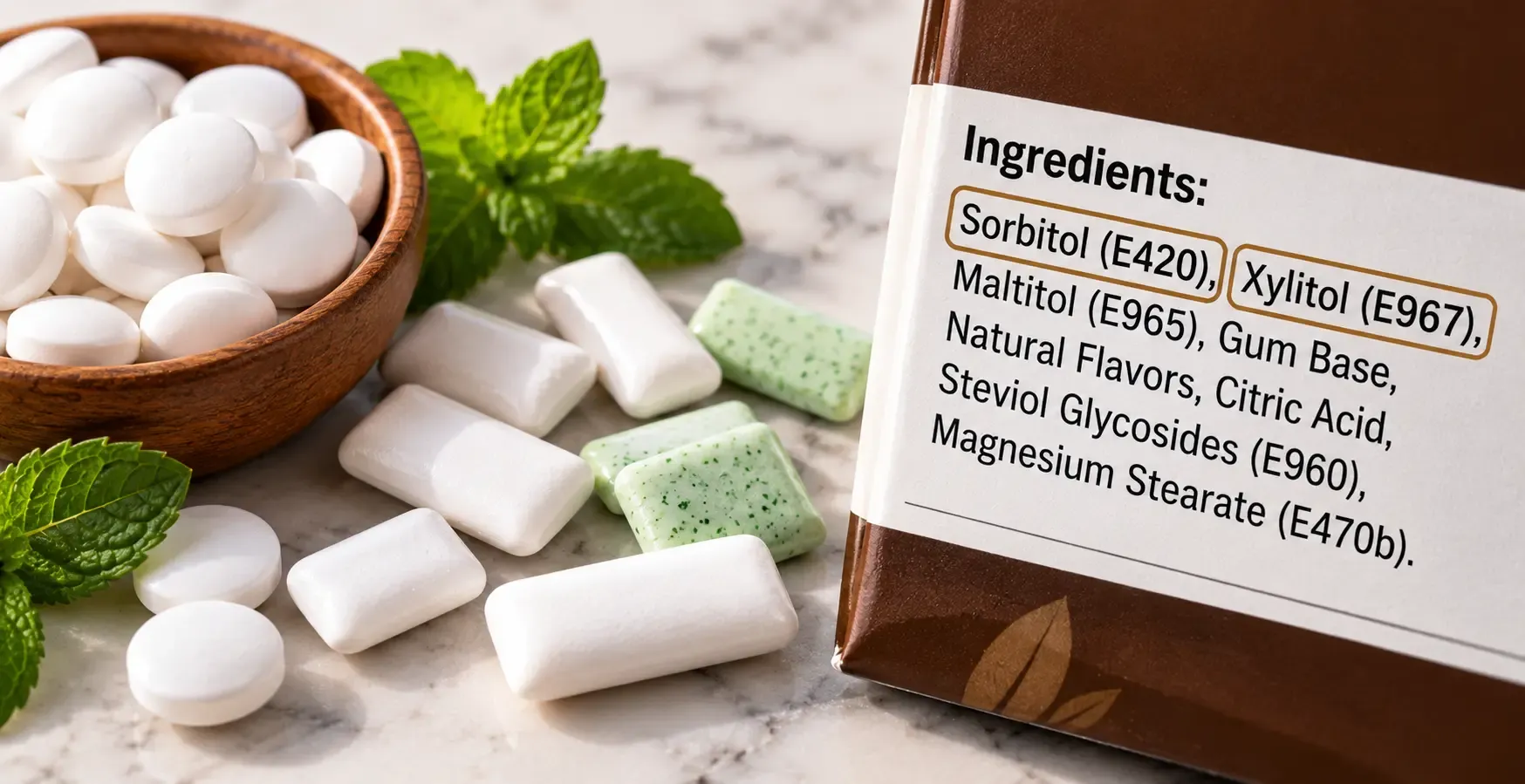
You pick up a pack of sugar-free mints in a UK supermarket. The label says "sweeteners (sorbitol, xylitol)". On a US pack, you might see "Sugar Alcohol 4 g" instead. For a second, that one word makes you put it back.
That pause is common, and the answer is reassuring. This guide explains why sugar alcohols are permitted, which two need a second look, and where the real risk on a sugar-free label sits. For the wider ruling on ethanol in food, read our complete guide to ethyl alcohol in food.
What Is Sugar Alcohol?
Sugar alcohols, also called polyols, are sweet carbohydrates whose molecules look partly like sugar and partly like alcohol. They have fewer calories than sugar. Most are made from plant starches and sugars.
Manufacturers make them in three main ways:
- Hydrogenation (adding hydrogen to a sugar): the US FDA says sorbitol is made by hydrogenating sugar solutions that contain glucose or fructose (21 CFR 184.1835).
- Fermentation that makes no ethanol: erythritol is made by fermenting glucose with food-grade yeast-like fungi such as Moniliella pollinis. The process yields erythritol, not drinking alcohol.
- Natural sources: small amounts occur in fruit, mushrooms and seaweed. Mannitol, for example, can be extracted from seaweed.
You will find them in sugar-free gum, mints, "no added sugar" chocolate, diabetic sweets, protein bars and toothpaste.
Common sugar alcohols on food labels
Name | E-number | Usual source | General status |
|---|---|---|---|
Sorbitol | E420 | Corn or wheat glucose | Halal |
Mannitol | E421 | Fructose or seaweed | Halal |
Isomalt | E953 | Beet sugar | Halal |
Maltitol | E965 | Starch (maltose) | Halal |
Xylitol | E967 | Birch wood or corn cobs | Halal |
Erythritol | E968 | Fermented glucose | Halal |
Lactitol | E966 | Milk sugar (lactose) | Halal in most views; some certifiers check the dairy source |
Glycerol (glycerin) | E422 | Plant oil, animal fat or synthetic | Doubtful until the source is confirmed |
General status reflects the scholarly and certified sources in this article. A specific product can still get a different result because of its other ingredients.
Glycerol surprises many shoppers. Food-testing lab Eurofins lists it among the most common polyols in food. Unlike sorbitol, it can be made from animal fat, so a blanket "all sugar alcohols are fine" answer misses it.
Is Sugar Alcohol Haram in Islam?
No. Mainstream scholars hold that sugar alcohols are not haram because they do not intoxicate. The ban on khamr (intoxicants) is tied to intoxication, not to a word on a label.
- IslamWeb Fatwa Center (fatwa 88496, 2004) says any intoxicating ingredient is forbidden, even in tiny amounts. It then cites trusted reports from specialists that sugar alcohol does not intoxicate, so food containing it stays permissible. The fatwa names the ingredient "phenylaline". Phenylalanine is actually an amino acid, but the reasoning applies to polyols the same way.
- Darul Ihsan (Hanafi, South Africa): Mufti Shafiq Jakhura ruled sugar alcohols permissible, noting that sorbitol and mannitol come from plants.
- The legal principle: scholars apply the maxim that things are permissible by default (al-asl fil-ashya' al-ibahah) unless evidence says otherwise.
Where do scholars differ?
Scholars agree that polyols are not intoxicants. Differences show up around ethanol used to carry flavors in the same product. The US Shia organization I.M.A.M. permits aromatics in an ethanol base below 3% if they do not intoxicate. Certifiers such as MUI and JAKIM set a 0.5% limit for food. Our guide to ethanol limits in halal certification covers these standards. Follow the standard of your own scholar.
Does Sugar Alcohol Contain Ethanol?
No. Sugar alcohols are different molecules from ethanol, the alcohol in wine and beer, and they cannot make you drunk.
The difference is in the structure. Ethanol has one hydroxyl group, the oxygen-hydrogen pair behind the "-ol" in chemical names. Sorbitol has six, which is why the FDA calls it a hexahydric alcohol. They share a family name but are very different substances.
The real side effect is digestive. EU law says foods with more than 10% added polyols must warn that eating too much may have a laxative effect (Regulation (EU) 2021/1175). The FDA requires a similar warning when a food could supply 50 g of sorbitol a day. This is a health note, not a fiqh ruling.
Can a Sugar-Free Product Still Be Haram?
Yes. The sugar alcohol is rarely the problem. When a sugar-free product gets a Doubtful or Non-Halal result, the cause is usually another ingredient on the same label.
Ingredient | E-number | Why it needs a check |
|---|---|---|
Gelatin | E441 | Often pork or non-zabiha beef; common in sugar-free gummies |
Glycerol | E422 | Can come from animal fat |
Mono- and diglycerides | E471 | Plant or animal fat |
Magnesium stearate | E470b | Plant or animal fat; used in mints and tablets |
Carmine | E120 | Insect-based red color; scholars differ |
Natural flavorings | — | May use an ethanol carrier |
Three checks you can do without any app:
- Read gummies first. Look for pectin, agar or halal-certified gelatin instead of plain gelatin.
- Look for a recognized logo. HFA in the UK, IFANCA in the US, or JAKIM and MUI on Asian imports mean an auditor checked the full recipe.
- Ask the brand. Email the manufacturer and ask where the glycerol and flavor carriers come from.
How to Check Sugar Alcohol Products With HalalScan
HalalScan checks every ingredient on a product, including the polyols and the ingredients around them, and gives you one clear result.
- Open the app and tap the barcode icon.
- Scan the barcode. The app checks the ingredients against more than 1 million product records.
- Read the result: Halal, Doubtful or Non-Halal.
- If it says Doubtful, review the ingredient analysis to see which ingredient raised the flag. On sugar-free items, it is usually glycerol, gelatin or a flavoring, not the sorbitol.
- Save it to a shared halal list so your family can shop from it.
No barcode? Search for the ingredient by name instead, or browse the products shoppers check most.
The scan takes less time than reading the label. HalalScan is free to download, with premium subscription. Tap the App Store or Google Play badge to get it.
Built for Muslim shoppers worldwide
HalalScan's database holds over 1 million product records across 50+ countries. More than 500,000 users run over 100,000 scans a day. The app uses the three-state model, so a Doubtful result tells you to check further instead of guessing for you.
The Bottom Line
Sugar alcohols are halal in mainstream scholarly views because they do not intoxicate and contain no ethanol. Glycerol and lactitol are the two to double-check. On sugar-free labels, the real risk is usually gelatin or a flavor carrier. For more label guides, visit the HalalScan blog. Download HalalScan free on the App Store or Google Play and scan the barcode to check every ingredient at once.