


You are standing in the beverage aisle of a local supermarket. You pick up a drink labeled "alcohol-free," but the label mentions botanical extracts and a brewing process. You know your family avoids anything haram, but food packaging laws are confusing. When a label says a drink has zero alcohol, does that mean it meets Islamic standards?
The legal definition of alcoholic beverages depends on government regulations, and those rules do not always align with halal requirements. In the United States, federal law (27 U.S. Code § 214) defines an alcoholic beverage as any liquid intended for human consumption that contains at least 0.5 percent alcohol by volume (ABV).

This means a drink can legally contain trace amounts of alcohol and still be sold outside the liquor aisle. Understanding this definition helps you make informed choices for your diet and your deen.
What Does "Alcoholic Beverage" Mean in Law?
Government agencies classify drinks based on math, not religion. The 0.5% ABV threshold is the dividing line for both the FDA and the Alcohol and Tobacco Tax and Trade Bureau (TTB).
If a drink sits below that 0.5% line, the law treats it as a standard food product rather than a controlled substance. This leads to three common label claims you will see in stores.
Label Claim | Legal Meaning (US Standard) | Halal Status Implication |
|---|---|---|
Alcoholic Beverage | 0.5% ABV or higher. | Non-Halal (khamr). |
Non-Alcoholic | Contains less than 0.5% ABV. | Doubtful. May contain trace alcohol from fermentation. |
Alcohol-Free | Intended to mean 0.0% ABV. | Requires checking. The original manufacturing process matters. |
Legal definitions allow trace alcohol in everyday items like fruit juices and kombucha due to natural fermentation. The problem arises when manufacturers intentionally brew alcohol and then remove it.
Fermentation vs. Dealcoholization: Why the Process Matters
To define an alcoholic beverage accurately, you have to look at how it was made. An alcoholic drink definition usually starts with fermentation—yeast consuming sugar to create ethanol and carbon dioxide.
Many modern "zero percent" drinks start as fully fermented alcoholic beverages. The manufacturer then uses vacuum distillation or reverse osmosis to pull the alcohol out. This is called dealcoholization.
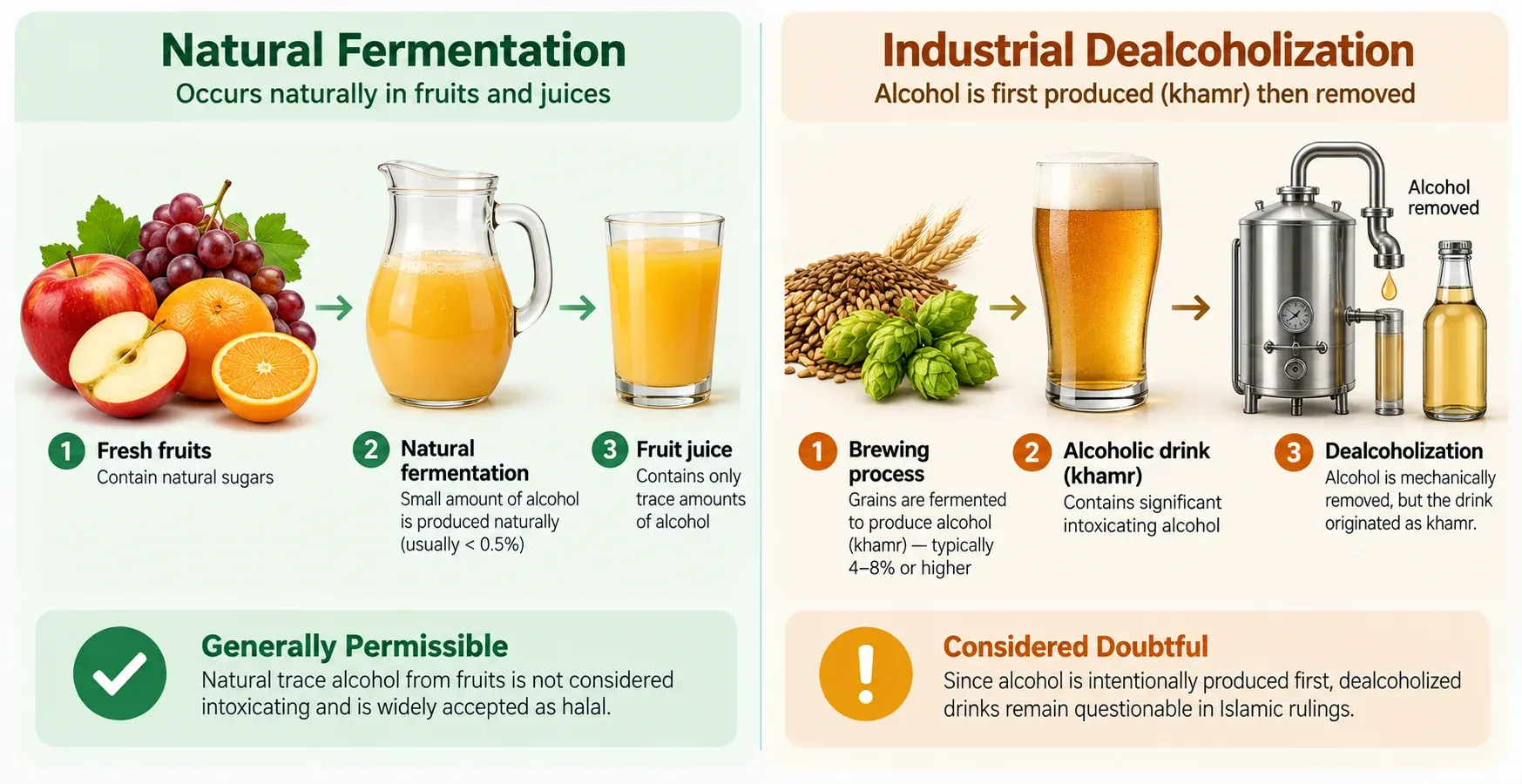
For a halal-conscious shopper, dealcoholization presents a major issue. Many Islamic scholars and certifying bodies maintain that if a beverage was intentionally produced as an intoxicant (khamr), removing the alcohol later does not make it halal. The original impure state remains a concern.
You can read more about how ethanol interacts with flavorings and extracts in our complete guide to ethyl alcohol and halal food.
The 0.5% ABV Rule and Islamic Dietary Law
How do major halal authorities view the 0.5% ABV standard? The short answer is that no single rule applies globally, but the source of the alcohol always dictates the ruling.
Certifying Body | Position on Trace Alcohol in Beverages |
|---|---|
JAKIM (Malaysia) | Strict zero-tolerance for drinks produced with the intention of creating alcohol (khamr). Trace alcohol from natural fruit fermentation may be tolerated under specific strict limits. |
HFA (UK) | Generally rejects dealcoholized beverages that started as wine or beer, even if the final ABV is 0.0%. |
IFANCA (USA) | Prohibits beverages marketed as "non-alcoholic" versions of alcoholic drinks (like non-alcoholic beer) to prevent normalization and contamination risks. |
Scholars agree that natural, unavoidable trace alcohol in a ripe banana or fresh apple juice is not haram. However, a beverage designed to mimic an alcoholic drink, even with the alcohol removed, is widely rejected. Rather than guessing the source of an ingredient, you can verify it directly with Halal Scanner. The app is free to download with premium via subscription on the App Store and Google Play.
How to Check Beverage Ingredients With Halal Scanner
Memorizing the definition of alcoholic beverage legal codes takes too much time. You can check any questionable drink in seconds. Halal Scanner classifies products into three clear categories: Halal, Doubtful, and Non-Halal.
Here is how you handle tricky beverage labels:
- Check the front label first: If the bottle advertises itself as "dealcoholized" or "non-alcoholic beer," put it back. This is a strong indicator of a Non-Halal or Doubtful origin.
- Scan the barcode: Open Halal Scanner and scan the product. The database cross-references over 1 million products across 50+ countries.
- Read the result: The app will return a Halal, Doubtful, or Non-Halal rating.
- Review Doubtful items: If a drink flags as Doubtful (mashbooh), the app highlights the specific ingredient causing concern, such as a hidden botanical extract or a synthetic flavoring.
- Share with your family: You can save safe beverages to a shared list so your spouse or roommate knows exactly what to buy next time.
The scan takes less time than reading the label. Tap the App Store or Google Play badge to download Halal Scanner and take the guesswork out of your weekly shop.
The Reality of Beverage Shopping
Navigating the beverage aisle does not have to be stressful. You just need the right information. Relying entirely on a government label can leave you with a Doubtful product in your cart.
By combining your own knowledge of halal standards with a verified database, you protect your diet and your peace of mind. Halal Scanner processes over 100,000 daily scans for a reason—it gives you clarity when the label does not.
Download the app for free on iOS or Android and scan your next drink before you buy it.