

Halal meat does not have a taste of its own. Studies comparing halal and conventional slaughter find small or no differences in flavour, tenderness and colour. Most of what you taste comes from the animal's breed, feed, age and stress before slaughter, and from how the meat is stored and cooked. Halal describes how an animal is slaughtered, not how it tastes.
Picture this: the lamb from your local halal butcher tasted richer at Eid than the supermarket lamb you grab on a weeknight. Was it the halal cut, or something else? This guide answers that with research, then shows you how to check if meat is halal, because your tongue can't.
What is halal meat? Halal meat comes from a permitted animal, such as cattle, sheep, goats or chicken. The animal is slaughtered with a cut to the throat while Allah's name is said, so the blood drains out. Pork, carrion and flowing blood are never halal, as set out in Quran 5:3.
For packaged meat products, Halal Scanner checks the barcode and shows a Halal, Doubtful or Non-Halal result. It is free to download on iOS and Android.
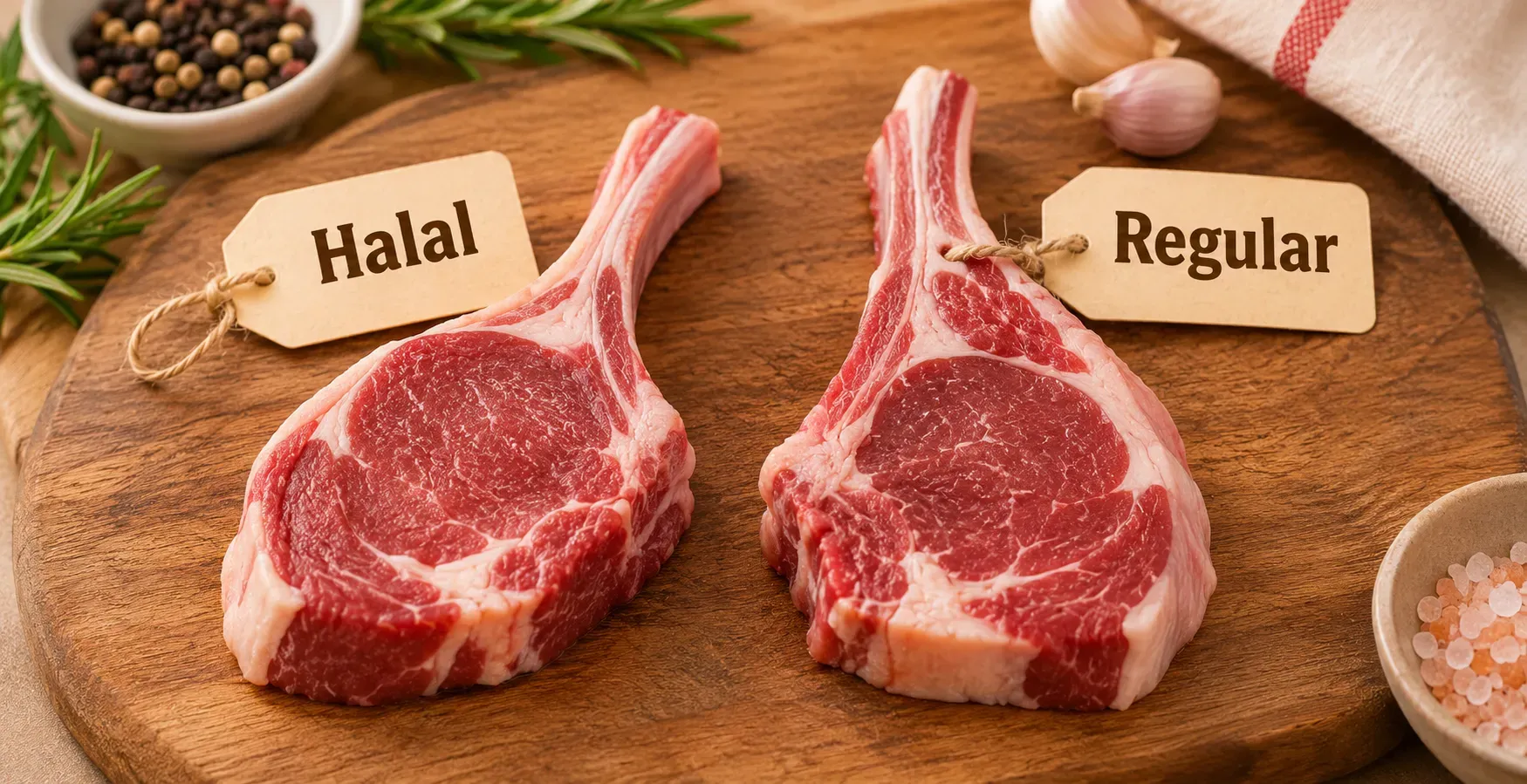
Does Halal Meat Taste Different? What the Research Shows
No study has found a consistent "halal taste." Controlled trials in beef and chicken find differences that are small, limited to certain muscles, or absent. Some even point in opposite directions.
- Beef, 2025. A study in the journal Animals compared conventional slaughter, halal slaughter without stunning, and halal slaughter with a reversible stun. Halal meat with a reversible stun scored lower for metallic flavour and some off-odours, but only in one of the two muscles tested. Other measures showed no significant difference. The trial used 45 meat samples, so treat it as a signal, not a verdict.
- Beef, 2013. Researchers in Malaysia compared unstunned halal slaughter with three stunning methods in heifers. They found meat quality was comparable, with no method clearly better than another.
- Chicken, 2023. A Poultry Science study of 100 slow-growing broilers concluded that neither electrical stunning nor traditional halal slaughter without stunning harmed meat quality.
- Chicken, 2022. A Chinese study in Animals found the reverse: stunned birds had lower stress hormones and better meat-quality traits than unstunned birds.
The results depend on the species, the muscle and the stunning method. That is why careful sources avoid saying halal meat simply "tastes better." This article covers taste. For the slaughter rules of specific meats, see our guides to halal chicken and whether Muslims can eat beef.
What Is the Difference Between Halal and Regular Meat?
The difference is in how the animal is slaughtered and who supervises it. The breed, the farm and the nutrition label can be the same. The table compares typical practice in the UK, EU and US.
What differs | Halal meat | Regular meat |
|---|---|---|
Animals allowed | Permitted species only; pork is never halal (Quran 2:173) | Any species sold for food, including pork |
Who slaughters | A Muslim; many scholars also accept a Christian or Jewish slaughterer (Quran 5:5) | A trained slaughterer of any faith |
Allah's name | Said at slaughter (Quran 6:121) | Not said |
Stunning | Depends on the certifier: some ban it, some allow a reversible stun | Required by law before slaughter |
Bleeding | Throat cut so the blood drains | Animal is also bled after stunning |
Oversight | A halal certifier audits the plant | Standard food-safety and welfare checks |
Nutrition | No change by rule | No change |
The law treats the two differently too. In the UK and EU, Regulation 1099/2009 requires stunning before slaughter but exempts religious slaughter carried out in a slaughterhouse. In the US, the Humane Methods of Slaughter Act exempts ritual slaughter from its stunning rules.
Halal vs non-halal meat: how the status works
A piece of meat is not simply "halal" or "not halal." Halal Scanner uses three results, because scholars and certifiers differ on some cases.
Meat | Status | Why |
|---|---|---|
Zabiha slaughter, no stun, certified by a body you trust | Halal | Meets the conditions all major certifiers accept |
Halal-certified, with a reversible stun | Halal for many scholars, Doubtful for others | Scholars and certifiers differ on stunning |
Beef, lamb or chicken with no halal certification | Doubtful | Slaughter and tasmiyah can't be confirmed; many scholars treat it as not halal, while some accept meat of the People of the Book |
Pork, or any animal that died before the cut | Non-Halal | Forbidden in Quran 5:3 |
Does Draining the Blood Change the Flavour?
Less than many people think. Both halal and conventionally slaughtered animals are bled, and studies on how much blood leaves the body give mixed results.
- Sheep and cattle. University of Bristol researchers found that in sheep, bleed-out was neither reduced by stunning nor improved by an unstunned neck cut. They then ran the same comparison in cattle.
- Rabbits. Halal slaughter without stunning drained more blood than gas stun-killing, and the meat kept better in storage.
- Chicken. In the 2023 Poultry Science trial, stunned birds bled less, yet their meat quality held up.
So draining the blood matters most for halal status, not flavour. Islam forbids flowing blood as a religious rule (Quran 5:3). The science on blood and taste is still mixed.
What Actually Changes the Taste of Meat?
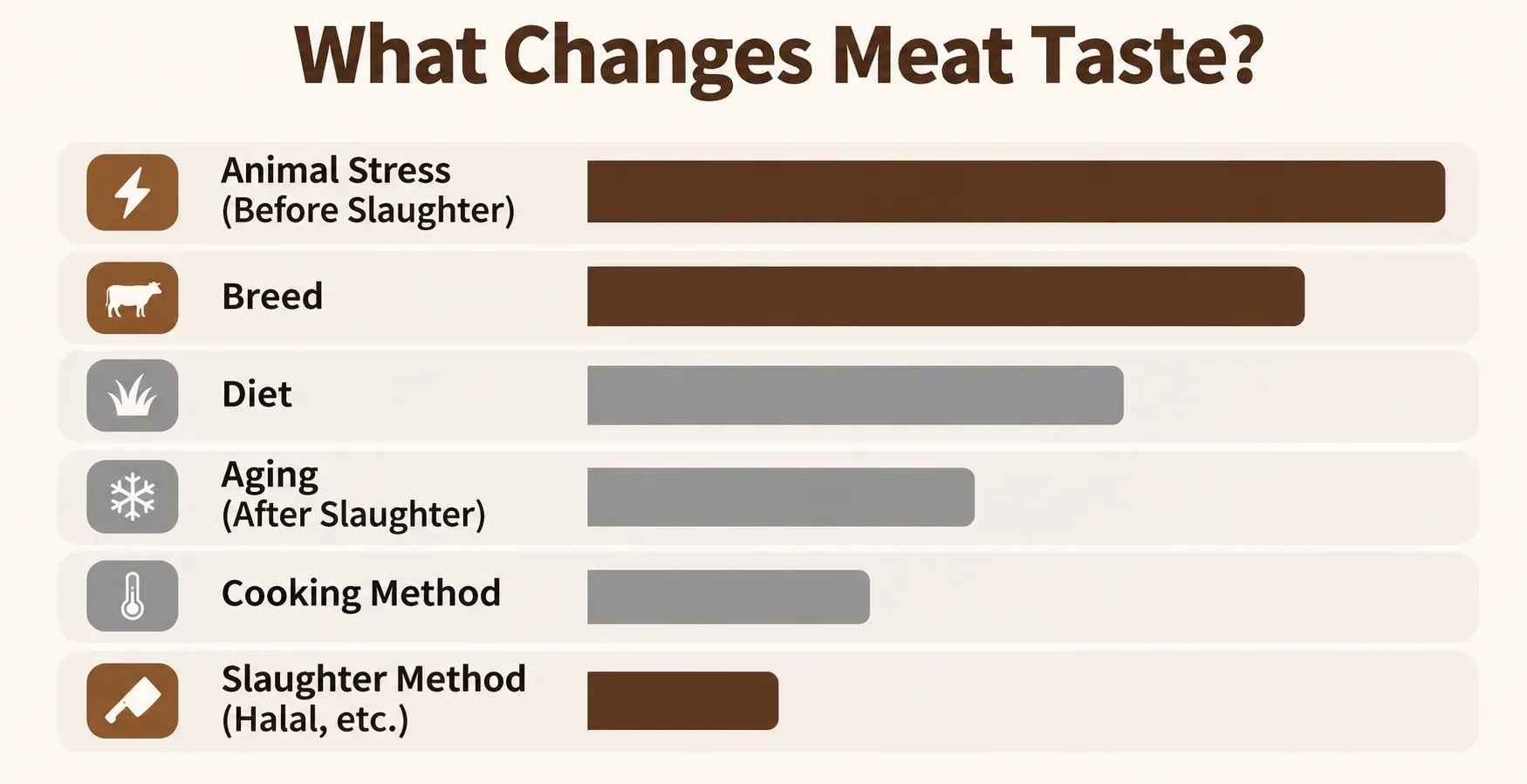
Stress before slaughter has a bigger effect on taste than the slaughter method. Breed, age, feed and handling also shape flavour and tenderness.
The UK's Agriculture and Horticulture Development Board (AHDB) explains how stress changes meat. Muscle normally drops from a pH of about 7 to 5.4 -- 5.7 after slaughter. Stress in the 24–48 hours before slaughter stops that drop. The meat turns dark, firm and dry, and it spoils faster.
Short stress, about 45 minutes before slaughter, does the opposite. The pH falls too fast, and the meat turns pale, soft and wet. A 2020 review in Meat and Muscle Biology adds that stress just before stunning can also make beef less tender.
Taste factor | What it changes | Linked to halal? |
|---|---|---|
Stress 1–2 days before slaughter | Darker, drier meat that spoils faster | No; depends on transport and holding pens |
Stress in the last hour | Paler, softer, wetter meat | Indirectly; Islam calls for calm, quick slaughter |
Breed, age, sex and feed | Tenderness and flavour (University of Idaho Extension) | No |
Bleeding | Small, mixed effects in studies | Yes; draining blood is required |
Stunning | Small, mixed effects in studies | Depends on the certifier |
Cooking and spices | Often the biggest difference on the plate | No |
Islamic teaching lines up with good handling. The Prophet ﷺ told Muslims to sharpen the blade and spare the animal suffering (Sahih Muslim 1955). Still, welfare varies from plant to plant in both systems, so a halal label alone doesn't guarantee a calm animal.
Why Halal Meat From Your Butcher May Taste Different
If halal meat tastes different to you, the animal and the cut are the likely reason, not the halal slaughter. Halal butchers often buy different animals from those on supermarket shelves.
A study from Tuscany, Italy, in the Journal of Animal Science and Technology shows this well. Ewe meat from halal butcher shops was leaner, at 4.2% fat versus 7.09%, with lower carcass scores than ewe meat from traditional shops. Tasters preferred the traditional meat. The animals differed before slaughter, so the taste did too.
Many halal butchers also sell mutton and goat, and cut bone-in pieces for slow cooking. These taste stronger than young supermarket lamb, whoever slaughters them.
Is Halal Meat Stunned?
Often, yes, at least in the UK. In the government's 2024 slaughter survey for England and Wales, 97% of poultry were stunned before slaughter. That figure counts halal stun slaughter as stunned. Sheep had the highest share slaughtered without stunning, at 29%.
UK certifiers disagree on stunning:
- The Halal Monitoring Committee (HMC) does not accept stunned meat or poultry.
- The Halal Food Authority (HFA) allows a controlled water-bath stun for chicken, with checks that birds are alive at slaughter.
For taste, the studies above find no consistent gap between stunned and unstunned meat. For halal status, follow your scholar's view and pick a certifier that matches it.
Where Does Halal Meat Come From?
Halal meat comes from the same farms and breeds as regular meat. What makes it halal happens at the abattoir: the slaughter method, the tasmiyah and the certifier's checks.
Demand is large. DinarStandard's State of the Global Islamic Economy 2024/25 report puts Muslim spending on food and drink at US1.43trillionin2023.ItprojectsUS1.94 trillion by 2028. That figure covers all food Muslims buy, not only halal-certified products.
What does halal chicken mean?
Halal chicken is a bird slaughtered alive, with Allah's name said and its throat cut so the blood drains. The main debates are machine slaughter and water-bath stunning. In taste terms, the 2023 trial above found no harm to meat quality either way. Our halal chicken guide covers the rules in full.
What does halal beef mean?
Halal beef follows the same rules as other halal meat, applied to cattle. In England and Wales, 97% of cattle were stunned in 2024, partly by halal stun methods. Read Can Muslims Eat Beef? for the details.
Can You Tell If Meat Is Halal by Taste?
No. Taste, smell and colour can't show who slaughtered the animal, whether Allah's name was said, or whether it was stunned. Only the supply chain can. These checks work without any app:
- Ask your butcher which body certifies the meat. Ask to see the current certificate.
- Check that certifier's standard. Make sure its rules on stunning and machine slaughter match the standard you follow.
- Look for HMC's serialised label in the UK. HMC advises shoppers to check its coloured, numbered label on the meat.
- Read processed meat labels closely. Sausages, deli slices and ready meals can hide gelatine, wine or unclear flavourings. Our halal cold meats guide shows what to look for.
For packaged meat, a barcode scan answers what taste can't. Halal Scanner gives the result in seconds.
How to Check Meat Products With Halal Scanner
Halal Scanner checks a packaged product's ingredients against its database and returns Halal, Doubtful or Non-Halal. It works best for barcoded items like sausages, burgers, deli slices, stock cubes and ready meals. For fresh butcher meat, use the certifier checks above.
- Scan the barcode. Open Halal Scanner and point your camera at the barcode.
- Or search by ingredient. No barcode? Type "gelatine," "beef extract" or "E471" into the text search.
- Read the result. You see Halal, Doubtful or Non-Halal for that exact product.
- Handle a Doubtful result. Doubtful (mashbooh) usually means a source is not stated, such as plain "beef fat" or "flavourings." Check for a certifier logo, contact the maker, or skip it if you follow a strict standard.
- Save it to a shared halal list. Add checked products to a shared halal list. One person builds it at home; another shops from it in the store.
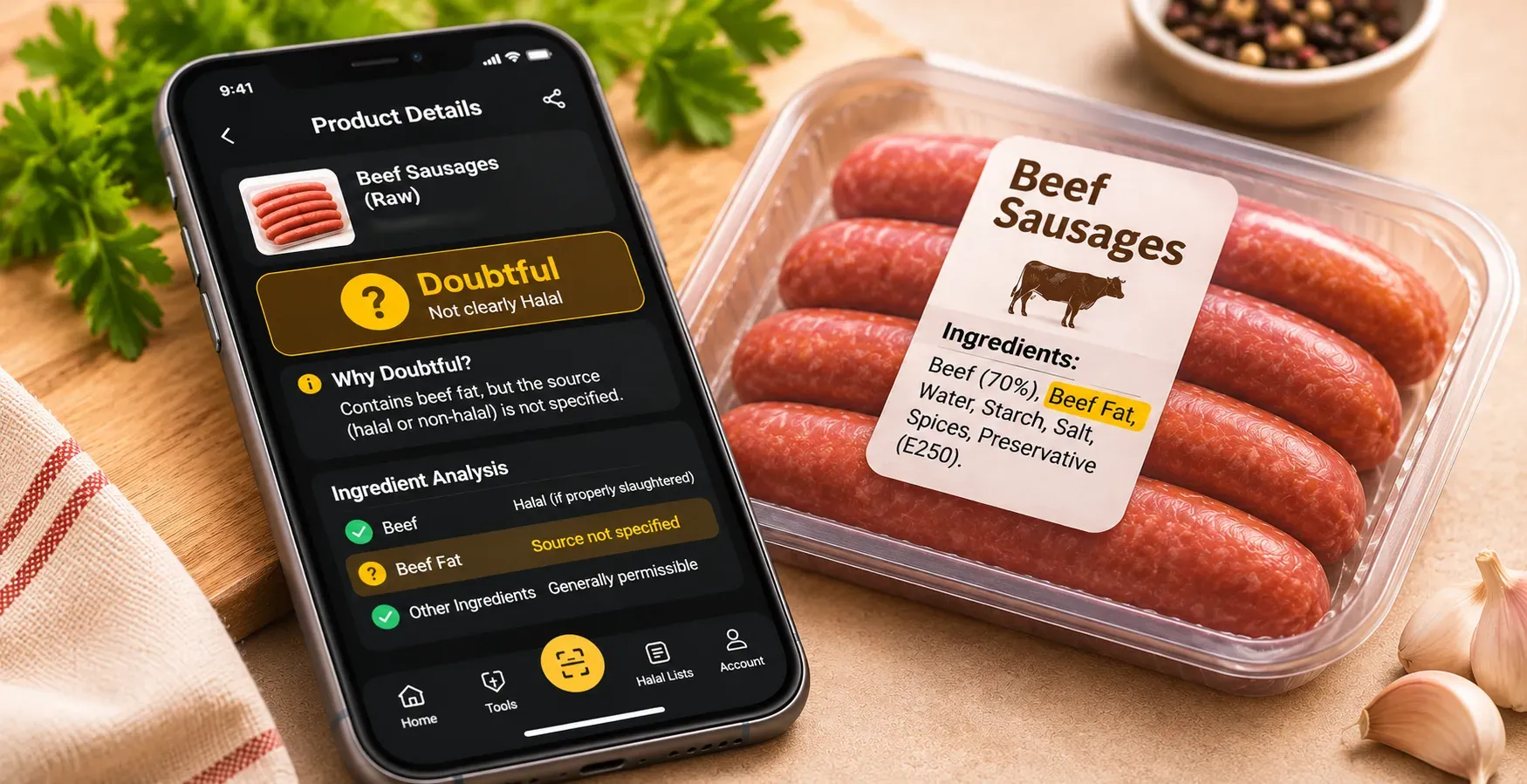
The scan takes less time than reading the label. Halal Scanner is free to download, with extra features available by subscription. Tap the App Store or Google Play badge below to get it.
Download on the App Store · Get it on Google Play
Halal Scanner is a research and verification tool. It does not replace certification from a recognised halal body or the advice of your scholar.
Why Shoppers Trust Halal Scanner
Halal Scanner reports these figures for its service:
Measure | Figure |
|---|---|
Product records in the database | 1 million+ |
Scans per day | 100,000+ |
Users | 500,000+ |
Countries covered | 50+ |
The app also includes Qibla direction, prayer times, a mosque finder and other Islamic tools. See how it works or browse checked products.
The Bottom Line
Halal meat does not taste different by rule. Research finds small, mixed differences between halal and conventional slaughter, and stress, breed, feed and cooking matter more. What halal changes is how the animal is slaughtered, and that is something only certification can confirm.
Check the certifier for fresh meat. For packaged meat, download Halal Scanner free and scan before you buy. Find more guides on the Halal Scanner blog.