
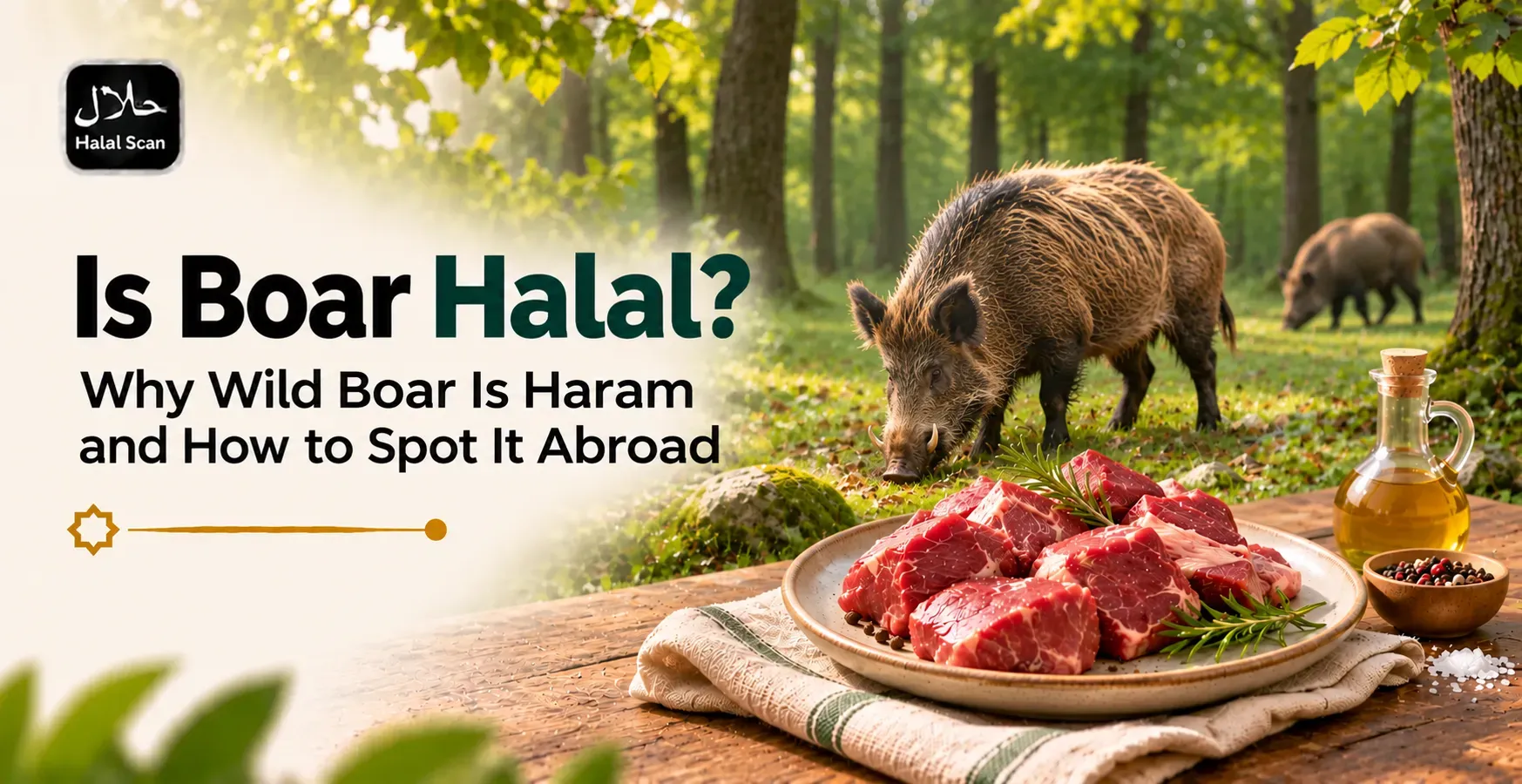
No, boar is not halal. Wild boar (Sus scrofa) is the same species as the domestic pig, so the Quran's ban on the flesh of swine covers it. Scholars across the Islamic schools agree on this. Boar meat, lard, and boar-derived ingredients are Non-Halal, whether the animal was farmed, hunted, or slaughtered with Bismillah.
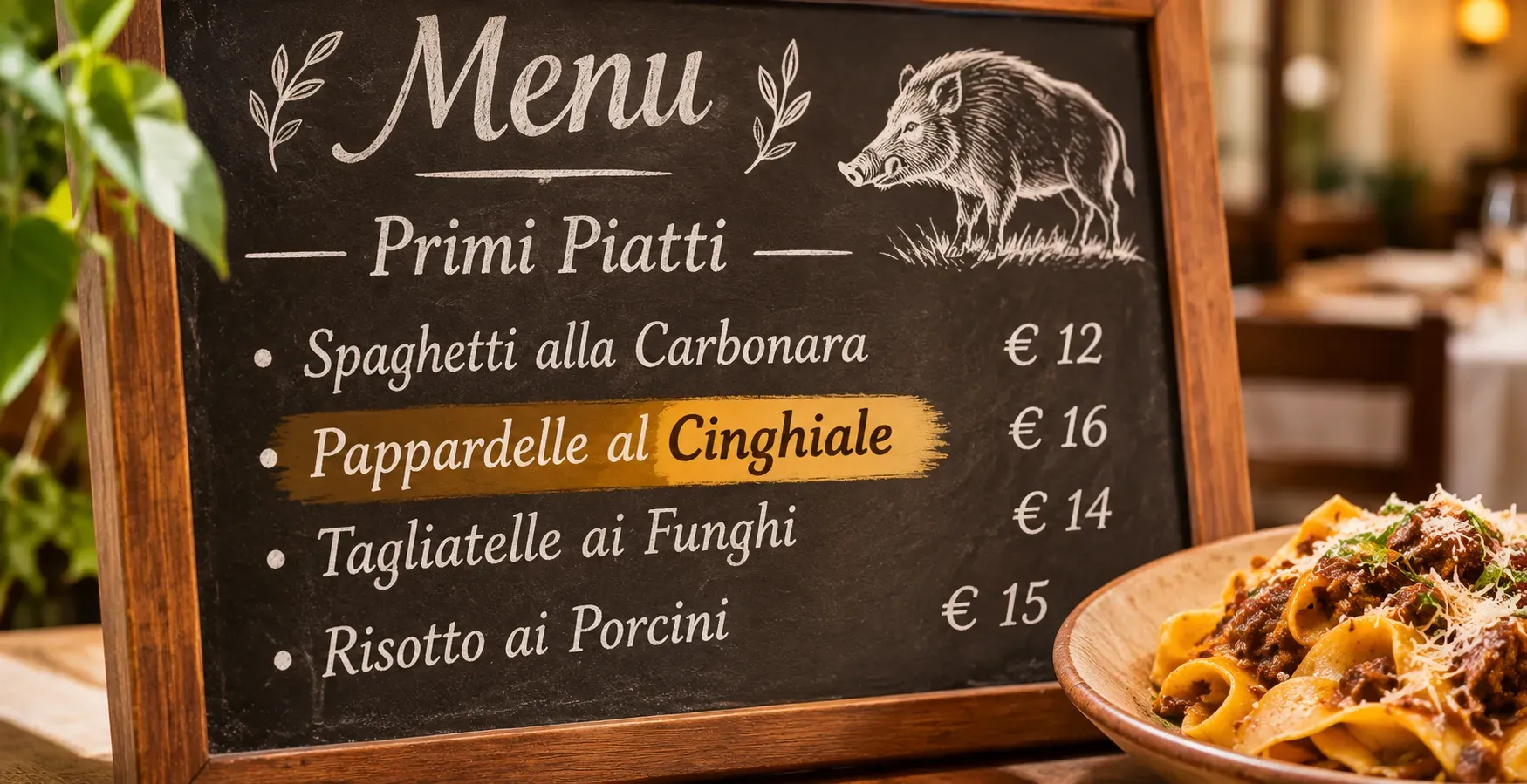
Picture a trattoria in Florence (an illustrative scene). The specials board lists pappardelle al cinghiale, and the waiter calls it "wild meat, very lean." Nothing on the menu says pork, yet pork is exactly what you would be ordering.
This guide covers the ruling, the words boar hides behind abroad, and the label ingredients that can come from pigs.
Is Wild Boar Halal? What the Quran and Scholars Say
Wild boar is haram, and scholars do not disagree on this. The Quran forbids the flesh of swine (lahm al-khinzir) in four separate verses: 2:173, 5:3, 6:145 and 16:115.
Surah Al-An'am 6:145 describes swine flesh as rijs, meaning impure. The word khinzir names the animal itself, not where it lived, so it covers wild and farmed pigs alike. The Sunni schools and Shia jurisprudence share this position.
Modern certifiers apply the same rule to ingredients. Indonesia's MUI states that any product or ingredient derived from pork or its derivatives is haram, in its published halal standards and fatwas.
Does saying Bismillah make boar halal?
No. Saying Allah's name (tasmiya) at slaughter or during a hunt is what makes a permissible animal lawful to eat. It cannot turn a forbidden species into a halal one, so a boar hunted by a Muslim who says Bismillah is still Non-Halal.
What about a real emergency?
Surah Al-Baqarah 2:173 lifts the sin from someone forced by necessity. The verse sets two limits: no desire for it, and no going beyond the need. Having a vegetable or fish dish on the menu is not a necessity.
Is Wild Boar the Same as Pork?
Yes. Encyclopaedia Britannica defines wild boar as the wild members of the pig species Sus scrofa, the ancestors of domestic pigs. "Boar" is also the standard word for an adult male domestic pig.
So "wild boar," "wild pig," "feral hog" and farmed boar all belong to the same species as the pig in a pork chop. A leaner texture or a "game" label does not change the category.
Food-safety agencies agree. The US CDC's trichinellosis surveillance defines noncommercial pork as including wild boar, alongside home-raised pigs.
A later CDC report found that 6 of 22 pork-linked trichinellosis cases from 2008 to 2012 came from wild boar meat. Health data is not the basis of the Islamic ruling, which rests on the Quran. It simply confirms that boar is pork by any official definition.
How Wild Boar Appears on Menus Abroad
Abroad, boar is usually named in the local language, and the word "pork" rarely appears. Europe holds an estimated 13.5 to 19.6 million wild boar before each hunting season, according to a 2026 study in the European Journal of Wildlife Research. That supply puts boar on many autumn and winter game menus.
Language | Word for wild boar | Where you may see it |
|---|---|---|
Italian | cinghiale | Pasta ragù, stews, cured salami |
French | sanglier | Game stews, terrines, pâté |
German | Wildschwein | Seasonal game (Wild) menus, sausages |
Spanish | jabalí | Stews, cured sausages |
Portuguese | javali | Stews, roasts |
Polish | dzik | Sausages, pâté, roasts |
Turkish | yaban domuzu (domuz = pig) | Hunting regions, imported products |
Malay / Indonesian | babi hutan ("forest pig") | Non-halal eateries, local markets |
Three habits help when you eat out:
- Ask which animal a "game" dish uses. German Wild and French gibier mean game in general, which can be deer, hare or boar.
- Ask about the fat, not just the meat. A venison sausage or terrine can still be made with pork fat.
- In Malaysia and Indonesia, treat babi on any label as pig.
Even "halal" labels need a trusted source. In January 2025, French inspectors shut a halal butcher in Bobigny after finding 14 wild boar carcasses without veterinary stamps, Morocco World News reported, citing Le Parisien. Cases like this are rare, but they show why a recognized certificate matters.
Pig-Derived Ingredients to Watch on Labels
The bigger everyday risk is not a boar steak but pig derivatives in packaged food. They rarely say "pork" or "boar" on the label.
Gelatine is the most common example. Gelatine Manufacturers of Europe, whose members make about 68% of the world's gelatine, estimates its pigskin gelatine needs skins from 210 to 230 million pigs a year, per a 2024 GME presentation.
Ingredient | How it appears on labels | Possible pig link | Usual result |
|---|---|---|---|
Lard, pork fat | "lard," saindoux (French), Schweineschmalz (German) | Pig fat | Non-Halal |
Gelatine | "gelatine," "gelatin" (older lists: E441) | Often pigskin or pig bone | Doubtful if the source is unstated; Non-Halal if pork |
L-cysteine | "L-cysteine," E920 | Human hair, duck feathers, or pig bristles and hooves | Doubtful unless synthetic or certified |
Mono- and diglycerides | E471 | Plant or animal fat | Doubtful unless the source is stated |
Enzymes | "enzymes," "pepsin," "rennet" | Can be porcine | Doubtful unless the source is stated |
The Irish halal certification body lists gelatine, enzymes, emulsifiers and flavours as questionable (mashbooh) because their origin is often unknown, in its halal food guidelines.
Some scholars argue that complete chemical change (istihalah) can alter a ruling. Others reject this for pork gelatine; Darul Iftaa Birmingham holds that processing does not make a forbidden source lawful. Our guide on kosher gelatine and halal shoppers covers how this plays out on kosher labels.
Rather than memorizing every code, you can scan the barcode in Halal Scanner and see whether that specific product comes back Halal, Doubtful or Non-Halal.
Are Boar Bristle Brushes Halal? Where Scholars Differ
Eating boar is agreed to be haram, but using boar bristle brushes is debated. Most fatwa bodies advise against them.
Darul Iftaa Birmingham rules boar bristle brushes impermissible, since all parts of the pig are impure. It adds that wet bristles pass the impurity on to hair or skin.
SeekersGuidance reaches the same answer, even for a brush used dry. In Malaysia, a 1985 national fatwa declared pig-hair brushes haram, and JAKIM's halal analysis centre now tests brushes for pig hair, per a 2026 Halalsphere paper.
Not every scholar goes that far. IslamOnline's fiqh desk notes a genuine disagreement on non-food pig by-products, with some permitting limited uses such as tanned leather. It still advises avoiding bristle brushes, because alternatives are easy to find.
Check hairbrushes, beard brushes, makeup brushes and pastry brushes. LPPOM MUI notes that the product name often gives it away, as in "Boar Bristle Brush." Nylon, plant fibre or other animal hair are common alternatives.
What Scholars Agree On and Where They Differ
One point is settled and two are open. Use this table to see which is which, then ask your scholar about the open ones.
Question | Scholarly position | Basis |
|---|---|---|
Eating wild or farmed boar | Agreed: haram | Quran 2:173, 5:3, 6:145, 16:115 |
Boar hunted with Bismillah | Agreed: still haram | Tasmiya applies only to permissible animals |
Eating boar to survive real danger | Agreed exception | Quran 2:173 |
Pork-derived gelatine and additives | Majority: haram; a minority applies istihalah | MUI standard; Darul Iftaa Birmingham |
Using boar bristle brushes | Debated; most fatwa bodies say avoid | Darul Iftaa Birmingham, SeekersGuidance, Malaysia's 1985 fatwa; IslamOnline notes the disagreement |
How to Check Products for Pork and Boar With Halal Scanner
Halal Scanner checks a packaged product's ingredients against a verified database. It returns one of three results: Halal, Doubtful or Non-Halal.
- Open the app and tap the scanner.
- Scan the barcode, or type an ingredient such as "gelatine" or "E920" into the search if there is no barcode.
- Read the result: Halal, Doubtful or Non-Halal.
- If it says Doubtful, hold off. Ask the maker about the ingredient source, or pick a certified alternative.
- Save it to a shared halal list so whoever shops next sees the same answer.
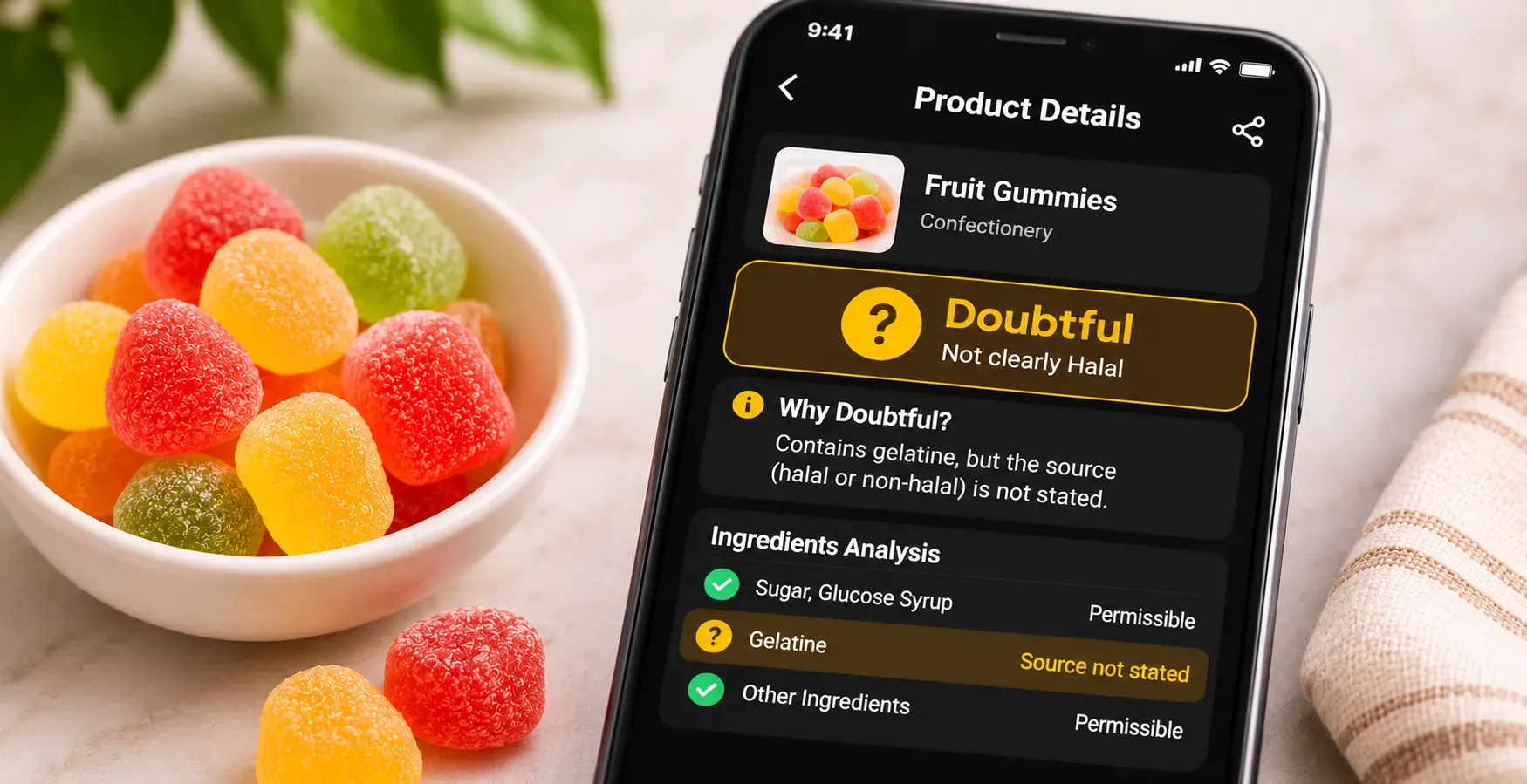
Menus have no barcode, so restaurants need a different approach. Three checks work without any app:
- Learn the local word before you travel: cinghiale, sanglier, Wildschwein, jabalí, dzik or babi hutan.
- Look for a halal mark you trust, such as JAKIM in Malaysia or MUI in Indonesia, and know which bodies are recognized where you shop.
- Email the maker about gelatine, enzyme or L-cysteine sources, and name your country, since recipes vary by market.
The scan takes less time than reading the label. Halal Scanner is free to download on the App Store and Google Play, with premium features by subscription.
Why shoppers use Halal Scanner: 1 million+ verified products, 100,000+ daily scans, 500,000+ users, and coverage in 50+ countries (Halal Scanner figures). That matters for a community the Pew Research Center counts at 2.0 billion people as of 2020. Results draw on verified halal data sources, and the app is a research tool, not a replacement for certification from a recognized halal body.
The Bottom Line
Boar is not halal. Wild or farmed, hunted or slaughtered with Bismillah, it is Sus scrofa, the animal the Quran forbids. Abroad, learn the local word for it; in the aisle, watch for gelatine, E471, E920 and enzymes of unstated source.
When a label leaves you unsure, scan it. Halal Scanner is free to download on the App Store and Google Play, or start from the download page. For more ingredient guides, visit the Halal Scanner blog, including how to check deli meats.